Custom Healthcare Software Development: How to Design Systems That Clinicians Actually Use
Custom healthcare software development succeeds when clinicians trust the system during their hardest moments. Most healthcare software fails to adopt not because it lacks features. The real cause is that it creates friction when time, focus, and clarity matter most.
This is the uncomfortable truth many teams discover too late.
Healthcare software does not fail in planning meetings or demos. It fails at 7 a.m. rounds, during emergency admissions, or in the middle of an audit. In 2026, success depends far less on polished interfaces. What it really hinges on is how well software fits real clinical workflows.
This guide is written for healthcare leaders, product owners, CTOs, and founders who want systems clinicians actually use, not tolerate. Instead of defining healthcare software again, it starts where most guides don’t: with why clinicians disengage.
What Custom Healthcare Software Development Means in 2026
From Generic Platforms to Workflow-Native Systems
Off-the-shelf platforms struggle in clinical environments because healthcare is not predictable. Patients arrive late. Emergencies interrupt plans. Regulations change without warning. Generic tools are built for average use cases. They are not built for edge cases that define healthcare.
Forcing clinicians to adapt to software has a real cost. It slows care, increases error risk, and drains trust. Over time, workarounds replace workflows. Notes move to paper. Systems get bypassed.
Custom healthcare software development in 2026 is about shaping software around how care actually happens.
Reliability Under Pressure as a Core Requirement
Healthcare systems are tested under stress, not calm conditions. Weaknesses are revealed during:
- Busy wards
- Emergency surges
- Audit days, and
- Partial outages reveal
Software that “works in demos” means very little here. Clinicians judge systems by how they behave when things go wrong. If a screen freezes during a critical moment, trust disappears instantly.
This is the gap many competitors leave open. They list customization benefits. This explains why customization is unavoidable.
Why Clinicians Abandon Healthcare Software
Hidden Adoption Failures
Clinicians rarely announce that they dislike a system. They simply stop relying on it.
Common friction points show up quietly:
- Alert fatigue that blurs what matters
- Click overload for simple tasks
- Broken handoffs between systems
- Latency during peak hours
Real-World Clinician Constraints
Clinical work runs on tight margins. Time pressure is constant. Cognitive load is high. Context switching happens every few minutes. Legal accountability always sits in the background.
Software that ignores these constraints becomes noise. Software that respects them becomes support.
Clinician pain points are rarely explained clearly, yet heavily searched. Addressing them directly builds trust.
Designing Healthcare Software Around Clinical Workflows
Mapping Clinical Workflows Before Development
Good systems start with observation, not assumptions. Shadowing clinicians reveals details no requirement document captures.
Which steps actually matter? Where do decisions happen? Where does documentation slow care instead of supporting it?
Translating real actions into system logic makes the difference between usable and unused software.
Designing Systems for Interruptions
Clinical work rarely follows a straight line. Tasks pause. Emergencies intervene. Work resumes later.
Software must:
- Save state automatically
- Support partial actions
- Recover without confusion
Core Principles of Clinician-Centric Software Design
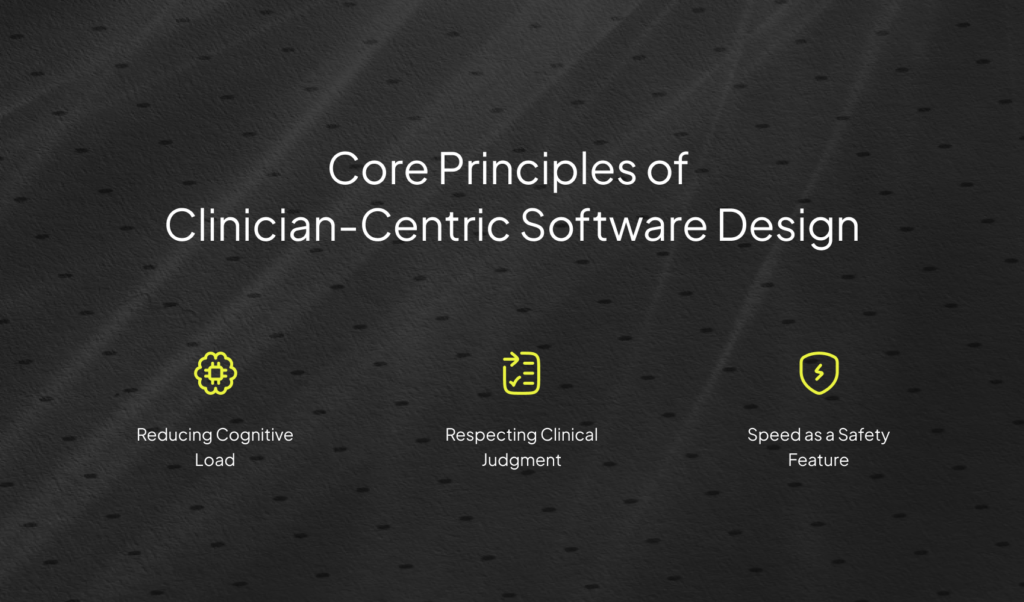
Reducing Cognitive Load
Clinicians already make complex decisions. Software should simplify, not add choices.
Effective design focuses on:
- Fewer decisions per screen
- Clear visual hierarchy
- Predictable behavior
Respecting Clinical Judgment
Clinicians do not want software to replace decisions. They want support.
Strong systems offer:
- Decision support, not decision replacement
- Transparent recommendations
- Easy overrides without penalties
Speed as a Safety Feature
Response time affects patient outcomes. A slow system interrupts thought and delays action.
Designing for instant feedback is not comfortable. It is safe.
Architecture Patterns That Support Clinician-Friendly Systems
Modular Systems Over Monoliths
In monolithic systems, one failure can freeze everything. That is unacceptable in healthcare.
Modular design isolates risk. Clinical, administrative, and data services operate independently. When one part struggles, others continue.
Event-Driven Architecture for Clinical Triggers
Vitals change. Labs arrive. Alerts fire. Systems must react immediately.
Event-driven design supports real-time responses without blocking workflows. Clinicians feel this as speed and reliability, not architecture.
API-First Interoperability
Healthcare systems live in ecosystems.
Integration with labs, imaging, insurers, and devices reduces manual re-entry and errors. API-first design allows systems to connect without friction.
This section fills a key gap. Architecture matters because clinicians feel its effects every day.
Planning to Build Healthcare Software Clinicians Will Actually Use?
Security and Compliance Without Slowing Clinicians
Security UX in Healthcare Systems
Security should protect quietly. Repeated logins and rigid access rules interrupt care.
Good security design includes:
- Authentication that fits urgency
- Role-based access tied to real jobs
- Fast verification without disruption
Audit-Ready Software Design
Audits cause stress when systems lack clarity. Audit-ready software reduces that burden.
Key elements include:
- Immutable logs
- Clear traceability
- Automatic evidence collection
Compliance as an Operational Feature
HIPAA and related regulations should shape daily system behaviour, not sit in policy documents.
Designing compliance into workflows prevents last-minute panic and costly fixes.
AI in Custom Healthcare Software
Where AI Helps Clinicians
AI adds value when it saves time or surfaces patterns early.
Useful applications include:
- Pattern detection over time
- Risk flags with context
- Documentation assistance
Where AI Hurts Adoption
Trust collapses when AI behaves like a black box.
Problems appear with:
- Unexplained recommendations
- Overconfidence in predictions
- No way to question outputs
Human-in-the-Loop AI Design
AI should support, not command.
Showing confidence levels, reasoning, and allowing easy override keeps clinicians in control.
Most pages hype AI. This explains how not to lose clinician trust.
Performance and Scalability for Real-World Healthcare Systems
Designing for Peak Loads
Healthcare demand spikes without warning.
Systems must handle:
- Flu seasons
- Emergencies
- External system outages
Graceful Degradation
Partial failure should not stop care.
Good systems define what still works when parts fail. Clinicians notice when software stays useful under strain.
Monitoring User Experience
Metrics matter, but perception matters more.
Latency perception, error visibility, and recovery time shape trust far more than backend charts.
Clinician-Led Healthcare Software Development Lifecycle
Discovery and Workflow Research
Discovery starts with people.
The real needs of clinicians are revealed through:
- Clinician interviews
- Workflow observation, and
- Risk mapping
This phase prevents costly rework later.
UX Design for Clinical Safety
Healthcare UX focuses on error prevention and clarity.
Clear defaults, safe actions, and minimal training reduce risk and resistance.
Development and Validation
Testing must mirror reality.
Issues can be revealed early through:
- Clinical scenarios
- Security validation, and
- Performance under load
Deployment and Continuous Improvement
Quiet deployments are good deployments.
Feedback loops from real users guide iteration without disruption. Healthcare software is never truly finished.
Cost Drivers in Custom Healthcare Software Development
Cost discussions often start with features. They should start with risk.
The biggest cost drivers are:
- Compliance depth
- Integration complexity
- Security measures
- Long-term maintenance
Cheap solutions often cost more later through rewrites, adoption failure, or penalties.
Choosing Between Healthcare Software Development Companies in the USA
Not all vendors understand healthcare pressure. Experience matters here.
When evaluating healthcare software development companies in the USA, look beyond portfolios. Ask how they handle audits, downtime, and clinician feedback.
Strong partners speak about workflows, not just technology. They plan for long-term care, not just launch day.
Many decision-makers start by comparing healthcare software development companies in the USA on price. The smarter comparison focuses on risk reduction and durability.
Why Top Healthcare Software Development Companies Think Differently
Top healthcare software development companies share a mindset. They design for trust, not flash.
They invest time in understanding users. They treat compliance as daily behaviour. They expect systems to change.
When teams evaluate top healthcare software development companies, the best signal is how they talk about failure. Do they plan for it, or ignore it?
The difference shows up months after launch, when real pressure hits.
Outsourcing Without Losing Control
Outsourcing scares many healthcare leaders. The fear is loss of control.
The risks are real:
- Weak domain understanding
- Poor documentation
- Compliance gaps
- Slow communication
These risks shrink when teams:
- Set clear ownership
- Transparent reporting, and
- Frequent feedback loops.
Common Healthcare Software Adoption Failures
Some mistakes repeat across projects.
- Over-customizing EHRs. This creates fragile systems.
- Designing for admins instead of clinicians. It frustrates daily users.
- Ignoring downtime planning invites chaos.
- Chasing trends. AI and dashboards look good in demos. Clinicians care about speed, clarity, and trust.
Future of Clinician-Centric Healthcare Software
Clinician-centric software is evolving toward systems that are more personal, predictive, integrated, immersive, and secure. These are not generic software. They are the solutions that will finally deliver on the long-held promise of digital health. The software is more effective, more efficient, and more equitable. They are the best friends of both clinicians and patients as they promote patient well-being. Powered by technology that serves humanity, clinician-centric software will truly change care outcomes for the better.
Conclusion: Building Systems Clinicians Trust
Imenso Software focuses on building systems around real clinical work. Projects start with understanding workflows, risks, and long-term goals.
As one of the top healthcare software development companies, we emphasize:
- Transparent communication
- Compliance-first design, and
- Steady delivery.
Feedback stays frequent. Risks surface early.
For organizations comparing top healthcare software development companies, this approach reduces surprises and builds trust over time.