Healthcare Platform Modernization: A Guide to Replacing Legacy Systems
The healthcare industry relies heavily on technology to deliver high-quality care. Still, many healthcare businesses rely on legacy platforms for critical operations. These compromise data security and operational processes. Modernizing them is thus crucial to support better patient outcomes. In this blog, we’ll go over how legacy platforms hamper patient and provider experiences. Then, we’ll give you strategies to modernize your healthcare platforms.
What Is a Legacy Healthcare Platform?
A legacy or obsolete platform in healthcare is a software that is no longer updated or produced. The platform is also not protected from security threats. This happens because a new system has replaced the old platform. If the system cannot be maintained, it turns into a legacy platform.
However, legacy platforms are foundational software that support crucial functions in a facility. Below are the common reasons for a healthcare platform to turn into a legacy system.
- The technology vendor no longer provides the product.
- The platform’s technology is no longer getting updated or maintained by the vendor.
- The vendor is not actively inspecting for bugs or providing security patches for the software.
- The platform cannot be scaled anymore.
- The healthcare company does not have the staff who can work with the platform’s technology.
Key Requirements for Modern Healthcare Platforms
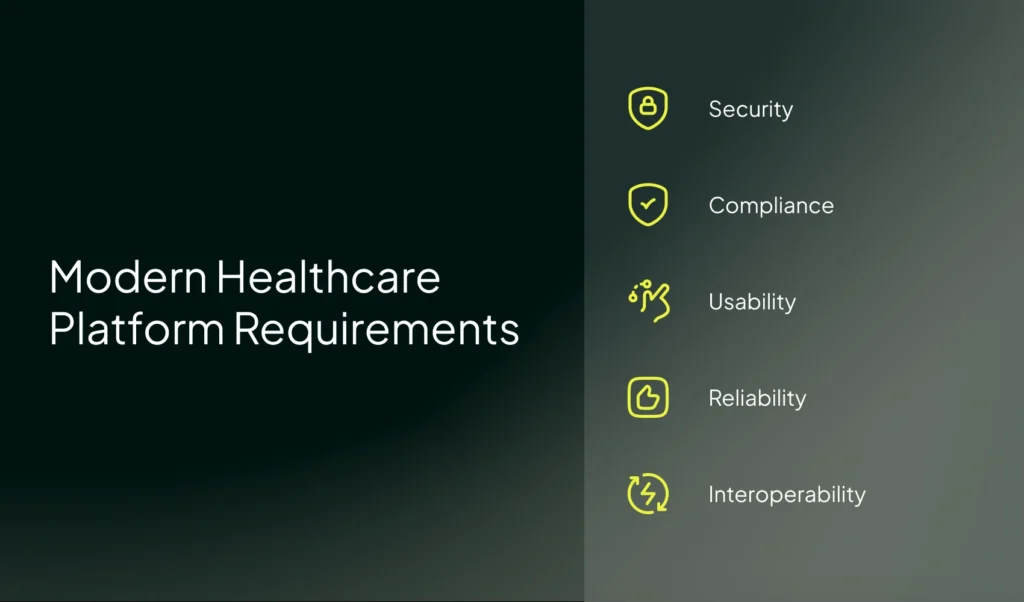
Modern healthcare software needs to be highly secure and compliant with key data protection regulations. At the same time, it should be designed to prevent confusion and unnecessary delays by the users (providers or patients). If the software cannot reliably connect with the customer’s wider ecosystem, such as EHRs, wearables, or billing platforms, then it’s not sustainable. Below, we have explained the major requirements for healthcare software in detail.
1. Security & Data Protection
The HIPAA Journal reports that in 2024, there were 181 confirmed ransomware attacks on healthcare providers. These attacks involved 25.6 million healthcare records. Legacy healthcare systems are particularly exposed to security breaches. It’s because they don’t have capabilities like real-time threat detection and automated compliance monitoring.
Modernization strengthens the healthcare platform’s security. Through data encryption, strong authentication, and role-based access controls, various vulnerabilities are mitigated. If the platform integrates with external providers or services, it needs more features. These include strict authentication, requesting validation, and limited access.
2. Compliance
All healthcare platforms that access, store, and share patients’ private information need to be HIPAA-compliant. The law strictly regulates protected health information (PHI). No medical facility can avoid it. Below are the HPAA rules that modern healthcare software must ensure compliance with.
- Privacy Rule: It sets standards for the use and disclosure of PHI can be used and disclosed. The rule determines the data you can gather, who can access it, and under which scenarios.
- Security Rule: It includes administrative, physical, and technical checks for electronic PHI. Security Rule directly impacts software development in the form of controls for access control, encryption, and system monitoring.
- Breach Notification Rule: It defines what to do when PHI is exposed or compromised. This rule mandates you to act quickly and transparently to find, record, and report breaches.
Healthcare software must ensure that compliance is built into it from the start of development. This includes that the platform must:
- Collect only the data it absolutely needs.
- Managing consent properly.
- Building comprehensive audit trails.
- Encrypting every data transaction.
3. Usability
Usability is a key factor of modern healthcare platforms. It is a quality attribute that examines how easy patient and provider-centric the user interfaces are. Modern platforms must incorporate all the aspects of usability as explained below.
Learnability: How easy it is for users to complete basic tasks the first time they use the platform.
- Efficiency: How quickly users can perform tasks after becoming familiar with the system.
- Memorability: How easily users can return to using the platform efficiently.
- Errors: How many errors does a user face while using the software? This also includes the severity of the errors and how easily a user can overcome them.
- Satisfaction: How happy the user is with the entire experience of using the platform.
Usability allows patients and providers using the platform to get what they want from the tool quickly and with minimal stress. It gives them a sense of confidence that they can easily fulfil their purpose for using the software.
Legacy healthcare software often lacks usability. This is a result of outdated, complex, and unintuitive user interfaces. They hinder efficiency and are a source of frustration for healthcare professionals. Poor usability in legacy platforms poses challenges with security, data management, and general patient care coordination.
4. Reliability
Medical errors in healthcare software can be dangerous to patient health. That’s why it’s crucial for platforms to be reliable. They must be built after a comprehensive reliability engineering analysis. Reliability in medical platforms refers to failure-free operation over time. To avoid medical errors, it’s critical to perform a thorough reliability analysis.
Legacy platforms are often unreliable. As a result, they can lead to the following errors:
- Errors in setting device parameters.
- Untimely or inappropriate activation of controls.
- Departure from adhering to the stated instructions.
Modern healthcare systems ensure full reliability as they are designed following these tasks:
Analysis of the existing reliability.
- Spotting of weak links and assigning higher reliability goals to them.
- Perform Failure Mode and Effects Analysis on weak links in the healthcare platform. This helps with anticipating potential failures or medical errors. The strategies are determined to achieve the desired reliability goals.
- Apply the Fault Tree Analysis technique. It quantifies the risk when the causes of failure indicated in the FMEA are too complex
- Redesign the healthcare system based on key failures. Finding and using process and reliability improvement techniques that will positively impact the outcome.
- Ensure that the work done on the FMEA and the design improvements was performed using divergent brainstorming and convergent solutions.
- Define reliability specs and document them in a reliability program
- Verify that the new design achieves the reliability goals with a sustainable outcome.
The Hidden Costs of Legacy Healthcare Systems
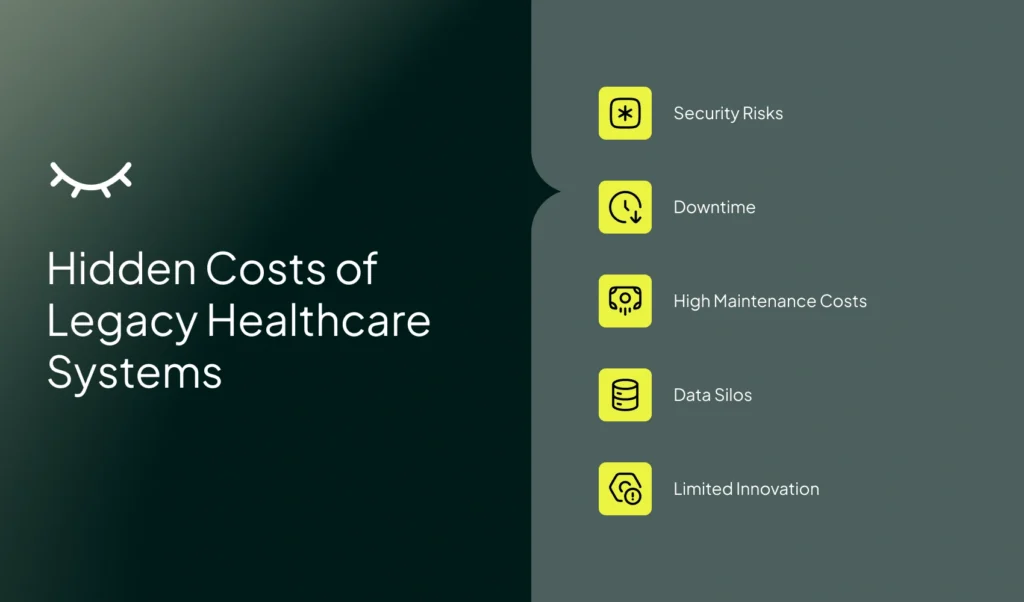
Legacy healthcare systems are highly expensive to maintain. According to a recent study, close to two-thirds of businesses spend over $2 million annually to maintain these outdated systems. Besides, since such software runs on obsolete technology, it can go down anytime and lead to lost productivity. It also indirectly hampers potential revenue. Here’s a breakdown of the hidden costs related to legacy healthcare systems:
High Maintenance Costs
Legacy systems demand frequent patches and expensive custom-built connections for new workflows. They depend on constant infrastructure upgrades and vendor support. The cost of legacy EHR systems can be up to $8,000 annually! The Paubox Report notes that high maintenance costs affect 53.6% of businesses.
Hardware and Infrastructure Costs
You need to invest in physical servers, power, cooling, and bandwidth for data backups, which are quite expensive. Networking and connectivity costs are also there. Legacy healthcare systems need very safe connections and more throughput. As the volume of data grows, so do storage and replication costs. The hardware and software for legacy system maintenance can stop being manufactured at any time. When stock depletes and it becomes difficult to procure maintenance products, the costs rise.
Cost of Insufficient Security
Legacy systems are built without defensive hardware and software mechanisms. So, they are vulnerable to cyber threats. There is no advanced encryption, multi-factor authentication, or secure data handling practices to keep the system secure. An average data breach for a healthcare organization can cost up to $9.48 million per incident.
Outdated legacy systems compound this risk. The more users there are of a legacy system, the higher you will need to spend on strengthening security. This also involves spending on specialized talent, such as cybersecurity staff and professionals adept at working with legacy technology.
Expenses Related to Lack of Integration
The inability to integrate legacy systems with other tools or services leads to many missed opportunities. Custom integrations, API, and middleware subscriptions are expensive. In their absence, you cannot collaborate with a partner, which leads to loss of income and reputation. Moreover, when systems cannot communicate effectively, they operate in silos. Imagine your EHR, patient monitoring device, laboratory information system, and billing tools working independently. It thus creates data silos that create a major dent in care continuity.
Cost of Lack of Innovation
Inefficient applications without future-proof technology like AI-driven analytics or telemedicine hinder competitiveness. Legacy healthcare software is not compatible with modern technologies that simplify workflows. Also, frequent system disruptions increase staff workload and attract costly repairs. In fact, even a single day of downtime costs an average of $900,000! Patient dissatisfaction due to delays and mistakes in manual work during care delivery harms revenue opportunities and long-term growth.
Still Operating on Legacy Healthcare Systems?
Healthcare Platform Modernization: Step-by-Step Roadmap
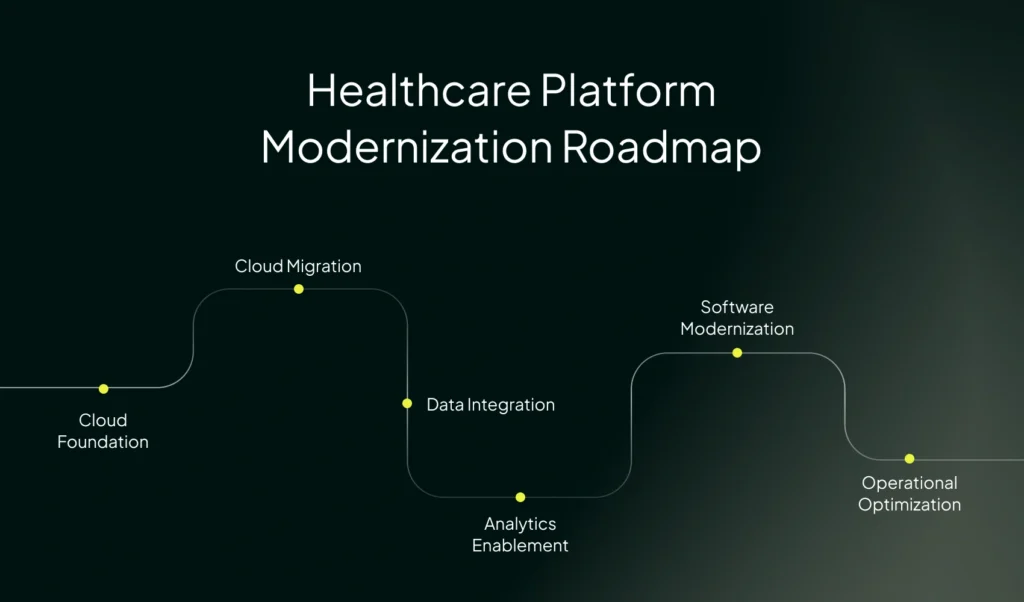
Modernizing healthcare systems enhances their scalability, security, and data integration. Below, we have broken down the process into key steps.
Create a Secure and Compliant Cloud Foundation
Establish a strong security strategy that complies with the healthcare best practices. Use HIPAA-qualified services for data safety. Employ stringent access rules, API security, and encryption to protect sensitive patient data. Adopt a proactive attitude towards organizational trust. It will lower regulatory risks and lay a strong basis for modernization success.
Migrate Systems and Data to the Cloud
Scalability and agility are two core constituents of modernizing healthcare platforms. For that, migrate all medical data and on-premises software to the cloud. Remember, this process is complex. If not executed properly, it can result in data loss. To prevent this, partner with a cloud migration service provider. It is especially important for businesses with large-scale transitions. Migrating to the cloud will give you a flexible digital basis for your long-term healthcare platform innovation.
Unify and Integrate Data
The next step is to get a centralized view of patient data throughout the organization. Analyze existing data flows. Then, standardize and integrate various data sources. Use integration tools for this purpose. This will help you create a cohesive, secure data lake. Ensure to follow standards like the FHIR. It facilitates advanced interoperability and analytics. Amazon API Gateway is an API management tool that will enable you to build, maintain, and protect APIs for strong care coordination and seamless data exchange.
Enable Analytics and Innovation
Massive healthcare datasets need affordable and flexible storage solutions. So, utilize big data techniques and data warehousing. This data is no less than a goldmine. Apply analytics and machine learning tools to gain insights from it. Tools like Amazon Comprehend Medical assess unstructured data to improve patient diagnosis and care. Promote proactive care by using integrated APIs that connect data to your workflow.
Modernize Legacy Software
Use techniques like strangler fig patterns to replace monolithic platforms with modular parts. To do so, first map out your existing business workflows. This will help you discover legacy functions that can be redesigned as microservices. It boosts the scalability and portability. It is especially so if you can establish an integration layer that uses APIs to allow for data interaction between new and legacy platforms.
Address Operational Considerations
Expedite deployments and automate infrastructure management using infrastructure-as-code solutions. Automating infrastructure management improves system visibility via rigorous logging and tracking. At the same time, it plans for quick disaster recovery and high availability. Automated repetitive operations also enhance efficiency and ongoing improvement with DevOps techniques.
Summing Up
In the dynamic healthcare sector, legacy platforms serve no purpose other than hindering growth. This ultimately results in low-quality patient care. Modernizing these systems offers countless benefits as discussed above.
At Imenso Software, we specialize in modernizing legacy platforms for healthcare businesses. Our goal is to empower providers to deliver the best care with advanced technology. If you are ready to modernize your platforms and drive better patient outcomes, contact us today.
Ready to Modernize Your Healthcare Platform?
Similar Posts

Healthcare Mobile Apps & Technology: Changing The Face Of Patient Care
In 2024, over 3 million healthcare mobile apps were downloaded in the U.S. That’s nearly a 50% rise from last year. Every year, more people use these apps as they see their usefulness for better health gains. Healthtech is transforming how patients receive care. Intelligent digital tools allow doctors to gather more data. As a […]...
AI in Healthcare Data Management: Building Secure and Seamless Data Pipelines
Healthcare generates the most data annually. It comes from new sources of information like Electronic Medical Records, wearable devices, and telemedicine records, among others. However, many hospitals are unable to leverage it to enhance patient care and operational efficiency. There are various reasons for this. A large amount of this data is unstructured, while structured […]...
Information Technology Software Solutions for Healthcare Industry
While healthcare is at times misunderstood to be a direct link between illnesses and their standalone treatments, that’s not the case. Ideally, any system of medicine should be constructed as an unbiased, comprehensive unit responsible for curing diseases or improving the quality of a patient’s remaining life, alleviating pain, making care accessible, reducing wastage of […]...