

HIPAA Compliance
Ensuring full compliance in all interactions, including voice-to-text processing and chatbot conversations, required a secure cloud infrastructure with RBAC, encryption at rest and in transit, and traceable access logs.
 Healthcare/Fintech
 USA

Phoenix Ortho is a 2006, U.S. based healthcare technology provider specializing in orthopedic Electronic Health Record (EHR) and practice management systems. With a reputation for simplifying the clinical workflows of orthopedic practices, the company is known for its robust infrastructure and modern user interface.

Ensuring full compliance in all interactions, including voice-to-text processing and chatbot conversations, required a secure cloud infrastructure with RBAC, encryption at rest and in transit, and traceable access logs.
SOAP note generation needed to reflect ICD-10 clinical accuracy across pathologies like TKA, ACL, and rotator cuff injuries.
Physicians required instant transcription of voice into structured notes—this had to work seamlessly in clinical environments with minimal latency.
Differentiating permissions between physicians and support staff while ensuring the assistant’s behavior aligned with their access rights.
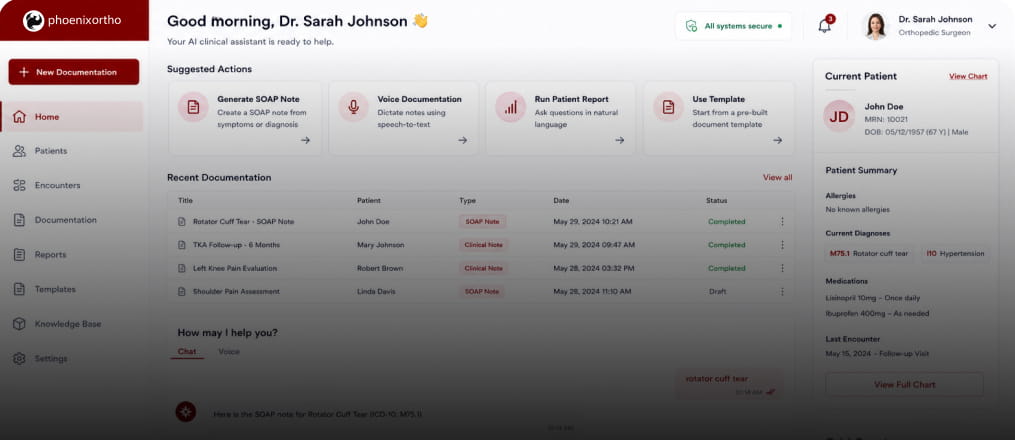
The platform combines Azure OpenAI (GPT-4o) with Azure Speech-to-Text to enable physicians to type or dictate prompts such as “rotator cuff tear” and instantly receive structured SOAP notes tagged with ICD-10 codes like M75.1. It also supports natural language-based reporting, allowing users to ask queries such as “TKA patients from the last 6 months” and receive structured tabular responses powered by a text-to-SQL engine connected to the Phoenix Go database.
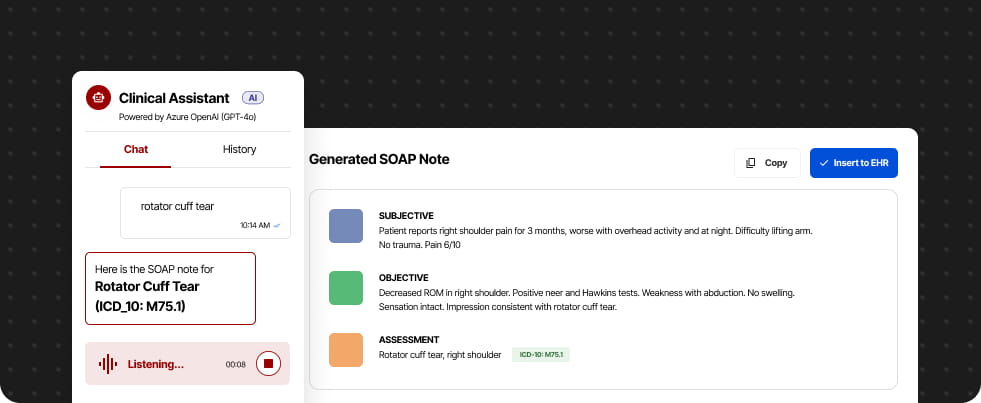
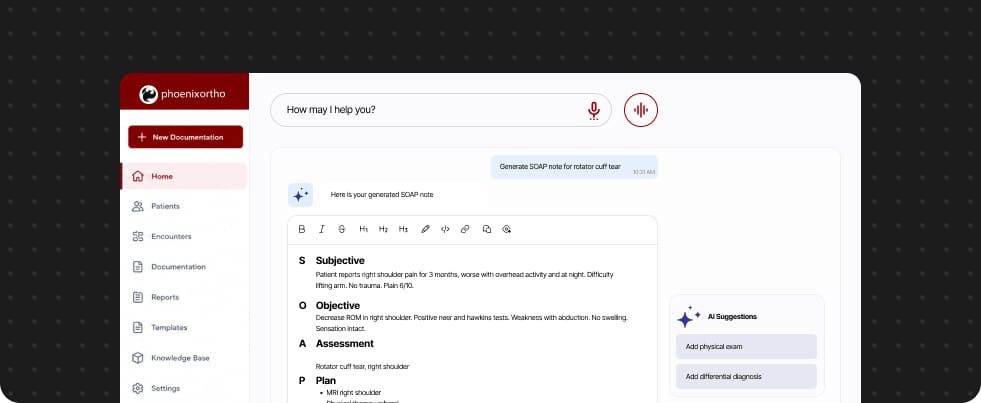
A modern Quill.js frontend was developed with a “How may I help you?” text and voice interface that allows physicians to interact naturally with the AI system, preview generated SOAP notes or reports, and insert documentation directly into patient records with a single click for improved workflow efficiency.
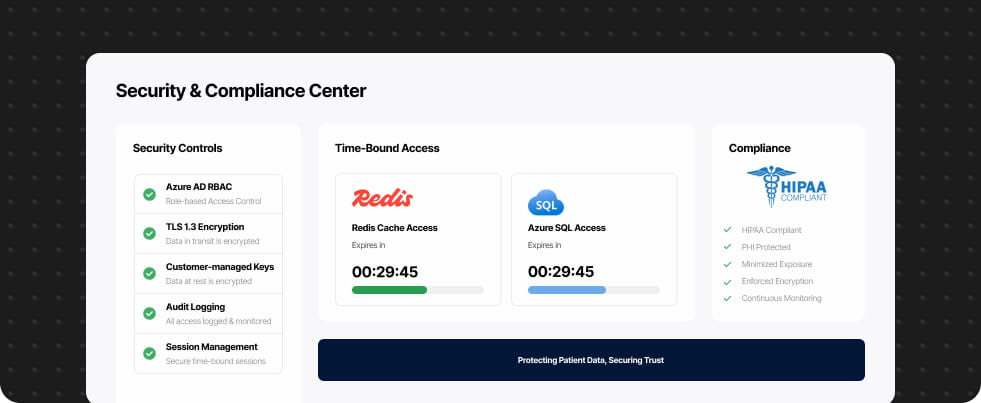
The solution was designed with HIPAA compliance at its core using Azure AD-based Role-Based Access Control (RBAC), TLS 1.3 encryption for data in transit, and Customer-Managed Key (CMK) encryption for data at rest. Redis and Azure SQL caching layers were additionally secured with time-bound access controls to minimize exposure of Protected Health Information (PHI).
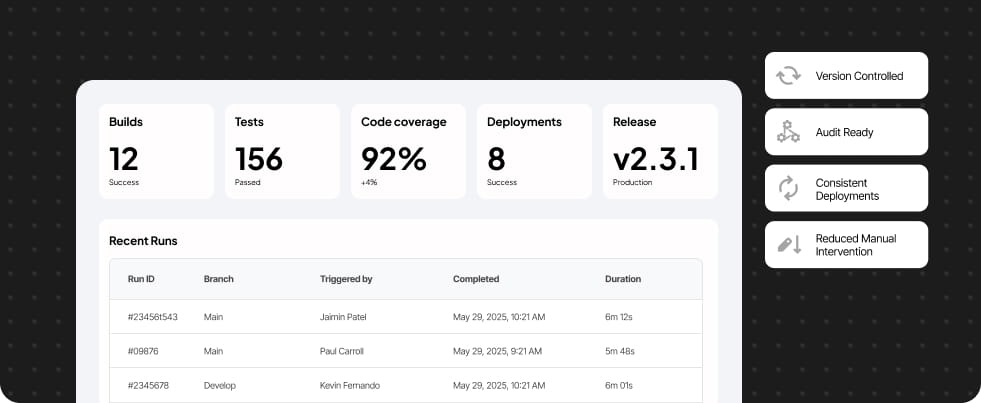
A robust Continuous Integration and Continuous Deployment (CI/CD) pipeline was implemented using Azure DevOps Pipelines to streamline deployments, maintain version-controlled releases, reduce manual intervention, ensure deployment consistency, and support audit-ready API delivery across the platform.
The platform combines Azure OpenAI (GPT-4o) with Azure Speech-to-Text to enable physicians to type or dictate prompts such as “rotator cuff tear” and instantly receive structured SOAP notes tagged with ICD-10 codes like M75.1. It also supports natural language-based reporting, allowing users to ask queries such as “TKA patients from the last 6 months” and receive structured tabular responses powered by a text-to-SQL engine connected to the Phoenix Go database.
A modern Quill.js frontend was developed with a “How may I help you?” text and voice interface that allows physicians to interact naturally with the AI system, preview generated SOAP notes or reports, and insert documentation directly into patient records with a single click for improved workflow efficiency.
The solution was designed with HIPAA compliance at its core using Azure AD-based Role-Based Access Control (RBAC), TLS 1.3 encryption for data in transit, and Customer-Managed Key (CMK) encryption for data at rest. Redis and Azure SQL caching layers were additionally secured with time-bound access controls to minimize exposure of Protected Health Information (PHI).
A robust Continuous Integration and Continuous Deployment (CI/CD) pipeline was implemented using Azure DevOps Pipelines to streamline deployments, maintain version-controlled releases, reduce manual intervention, ensure deployment consistency, and support audit-ready API delivery across the platform.







80% reduction in manual documentation time, SOAP notes could be generated in 5–7 seconds compared to manual typing which took up to 2–3 minutes per encounter.
Data governance, role restrictions, and secure transmission met or exceeded U.S. federal compliance standards.
Early testing feedback showed 92% positive responses from doctors who found the assistant intuitive, fast, and clinically accurate.
No changes were required to the existing patient visit screens—POGO AI sits on top as a non-intrusive assistant interface.
The POGO AI App marks a major step forward in AI-enabled clinical documentation for orthopedic practices. Through a thoughtfully designed voice and AI-powered chatbot interface backed by secure Azure infrastructure, Phoenix Ortho now empowers its users to document, analyze, and act faster than ever before—without compromising on accuracy or compliance.


