Why Custom Software Maintenance Matters for Long-Term Growth
Custom software development is a strategic way of gaining a competitive edge. However, the journey doesn’t end with the deployment itself. To get the most out of it, ongoing maintenance and support are essential.
In this blog, we will explore how maintenance and support make software more resilient in the evolving landscape. We’ll also compare both services so you can decide where and when to invest.
Why Custom Software Maintenance is Essential
Issues can arise even in the most well-made software at any time. Maintenance and support services thus help you detect and fix all probable problems. An error-free solution boosts user productivity and slashes downtime. It also helps you remain competitive in the market. Given below are the major benefits of custom software maintenance and support.
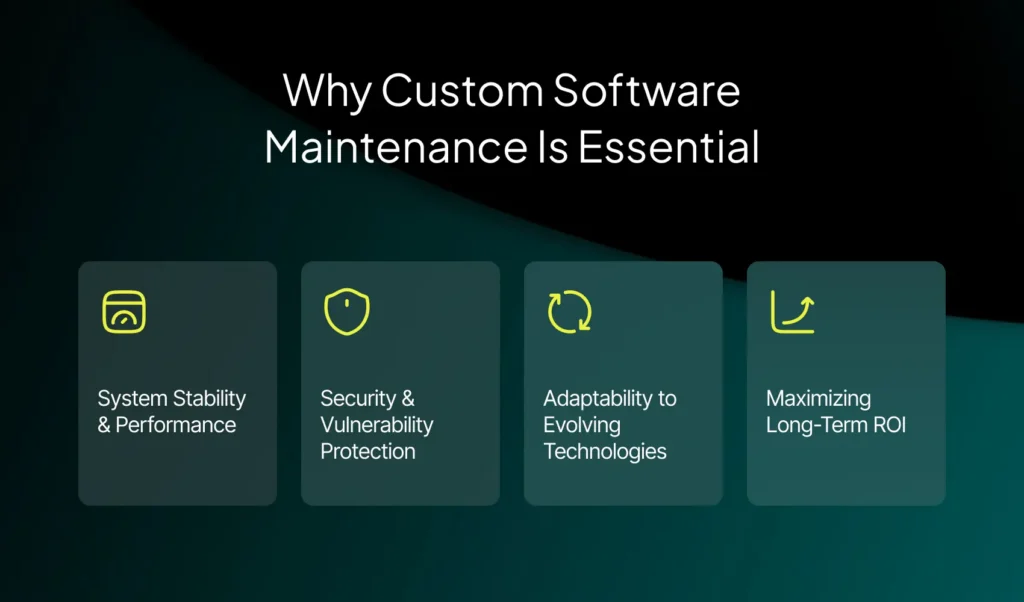
1. System Stability & Performance
A proper maintenance process keeps your software applications stable. This prevents any issues with the business operation for which it is used. Different types of software maintenance also ensure that your or your end user’s application is in line with their evolving needs. The solution can handle an increase in users and give them a satisfying experience as they use the different features. All of this happens when it does not have incompatibilities and glitches.
2. Security & Vulnerability Protection
A software solution must keep adapting to new environments and security threats. Maintenance prevents any malicious attempts by cybercriminals to destroy the integrity of software. Through regular security patches and security audits, the service shields the application from sophisticated attacks. It can integrate well with new tools and meet the changing regulatory standards.
3. Adaptability to Evolving Technologies
In adaptive maintenance, the software is modified post-delivery. It’s done to keep it usable in a changed or changing environment. The “environment” means factors on which your software relies or interacts with, not the internal code logic. Thus, the solution adapts to the changing technology, such as new operating systems. Integration with third-party services or APIs enables it to communicate with other systems. An adaptable software is also one that is legally compliant with new regulatory laws and policies.
4. Maximizing Long-Term ROI
Custom software development and deployment is never a ‘set and forget’ thing. Regular checking avoids expenses on emergency repairs. Security patches, updates for compatibility, and scaling the product provide cost-effectiveness in the long run. Ongoing support reduces wasted time, efforts, and expenses on costly hardware purchases. Moreover, you don’t need to rely on external consultants to take a look at your application. It works as intended all the time and gives you the benefit of faster market response time. This reflects nicely on your bottom line.
Custom Software vs Off-the-Shelf: Maintenance Differences
Custom software maintenance and support differ significantly from off-the-shelf in many areas. The Custom software gives full ownership over the maintenance roadmap. The support for it is dedicated because teams work based on the unique architecture and business context behind the solution. Also, maintenance tasks are more flexible with custom software vs. a generic one. Let us explain these differences in detail.
1. Ownership & Control
The client of the custom software development service retains full control over maintenance of the product. According to the scope of the software, the support teams optimize and refactor the code. They make it scalable and flexible as per the needs of the company. Detailed maintenance roadmaps for scalability and future-proofing are made after a thorough discussion with the company, so the services align with your long-term goals.
But with generic software, in contrast, maintenance follows vendor-controlled update cycles, when they push updates. This can also cause sudden downtime during demanding business periods.
2. Type of Support
Maintenance and support for custom software after deployment are dedicated. You get a dedicated project manager who oversees the maintenance team. From performance tuning and security changes to infrastructure management and support levels, everything is tailored for your business growth. The direct communication with the PM eliminates barriers to accurate information flow.
3. Flexibility & Scalability
Just like tailored software, the maintenance and support for it are also flexible, designed to address specific business needs. The dedicated support team offers service level agreements according to your needs, budget, and dependencies. The services can be scaled when you want to add features and reduced during leaner periods.
4. Security & Vulnerability Management
In custom software, security is tailored to meet strict government compliance standards. In contrast, in generic or COTS software, vendors provide ongoing updates and technical support for it to be functional. Custom software maintenance follows the shift-left approach. Activities like testing, quality assurance, and security checks are a part of the development lifecycle. In off-the-shelf software, security implementation occurs after purchase and during initial setup. Companies cannot influence the vendor’s development process. They must depend on the vendor’s security practices.
Types of Software Maintenance
For effective management of software, you must know the various types of maintenance. All these types together ensure that your product works seamlessly in the long run.
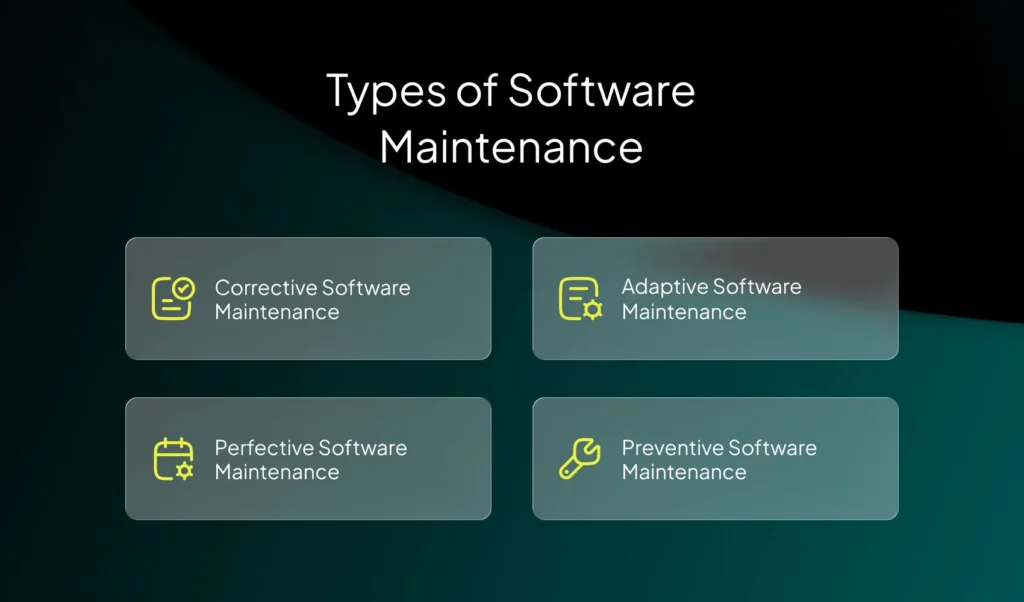
1. Corrective Software Maintenance
Corrective software maintenance fixes bugs found after deployment. It involves detecting and resolving loopholes. The core aim is to ensure proper functioning of the software. Corrective maintenance is key to fixing issues that can affect the user experience. It’s also necessary to ensure the operational efficiency of the product. Corrective maintenance is reactive. It means that it stems from user reports of platform errors.
Overall, corrective maintenance maintains software’s integrity. A custom product development company conducts this maintenance to uphold the quality standard of its product. This, in turn, ensures a positive user experience.
2. Adaptive Software Maintenance
Adaptive software maintenance modifies and updates the software. Thus, the product keeps pace with the dynamic customer needs. Adaptive maintenance ensures that the software is compatible with new hardware, software, and OS. Conducting this type of maintenance helps you keep your software functional in the evolving tech landscape.
By keeping the software usable, adaptive maintenance future-proofs it against new tech advances. It ensures that your software stays relevant to the needs and preferences of your users.
3. Perfective Software Maintenance
Perfective software maintenance enhances the software features. This improves its performance and usability. When conducting this maintenance, development teams add new functionalities. Alternatively, they can modify the existing features to meet the new user’s needs. This process makes the software more effective. It increases the end user’s satisfaction and experience.
Custom software development companies use perfective maintenance to continually improve the product. Regular preventive maintenance ensures that your software doesn’t lag behind that of your competitors.
4. Preventive Software Maintenance
Preventive software maintenance involves taking proactive measures to prevent future issues. It includes code optimization, restructuring, and documentation updates. All of this increases the software maintainability. Preventive maintenance reduces software complexity and prevents issues before they happen. It is key to ensuring the longevity of software.
A software development company uses preventive maintenance to sustain the health of the software. Properly investing in this maintenance reduces the need for corrective maintenance in the future.
Not Sure What Your Software Really Needs?
Software Maintenance vs Software Support
Both software maintenance and support are vital to keep the product running. However, they are different services. It’s essential to understand how they vary to invest in the right service for your needs. Below are three main differences between them.
Scope
The software support provider offers a limited scope. Typically, they work only on emergency needs. Suppose a software experiences a serious error. In this case, the business will hire support services from its technology provider. Support teams will repair software that is working sub-optimally. The product can encounter a major issue or a technical error. Support teams fix the problem so the software can continue functioning.
Maintenance services have a more comprehensive scope. Maintenance teams fix almost every type of error. The software development company oversees all the functions of its product. This includes everything, from preventative to adaptive maintenance. In short, software maintenance covers all aspects of the product/app.
Types of Clients
A software support service provider works in an IT group that can fix a range of problems. They resolve errors in software by the in-house team of a business and vendors. So, a software support provider has numerous clients. All of them have different types of software on their premises. Even if your in-house team has not built the product, you can reach out to a support provider. They help repair the system so it functions as intended.
A software maintenance company only serves businesses for whom they have created the product. Custom software development companies usually provide maintenance services. They specialize in creating products for a specific industry(s). Since they focus on developing for certain industries, they can effectively keep the software usable in the long run.
Cost Structure
Software maintenance companies offer regular service to their clients. They are essentially the creators of the software. So, by offering maintenance services, they ensure that it works well. Maintenance services usually have a high cost. This is because the team works constantly on your software. It implements new features and fixes errors. All this necessitates the need for a higher fee. The maintenance fee is usually charged monthly. This is because maintenance is an ongoing process.
The cost of support services is not that high. This is because it primarily involves fixing small glitches. The service provider tends to demand a high price only if there’s a serious error. Support fee is charged on a pay-on-the-go basis. This is because these services are only needed in case of an emergency issue.
Summing Up
As you can see, custom software maintenance and support allow it to perform optimally. These services ensure that your product fluidly accommodates the changes that come with business growth. At Imenso Software, post-deployment maintenance and support are an important extension of our development processes. These include proactive monitoring, timely updates, and regular bug fixes. Our core aim is to ensure that your software always remains a valuable asset for the long term.
Keep Your Software Secure, Stable, and Future-Ready


Similar Posts
Why PHP Laravel Framework is the Best
Picking a PHP development framework for developing web applications with can be a daunting and challenging task considering that there are currently so many options to consider. Nevertheless, some frameworks have proven themselves to be reliable when it comes to web development. One such framework is Laravel. In this article, we will be looking at […]...
Top .NET Libraries for Efficient RESTful API Development
Have you ever clicked a website link, only to be disappointed by a blank screen for the next few minutes? Infuriating, isn’t it? In most cases, the problem stems from inefficient APIs integrated into the website. Most businesses deal with this problem regularly which is the reason why having a trusted dot net development company […]...
ReactJS vs AngularJS vs VueJS – An extensive comparison
While the JavaScript frameworks continue to dominate development space, all the JS frameworks do not stand equal in respect of fulfilling necessity of all projects. While React JS and Angular JS continuously get support from developers worldwide, according to many the small and neat team of VueJS actually helped the framework to keep them the […]...