Legacy System Modernization: Why Enterprises Choose Outsourcing Over In-House
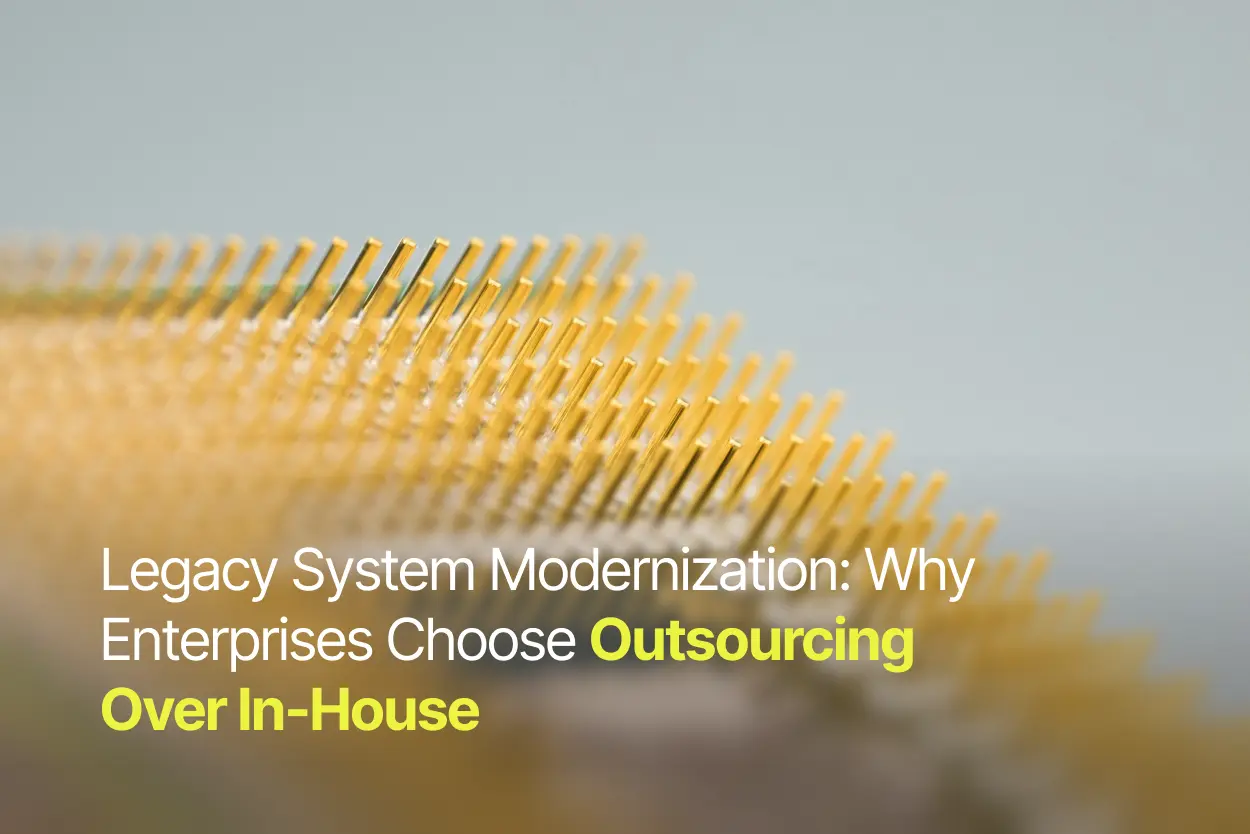
Legacy systems are difficult to maintain and highly vulnerable to security loopholes. Modernizing them offers benefits that go way beyond cost savings. It helps businesses reduce downtime, achieve compliance, and protect against cyber threats. A comparison of these expected gains with the disadvantages of legacy systems allows enterprises to clearly comprehend the modernization outcomes. Outsourcing modernization has been shown to provide better results than in-house efforts. In this blog, we will explore the many advantages of outsourcing this complex process, which is a key driver of business success.
Understanding Risk-Adjusted Time-to-Benefit
Before getting into why outsourcing legacy system modernization is preferred by competitive enterprises, let us explain the core idea behind comparison, i.e., risk-adjusted time-to-benefit.
1. What Is Time-to-Benefit
It is the number of months until your modernization produces measurable gains. These include lower run-rate cost, greater resiliency, and faster change velocity, such as improved deployment frequency. DORA “four keys” turns those gains into trackable outcomes. The metrics are Change lead time, Deployment frequency, Change fail percentage, and Failed deployment recovery time.
2. What Risk-Adjusted Means in Modernization
It weighs that timeline by the real chance of delays, rollbacks, hidden integrations, audit gaps, and reworks. This is because large transformations routinely face challenges in using the latest technologies to modernize legacy systems.
So, for an enterprise, weighing a timeline can allocating 70% on planning, 20% to delay by two months, 10% to work delayed by four months. Doing so changes uncertainty into comparable numbers.
Why Legacy System Modernization Outsourcing Accelerates Time-to-Value
Outsourced partners have established expertise in maintaining legacy systems. They have migration “factories,” playbooks, and SLAs that standardize discovery, remediation, and cutover. The specialists can map the legacy system’s complexity, eliminate instances of budget overruns by allocating resources wisely, and provide support post-migration. Independent ROI studies around managed legacy modernization reveal earlier productivity and cost benefits when expert guidance is available.
Key Risks of In-House Legacy System Modernization

Legacy system modernization requires deep institutional knowledge and specialised security expertise. It also demands change-management capabilities that most in-house teams lack. Ayo Akinsanya, CISSP, CC, In his recent study points to five security considerations that can potentially open up many risks. Here’s what you should know.
1. Undocumented System Dependencies
Legacy environments often hide major integrations and data flows that only veteran engineers understand. If your teams blindly encrypt or update one component, it can break downstream applications and key processes.
Core contributors in an in-house team often depart and take undocumented insights with them. Moreover, the lack of forensic expertise (“system archaeologists”) needed to reverse-engineer dependencies exposes enterprises to various risks.
2. Access Control vs. Operational Continuity
Legacy systems often grant overly broad privileges. But there’s a huge risk in enforcing least privilege overnight. It can cripple essential operations, such as patient care or transaction processing. Here again, the lack of talent creeps in. In-house teams don’t often have the design expertise to create a hybrid identity model (modern IAM plus legacy fallbacks).
3. Database Encryption Compatibility Issues
Encrypting columns or tables in old databases often breaks report generators, fixed-width exports, and batch jobs. However, standard encryption alters data formats, causing custom reporting tools to fail. It also prevents enterprises from meeting regulatory deadlines.
In-house teams focused on daily maintenance don’t have granular visibility into every legacy application that relies on a database. Also, to detect a 300% slowdown under production loads demands realistic test environments. They are rarely maintained in-house.
4. Encryption Implementation Complexity
Most legacy systems are coded with antiquated programming languages. They also rely on unsupported third-party utilities. When encryption is applied, application compatibility, indexing, backups, and recovery all break. In turn, it can halt full-text search, pattern matching, backups, and batch processes.
A standard in-house team cannot adapt well to legacy backup routines to encrypted formats. Not only that, but fixing indexing and query issues requires a deep collaboration between DBAs, developers, and security architects. Many in-house teams in enterprises do not follow such formalized collaboration.
5. Workflow and Integration Failures
Security controls conflicting with entrenched user behaviours lead to insecure workarounds. Some examples are emailing sensitive documents and credential sharing. Users then bypass controls entirely, which eliminates security gains and increases risk.
To address this risk, change management is needed. But internal in-house teams lack professional training in user experience design and organizational psychology.
This security consideration also requires continuous audit-driven tuning of access models and emergency override procedures. When dedicated governance processes are not used, it cannot happen.
Existing in-house teams must be augmented with external experts skilled in legacy system archaeology, cryptographic engineering, and user-centric security design to make modernization efforts successful.
What Legacy System Modernization Outsourcing Really Delivers

Outsourcing legacy modernization is the route to achieving cost efficiency and speed. This allows businesses to focus on mission-critical goals rather than get tied up with the complexities of migration. Below are its chief benefits.
Access to Specialized Expertise
Outsourcing legacy applications gives you access to a specialized skillset. Modernization isn’t easy. To refactor old codebases, understanding various languages is crucial. Reputed partners hold deep expertise in cloud platforms. This allows for a seamless migration. They have decades of experience in breaking down monolithic apps into microservices. This leads to greater scalability and maintainability. Further, the outsourced team has experts with niche cybersecurity expertise. Thus, they ensure that the process is carried out safely.
Faster Execution and Reduced Time-to-Market
Many businesses struggle to modernize quickly. Legacy systems hinder all digitization initiatives. Dedicated outsourced teams are solely focused on your project. They use efficient project management frameworks like Scrum and Agile. This ensures timely completion. Providers also have access to advanced tools. Through them, they can perform continuous integration and automated testing. This, in turn, lowers your time to market.
Lower Hiring and Infrastructure Costs
Legacy system modernization requires a diverse skillset. It’s very expensive to hire the right talent. Outsourcing cuts the expenses related to hiring and training. You can scale the outsourced team up or down based on your needs. This prevents you from bearing unnecessary overhead. You also do not have to spend on creating the right infrastructure for migration. All of it is taken care of by the provider.
Reduced Operational and Security Risks
There are many risks involved in legacy modernization. System downtime and data loss are the two biggest ones. But the outsourced team already has a proven methodology to mitigate these. They use evidence-backed approaches for seamless transitions. Being highly experienced, they know how to handle common challenges that arise. They perform migration in a way that doesn’t disrupt your workflows. Finally, they rigorously test and use the best quality assurance protocols. This allows them to find and fix problems before they hinder your project.
Quantifying the Advantage of Legacy System Modernization Outsourcing (With a Mini-Model)
Legacy System Modernization Outsourcing offers measurable benefits. The mini model below will help you further understand its advantages.
- The average annual legacy system maintenance cost in the US is $250,000.
- Approximated productivity loss due to obsolete tech is $125,000/year.
- $50,000 is spent on security threats and compliance annually.
- Outsourcing modernization once amounts to $500,000–$750,000, depending on complexity.
- Modern system ongoing support and cloud maintenance costs $50,000/year
- Productivity losses post-modernization are very minimal.
- Security expenses after modernization are around $10,000/year.
- ROI is measured over 5-years.
5-Year Cost Comparison Table
| Cost Category | Legacy System (Annual) | Modern System (Year 1) | Modern System (Years 2–5) | 5-Year Cumulative Savings |
| Maintenance & Support | $250,000 | $700,000 (project) | $50,000 | $1,000,000 |
| Productivity Loss | $125,000 | – | – | $500,000 |
| Security & Compliance | $50,000 | $30,000 | $10,000 | $160,000 |
| Total | $425,000 | $730,000 | $60,000 | $1,660,000 |
ROI Calculation
ROI = Total Savings over 5 Years − Modernization Investment ×100
For this example:
- Total savings = ₹57,50,000
- Investment (Year 1) = ₹15,00,000
ROI=57,50,000−15,00,00015,00,000×100=283.3%
ROI= 15,00,000 57,50,000−15,00,000 ×100=283.3%
Still Running Critical Systems on Legacy Infrastructure?
Key Quantitative Advantages for Businesses
- Over 5 years, organizations save over $1.6 million. This figure is arrived at by comparing the maintenance of outdated infrastructure.
- Modernization generally delivers 30% lower maintenance costs. It offers up to 35% better performance.
- Modern systems experience up to 45% fewer security incidents. Their compliance overheads are much less. This is critical under HIPAA, PCI DSS, and SOX regulations.
- The original modernization expenses are typically recouped within 2–3 years. Efficient workflows are mainly responsible for it.
Recent Studies Validating Effectiveness of Legacy System Outsourcing for Cost, Agility & Scalability
Several studies in recent years show the positive impact of expert-led modernization with a specialized skillset on cost, scalability, and agility for enterprises.
- In the Deloitte – Global Outsourcing Survey 2024, executives report that outsourcing is no longer just about cost. Agility and skilled talent are the major drivers. 80% plan to maintain or increase third-party spending. It’s evidence that enterprises buy speed and scalability from service partners.
- AI-driven modernization is the standard practice today, with McKinsey estimating 40 to 50% acceleration in modernization timelines. Outsourced teams use an advanced tech stack (AI/ML, IoT, and blockchain) to bring these efficiency gains.
- Forrester’s 2024 study ‘Unlock Competitive Advantage with Application Modernization,’ finds that organizations modernizing beyond lift-and-shift gain agility and competitive value. The stronger automation capabilities in modernized applications also free up internal employees from manual workloads. It implies that expert-led modernization, often through partners, reduces cycles to deliver features on a large scale.
- IBM’s research shows that with technology becoming more pervasive, 81% of executives say that their ability to differentiate will be dependent on having the right expertise in the right positions. But AI skills gaps make do-it-yourself AI solutions risky. The study highlights companies increasing managed services or BPO to meet the agility and scaling needs of the AI era.
Summing Up -H2
Legacy system modernization is key to staying competitive. However, it’s a very complex and case-dependent process. To get the best results, outsource this process to a reliable technology provider. At Imenso Software, we have decades of experience updating legacy systems. With capabilities across a range of tech stacks, we turn legacy systems into innovative solutions. Contact us today to take the first step toward modernization and seamless business growth.
Ready to Modernize Your Legacy Systems with Confidence?
Similar Posts
Digital Transformation Roadmap: From Legacy Systems to Cloud-Native Platforms (Enterprise Guide 2026)
Key Takeaways What Is a Digital Transformation Roadmap? A digital transformation is a systematic plan. Its aim is to transition a business from legacy to modern systems. The roadmap is comprehensive. It also specifies goals, time frames and the tech stack. Enterprises need structure because systems are deeply linked. A small change in billing can […]...

Enterprise Software Modernization: Strategies to Scale Without Disruption
Big organizations face their unique set of challenges. Digital transformation for them is quite different from what it’s like for small and medium-sized businesses. A telltale characteristic of these businesses is the humongous volume of interlinked systems, data and infrastructure. But to keep succeeding in the modern environment, upgrading and improving enterprise software is essential. […]...
Enterprise Software Development Stages: A Complete 6-Step Guide
Organizations around the world spend over $5 trillion on enterprise software. It’s a rapidly growing industry because of the various benefits it offers. From higher productivity via automation to data-driven decisions, it positively impacts all facets of an organization. However, creating such a solution isn’t straightforward. From planning to implementation, there’s so much that goes […]...