Enterprise Software Development Stages: A Complete 6-Step Guide
Organizations around the world spend over $5 trillion on enterprise software. It’s a rapidly growing industry because of the various benefits it offers. From higher productivity via automation to data-driven decisions, it positively impacts all facets of an organization.
However, creating such a solution isn’t straightforward. From planning to implementation, there’s so much that goes into a feature-rich, quality product. In this blog, we will go through every step of creating an effective enterprise software.
You’ll understand exactly what each stage entails. This will help you gain better knowledge of the process. Thus, you can plan your own enterprise software with confidence.
Stages of Enterprise Software Development
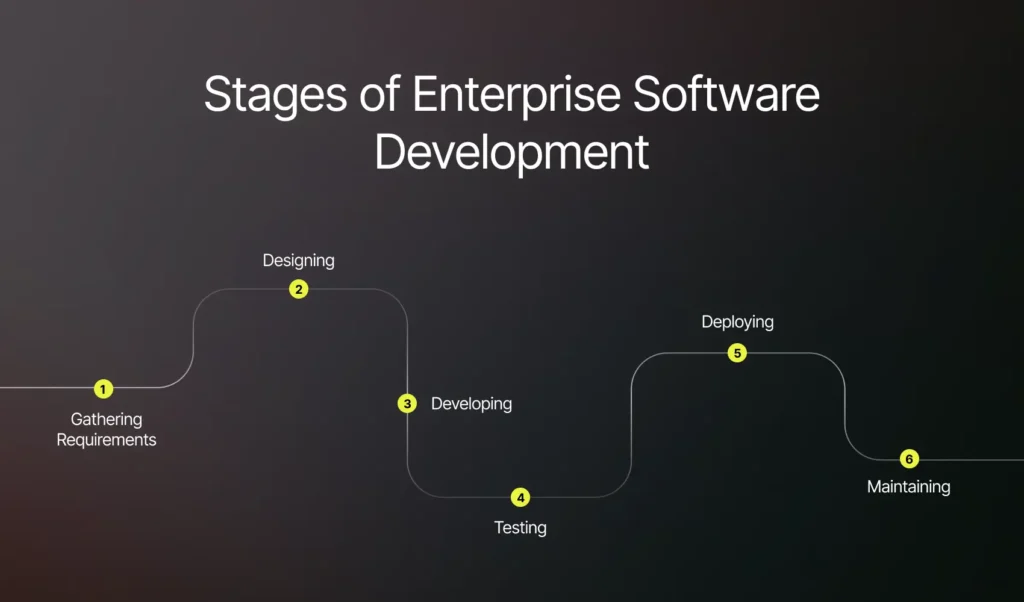
1. Gathering & Analyzing Requirements
This type of development project begins with a full knowledge of the client’s requirements. This ensures that the end product matches the business goals. It also aligns the solution with your workflows and technical specs.
Here are the major requirements that software development teams collect and analyze.
- Business outcomes with the new software. This can be automation, managing compliance, improving, or establishing a new workflow for increased efficiency.
- Measurable outcomes that the software should deliver.
- The parties that will be affected by the software include business users, departments, and stakeholders.
- Technical specifications, like main features, user roles, and required outputs.
- Tech stack and integration needs.
- User experience and performance needs
- A plan for maintenance and scalability of the software
- Budget limitations
2. Designing Phase
In the design phase, the requirements and goals are translated into a design and architecture plan. For this, the custom software development company analyzes the SRS (Software Requirements Specification). Every feature, module, workflow, and dependency is reviewed in detail.
Software developers and architects create a high-level design for the final product’s structure. It specifies the style of the architecture, data flow, and communication between components. The benefit of this is that scalability, performance, and security are built into the development stage from the start.
The enterprise software development company, at this stage, decides on the type of architecture design (monolithic, microservices, event-driven, layered). Integrations and types of deployment (cloud, on-premises, hybrid) are other major deciding areas.
Besides delving into the architecture design, user interface, experience, and wireframing, this phase also has some planning. Teams plan out the expected budget and create timelines for development.
The design phase has various sub-stages, which include the following:
- Understanding user needs, challenges, and business outcomes
- Research about the product through interviews, focus groups, and surveys
- Designing through wireframing and building prototypes
- Technical design, which explains how different parts of the software will fit together.
3. Front and Back-End Development
The enterprise software development stage is the longest. It involves implementing the features, modules, and design into a fully functioning application. The major processes in this stage are:
- Configuring development infrastructure and setting up version control systems (Git). Developers also set up continuous integration/continuous deployment (CI/CD) pipelines.
- Clean and maintainable coding following established coding standards.
- Applying business logic and algorithms
- Building APIs and connecting them with third-party or legacy systems
- Developing databases and optimizing their performance.
- Defining and writing test cases, and doing different types of testing
- Following security practices for data protection and regulatory compliance
Mistakes to Avoid in the Development Stage:
1. Absence of detailed planning or a clear developmental roadmap leads to errors and inefficient processes.
2. Inadequate communication between the client and the developers causes bugs in the software.
3. Not incorporating user-centred design principles creates a poor user experience.
4. Not building an MVP and getting feedback about the application earlier on.
5. Not implementing security protocols when deadlines are tight.
6. Not using Agile frameworks for the iterative development process.
7. Creating a complex architecture of systems increases development time and maintenance cost.
Planning Your Enterprise Software?
4. Testing Stage of Enterprise Software Development
Enterprise software is responsible for vital operations and customer interactions. It handles complex processes. Enterprise apps also process enormous volumes of data. All this makes software testing a crucial step in development. Below is an effective strategy.
A. Understand What Needs to Be Tested
You must know exactly what you need to test and why. First, define the acceptance criteria. It must be tied to tangible business goals. This prevents ambiguity and guides development.
Then, using tools like JIRA, connect testing needs, test cases, and defects to create an auditable trail. This maintains traceability. It helps you track progress and spot gaps. It ultimately ensures that all business needs are covered.
B. Create a Real-World Environment and Manage Data
Accurate testing needs environments and data that match real-world scenarios. Conduct testing in setups that reflect the production environment. This lets you figure out environment-specific problems early. Ensure compliance with data privacy laws. Mask sensitive data with synthetic datasets to protect customer and staff data.
C. Test Automation
Automation quickens the validity of essential features with every change of code. Automate regression, smoke, and performance tests. It detects regressions and measures the software’s responsiveness. Below are some useful tools
- Selenium for UI automation
- Qyrus for end-to-end testing
- TestNG and JUnit for unit and integration tests
D. Performance and Load Testing
Enterprise software typically withstands high traffic and complex transactions. Tools like JMeter and Qyrus mimic hundreds of concurrent users engaging with the platform. It spots loopholes, response time issues, and memory leaks early on.
Performance testing also verifies the software’s scalability and resource consumption. It indicates if the app can handle real-world demands.
E. Security Testing
You need to shield your enterprise software data from security threats. Conduct vulnerability assessments and penetration testing.
Frequent scans and ethical hacking simulate attacks. This uncovers any security gaps. It also ensures the effectiveness of security controls.
Ensure that your testing validates adherence to industry standards. For example, it must adhere to legal requirements like HIPAA and GDPR. This helps you avoid reputational and legal risks.
F. Continuous Integration/Continuous Deployment Integration
Incorporating testing into CI/CD pipelines turns quality assurance into an automated process. This, in turn, provides instantaneous feedback. It detects threats early. So, you can perform rapid iterations without impacting quality. Integrating testing into DevOps fosters collaboration between operations, development, and QA teams. Ultimately, it accelerates software delivery.
G. User Acceptance Testing (UAT)
Involve end-users and business analysts to validate the app’s functionality. UAT not only tests usability and workflows. It also focuses on ease of use. It tells you whether the software aligns with your business processes.
5. Deployment Stage of Enterprise Software Development
At this stage, your software is ready for release. Get all the necessary permissions to install the system. In this stage, you test all the software apps rigorously. Once everything is validated, you prepare it for release.
As a best practice, use Application Release Automation (ARA). It automates the management of deployment. However, you need to train the staff on the proper use of the app. The training ensures that everyone works smoothly with the app.
Below are some tips for effective deployment.
- Create a deployment checklist. It contains all your tasks and objectives. A checklist ensures that you do not miss any steps. Make it easily accessible for everyone in the team.
- Adopt continuous delivery (CD). It ensures that code changes can be made quickly before deployment.
- Track deployment metrics. It helps you measure the success of deployment. Have a platform that identifies and tracks target metrics and shares them with all stakeholders.
- Keep separate clusters. One for production and the other for non-production. It keeps things safe and organized.
6. Maintenance Stage of Enterprise Software Development
Maintenance is the last stage. It signals the end of the development cycle. In reality, maintenance isn’t a stage. It’s an ongoing process because the product will always need maintenance for long-term success. There are different types of maintenance, each serving its own goals. For example, corrective maintenance keeps the product up and running. Perfective maintenance enhances the features. It ensures that the software keeps pace with the changing needs.
Below are various activities that are a part of this stage.
A. Hosting and Infrastructure Maintenance
This includes:
- Auditing the current software infrastructure
- Organizing the code and documentation to fix potential issues
- Updating and patching
- Enhancing the solution’s performance
B. Application Maintenance and Support
Application support for live software secures your business continuity. It eliminates possible risks.
C. Backup and Disaster Recovery
Regular system backups maintain security through access controls and firewalls. Backup protocols and disaster recovery plans increase the security of your data.
D. Software Optimization
It involves removing potential defects uncovered when using a product. The software is then modified so it can keep pace with business changes.
E. Software Development Process Automation
This refers to setting a single code repository. Then, an approach is implemented where every team member, mechanism, and test script uses the same automated flow for building and getting software copies.
Summing Up
These seven stages lay the foundation of the success of enterprise software. Every phase provides a structure for the software’s progress. It is vital to keep the end user needs in mind to develop a purposeful and efficient product.
Unsure of where to start? Imenso Software specializes in creating enterprise solutions tailored to your business goals. From concept to deployment, we work closely with you to deliver scalable and secure software. Ready to boost efficiency through tech-driven enterprise solutions? Contact us today.
Ready to Build Enterprise Software That Scales?


Similar Posts
Legacy System Modernization: Why Enterprises Choose Outsourcing Over In-House
Legacy systems are difficult to maintain and highly vulnerable to security loopholes. Modernizing them offers benefits that go way beyond cost savings. It helps businesses reduce downtime, achieve compliance, and protect against cyber threats. A comparison of these expected gains with the disadvantages of legacy systems allows enterprises to clearly comprehend the modernization outcomes. Outsourcing […]...

Leveraging Digital Twins: Practical Enterprise Use Cases And Insights
Digital twins are no longer experimental tech. They are real business systems used across industries today. Digital twin technology creates a live digital version of a real system, asset, or process.This digital version connects to real data. It updates in real time. Thus, it helps teams test decisions before they act. In simple terms, digital […]...

Enterprise Software Modernization: Strategies to Scale Without Disruption
Big organizations face their unique set of challenges. Digital transformation for them is quite different from what it’s like for small and medium-sized businesses. A telltale characteristic of these businesses is the humongous volume of interlinked systems, data and infrastructure. But to keep succeeding in the modern environment, upgrading and improving enterprise software is essential. […]...