
Sustainable Software Development: Green Practices for Modern Businesses

Streaming a video, using a mobile app, or running an AI-powered platform may feel effortless to users. Behind every digital interaction, however, data centers and cloud infrastructures work continuously to process, store, and transfer massive amounts of data. These operations consume significant energy and contribute to growing carbon emissions worldwide.
As digital consumption continues to rise, businesses must rethink how software is built and maintained. Sustainable software development helps organizations reduce energy usage, optimize resources, and create efficient digital systems that minimize environmental impact without compromising performance or scalability.
What is Sustainability in Software Development and Why It Matters
Recently, extreme climate events have been behind major economic havoc. Not only that, but it has also led to substantial human losses. So, finding novel approaches to cut down carbon footprints in every area of life has become pivotal. The sphere of technology is no exception.
Sustainability in software development is one of the approaches. It is a set of practices that optimizes development processes, manpower, and energy usage. The ultimate aim is to reduce environmental harm.
Modern software adds three new high-energy consumption aspects to its earlier characteristics. These include:
- The amount of data that is produced daily and needs to be managed by the software applications has risen significantly.
- Most software is internet-based. Thus, moving data all over the network with the subsequent energy usage.
- The amalgamation of AI in software programs.
Sustainable software development pertains to:
- Product teams should create low-cost and eco-safe solutions
- Optimization should upgrade the quality of products.
Why Sustainable Software Development Is a Business Priority
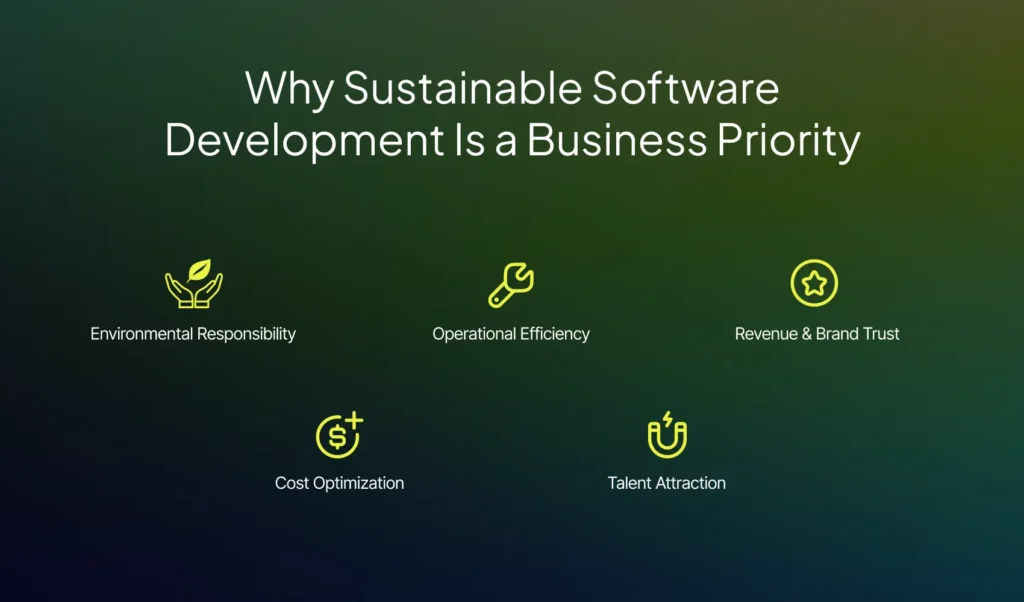
Sustainable software development offers varied benefits. Below are the key ones.
1. Environmental Responsibility
Sustainable software development depends on eco-safe practices. Thus, it causes less environmental damage. In the coming 5 years, data centers will consume twice the global electricity as they do now. AI-led tech further causes a rise in data center power. So, it has become vital to start cutting down the volume of consumed resources and emissions caused by ICT.
2. Operational Efficiency
Sustainable software engineering transforms SDLC approaches. Sustainability optimizes the work of tech teams. Instead of working overtime to meet deadlines, managers encourage actual productivity. They seek ways to organize smarter work to enjoy greater efficiency afterwards.
3. Revenue & Brand Trust
Sustainability software enhances revenue due to more driven and productive teams. When tech teams know that they are developing a product that brings real value to users, it increases their motivation. Thus, they work harder to offer more creative and better solutions. This, in turn, generates more profit. Further, it signals purchasers that you care. People view brands that prioritize sustainability as more reliable. Often, eco-safe businesses report higher profit margins.
4. Cost Optimization
Sustainable software lowers the load on servers and uses less power. So, it’s highly cost-effective. The approach cuts unexpected costs. It results from compliance with new protocols. In the future, we can expect new acts restricting carbon emissions. So, by creating sustainable solutions, businesses are well-prepared for the future.
5. Talent Attraction
Sustainability in software engineering positions your company as a great place of work. When potential candidates know their work will contribute to a bigger idea, they are more inclined to join the organization. This is vital in a highly competitive labour market with limited qualified human resources.
Thinking About Making Your Software More Sustainable?
Understanding Green Coding
Technology has changed how we function. However, it also poses a threat to an urgent concern: climate change. It’s exactly here that green coding can help.
Green coding is an effort to cut down the environmental impact of technology and software. It’s a set of practices to create new software that uses less energy. Basically, green coding lowers its environmental impact by rewriting programming code to cut the energy usage of a specific software.
The Four Pillars of Green Software Engineering
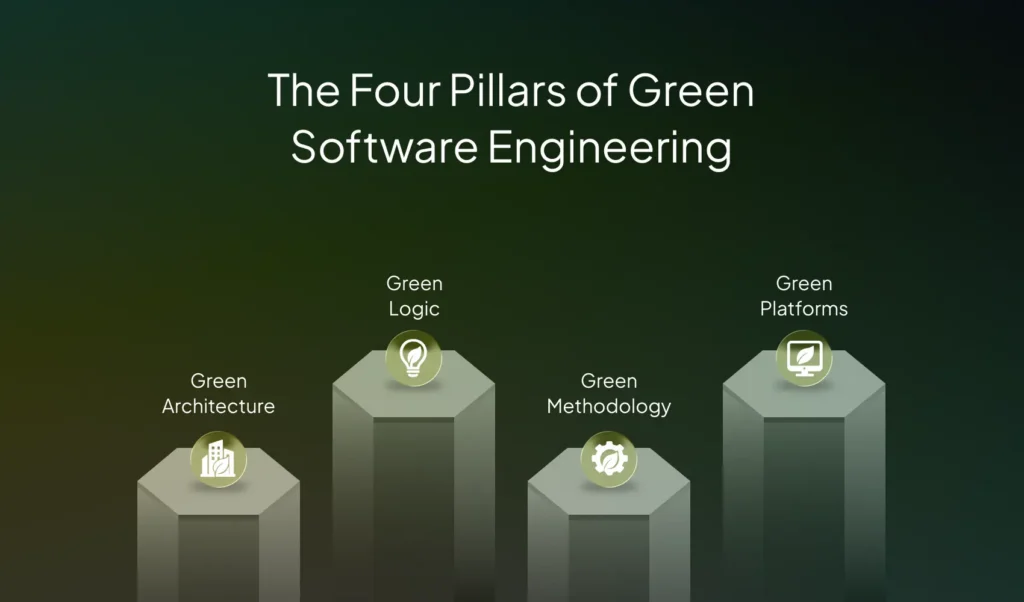
1. Green Architecture
Green architecture is the process of optimizing an app for energy use. It aligns with the structural principle of green coding. Here, the actual code units can be modified to enhance energy efficiency. The goal of green architecture is to lower how much of work and energy the hardware hosting the software typically exerts. This could be new coding for automatic shutdowns, or a low-power mode to cut energy usage.
2. Green Logic
This aspect of green coding centers around the notion that each decision can create a cascading effect for green coding and energy savings. Some examples of these decisions are creating better visuals for content. This is done to improve user speed to save time and energy. Another is aiming for “zero-waste” codes by eliminating old codes. Yet another is using smaller files to lower the carbon footprint of extra resources used in green coding.
3. Green Methodology
Green methodology endeavors to improve the process for software development. It does this by promoting rapid feedback for fast adjustments to cut the carbon footprint through software development. Additionally, reusable code is encouraged in green coding.
4. Green Platforms
It is crucial to make the platform so that your application’s green coding will be hosted “greener.” This is vital to ensure better performance and energy efficiency. This could include altering the configurations for the platform. It can also be overlooking recent metrics to discover how servers are handling the existing supply and demand.
How to Implement Sustainable Software Development
Below are the most essential things to look into to adopt green coding.
1. Set Measurable Sustainability Goals
Green coding needs you to overhaul your current coding. Eliminate repetitive code and unnecessary loops to cut down the energy usage. As a best practice, build smarter software that can automatically end codes when they are not in use.
2. Choose Energy-Efficient Programming Languages
It is seen that the language C is the most energy-efficient language. Other options include C++, Rust, Java, and Pascal.
3. Work Towards Consistent Improvements
You cannot find a green coding approach overnight. So, remain open-minded. Keep testing various parts of your green coding strategy for continuous improvement.
4. Determine the Long-Term Use of Data and Networks
Data storage centers are closely tied to green coding. It’s essential to find new avenues for data usage. You must also enhance specific processes, like caching, to cut energy consumption.
5. Encourage and Adopt New Perspectives
Encouraging innovation and new collaborations are great ways to create a suitable green coding strategy for your business. It lets you compare and contrast successful tactics. Ultimately, you can test and implement new energy-saving ideas.
Best Practices for Sustainable Software Development
1. Set Sustainable Development Goals
Long-term sustainability goals are vital if you are serious about green software engineering. These can be:
- Reduction in total energy consumption
- Attaining carbon neutrality in development operations
- Using renewable energy sources for data centers.
These goals should be accompanied by metrics specific to them. Monitor the progress in metrics to make sure that your organization is minimally impacting the environment and society.
2. Choose Energy-Efficient Programming Languages
Use lightweight and energy-efficient languages for green coding. Examples include the Elixir programming language. It is based on Erlang and its virtual machine, and so, it uses lightweight processes. These processes have little memory and CPU resource consumption. Not only that, but the language also utilizes OTP to process tasks jointly.
Similar to Elixir is Erlang. Both are known for their superior concurrency, fault tolerance, and real-time system capabilities. These capabilities reduce server consumption.
3. Use Energy Measurement Tools
Open-source solutions, like the Green Metrics Tool, automate the generation of the Software Carbon Intensity (SCI) metric for any software. The tool simulates typical software interactions and maps machine and CPU energy and network traffic.
Another open-source tool is Nextcloud, a self-hosted file sync and share platform. It enables users to store, access, and share their files on their own servers. If not their own servers, you can use eco-friendly data centers, and successfully minimize the carbon footprint linked with your data storage.
Cloud Carbon Footprint is another free tool that connects to your cloud usage data. It converts it into estimated energy use and carbon emissions. This tool supports AWS, Azure, and GCP. This makes it best for a multi-cloud environment where the team desires a unified dashboard.
4. Adopt Agile and Lean Approaches
Sustainable software development becomes achievable through methods that emphasize iterative development, waste reduction, and ongoing feedback. Central to lean software development is the ‘change for the better’ philosophy. Teams work together to refine code and adopt tools that better serve the overall objectives.
Likewise, Iterative development, a major Agile principle, prioritizes releasing small increments of functionality consistently. It is in line with the need of today’s AI systems to continuously refine as data and requirements change. The agile approach allows developers to quickly adapt to changing circumstances. Thus, they can respond to rising sustainability challenges.
5. Follow Sustainable UX Design Principles
Sustainable UX design allows software to contribute positively to environmental goals. Such UX designs also maintain functionality and user satisfaction. They require fewer server requests or milder processing. Some key sustainable design principles include:
- Dark mode to minimize energy consumption on devices.
- Making sustainable options, like digital receipts, the default setting.
- Optimizing data transfer protocols
- Making design accessible for all users
- Designing for easy data migration or archival when the product is no longer used
Summing Up
Sustainable and green practices in software development aren’t a trend. It’s a force altering the future development. Ultimately, this approach serves the bigger aim of a healthier planet. By adopting it, businesses positively contribute in two ways. The first is to protect the environment. The second is creating powerful applications.
Ready to take the first step towards sustainable software development? Contact Imenso Software today to learn how our expertise in eco-friendly software solutions can help you achieve your sustainability goals. Let’s create efficient software that’s good for the planet together.


