
SaaS Product Development Cost: What to Budget in 2026
Key Takeaways
- SaaS development cost depends mainly on features, team, and product scale.
- Building in stages helps reduce risk and saves money early on.
- Most of your budget goes into development, design, and testing.
- Hidden costs like hosting, maintenance, and tools add up after launch.
- Choosing the right team and location can greatly reduce total cost.
In 2026, SaaS product development cost depends on three things. These are the features, team, and scale.
Here is a quick but helpful overview:
- MVP SaaS product: $25,000 to $80,000
- Mid-level SaaS product: $80,000 to $200,000
- Enterprise SaaS platform: $200,000 to $500,000+
SaaS Development Cost Breakdown
| Type of SaaS | Cost Range | Timeline | Team Size |
| MVP | $25K – $80K | 2 – 4 months | 3 – 5 people |
| Mid-level SaaS | $80K – $200K | 4 – 8 months | 5 – 8 people |
| Enterprise SaaS | $200K – $500K+ | 8 – 14+ months | 8 – 15+ people |
Staged Development Cost Path
Most better performing SaaS products are not built in stages. This staged approach reduces risk. It also helps you spend money only when needed.
Below is a clear view of this cost path.
Stage 1: Validation (idea testing)
Right now, you are testing if your idea is worthwhile. Product building has not begun yet. The cost begins from $500. It can go till $5,000.
This usually includes:
- Landing pages
- User surveys and interviews
- Basic prototypes
- Small ad campaigns to test interest
Stage 2: No-code MVP
Now you know that your idea shows some promise. The next action is to create a simple version of your product. No-code tools are highly helpful here. With their aid, development generally falls between $1,000 to $8,000.
At this stage, you can:
- Launch a working product
- Onboard early users
- Test real usage
Stage 3: Custom MVP
Your audience seems to like your MVP. It’s now time to build a serious SaaS product. In this stage, you build a custom solution. $25,000 is generally a rough figure of the starting cost. It can go up to $80,000. This is also when firms reach out to professional custom software development services for the solution.
This cost includes the following:
- Custom frontend and backend
- Scalable database
- Proper security setup
- Integrations with tools like payments or analytics
Stage 4: Scale and expansion
By the time you come to this stage, more people have started to use your product. To enable it to keep performing well, you move to scaling. This includes improving performance. You add advanced features to make the product competitive and handle the load well.
Costs vary a lot here. Generally, they usually include:
- Infrastructure upgrades
- Feature expansion
- Better security and compliance
- Team expansion
Where Your Budget Goes (Step-by-Step Breakdown)
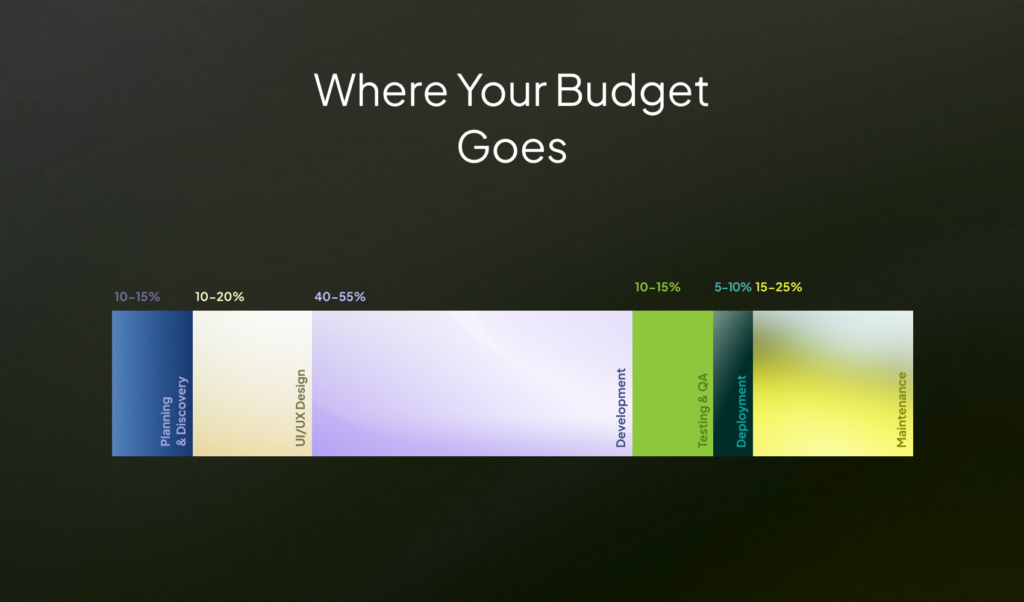
Your total budget is split across different stages. Each stage has a clear purpose.
Planning and research
This stage defines your product idea, users, and features.
- Cost share: 5% to 10%
- Includes market research, competitor analysis, and product roadmap
Studies show that strong early planning reduces project failure risk by up to 30% or more.
UI and UX design
This stage focuses on how your product looks and feels.
- Cost share: 10% to 15%
- Includes wireframes, prototypes, and user flows
Good design reduces user drop-off and improves conversions.
Frontend and backend development
This is the core of your SaaS product.
- Cost share: 40% to 55%
- Includes APIs, database, dashboards, and business logic
This stage takes the largest budget because it builds the product.
Testing and quality checks
This ensures your product works without bugs.
- Cost share: 10% to 15%
- Includes manual testing, automation, and performance testing
Fixing bugs after release can cost up to 30x more than fixing them early.
Deployment and launch
This stage puts your product live.
- Cost share: 5% to 10%
- Includes cloud setup, CI/CD pipelines, and release
Ongoing support and updates
This keeps your product running and improving.
- Cost share: 15% to 25% per year
- Includes bug fixes, updates, and scaling
What Increases or Decreases SaaS Development Cost
Several factors directly affect your budget.
Number of features
More features increase development time and cost. Simple products cost less. Complex workflows increase cost fast.
Type of product (B2B vs B2C)
B2B products often cost more because they need:
- Advanced dashboards
- Integrations
- Role-based access
Integrations and APIs
Each integration adds cost. Examples include:
- Payment gateways
- CRM tools
- Analytics systems.
Tech stack used
Modern and scalable tech stacks may cost more upfront. But they reduce long-term maintenance costs.
Team location (US vs Europe vs India)
Development cost depends heavily on where your team is based. This is one of the biggest cost drivers.
Timeline and urgency
Faster delivery requires more developers. This increases cost due to parallel work.
Developer Cost by Region (2026 Rates)
| Region | Hourly Rate | When to Choose |
| US | $100 – $200/hr | high complexity, fast delivery |
| Europe | $60 – $120/hr | balanced quality and cost |
| India / Asia | $25 – $60/hr | cost-effective development |
Select as per your budget and product complexity. Generally, firms prefer custom software development services in India. The main reason? To cut costs while maintaining quality.
What Does It Cost to Build SaaS with Imenso Software?
Your SaaS product can cost very different amounts depending on who builds it.
In the US, agencies usually charge higher rates. This is due to local salaries and overhead. In contrast, Imenso Software, an Indian company, offers more cost-efficient pricing. At the same time, there is no compromise in quality.
This is one reason many startups choose us for custom software development services.
Cost comparison: US agency vs. Imenso Software
| Product Type | US Agency Cost | Indian Company (Imenso) Cost |
| Custom MVP | $80K – $150K | $20K – $45K |
| Mid-scale SaaS | $150K – $300K | $45K – $120K |
| Enterprise SaaS | $300K – $500K+ | $120K – $250K+ |
Why development at Imenso Software costs low?
Costs are lower at Imenso because of:
- Lower operational and salary costs
- Access to a large pool of skilled developers
- Flexible engagement models
At the same time, we follow global development standards. Our teams use modern tech stacks and agile processes. Structured project management ensures that we deliver a high-quality product within the timeframe you’ve assigned.
Get a Clear SaaS Cost Estimate
How AI Features Change SaaS Development Cost in 2026
AI is now a core part of many SaaS products. Here is how AI impacts your budget:
Common AI features and their development cost
| AI Feature Type | Cost Range | What it includes |
| LLM API integration | $5K – $15K | Chatbot, text generation, summaries using APIs like OpenAI |
| RAG pipeline (AI + your data) | $10K – $30K | Search + retrieval + AI responses based on your own data |
| Custom ML model | $20K – $60K | Training your own model for predictions or recommendations |
| AI automation workflows | $5K – $20K | Rule-based + AI workflows for tasks and processes |
AI infrastructure costs can add 10% to 25% to the total product cost. In most cases, adding AI increases total budget by 15% to 30%.
Monthly AI costs you should plan for
AI also adds ongoing costs.
Here are the main cost areas:
- API usage (tokens): $50 to $1,000+ per month for small to mid apps
- Cloud compute (GPU/servers): $100 to $2,000+ per month depending on load
- Vector databases and storage: $50 to $500 per month
- Monitoring and logging tools: $50 to $300 per month
When to use APIs vs. build custom AI
This is an important decision to make. Below is a clear answer.
Use third-party APIs when:
- You want to launch fast
- Your use case is common (chat, summaries, simple automation)
- You do not have large proprietary data
Build custom AI when:
- You need unique features or predictions
- Your product depends on your own data
- You want more control over performance and cost
Hidden Costs in SaaS Product Development
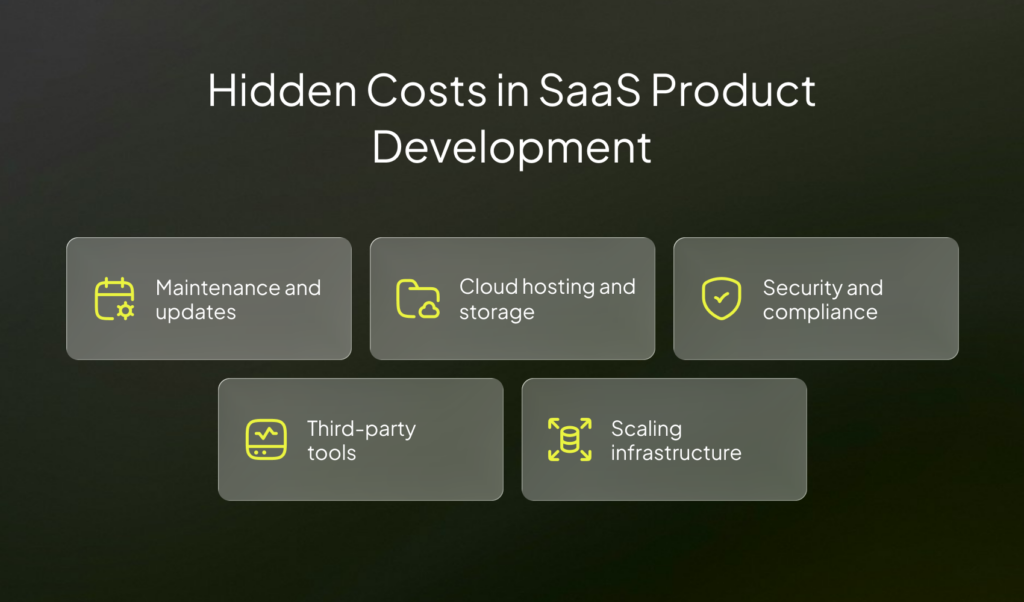
Most firms plan for development costs first. But there are so many ongoing costs that start after launch.
Key hidden costs you should plan for
Always budget for:
- Maintenance and updates
- Cloud hosting and storage
- Security and compliance
- Third-party tools
- Scaling infrastructure
1. Maintenance and updates
Once your product is live, the work does not stop. You will need regular updates, bug fixes, and more. The cost falls between15% to 25% of your development cost per year
For example, your product costs $100,000 to build. Here you may spend $15,000 to $25,000 every year just to keep it running.
2. Cloud hosting and storage
SaaS products run on cloud servers. These costs depend on usage, traffic, and data storage. This cost can range from $200 to $2,000 per month. These figures are for early-stage products
As your user base grows, this cost can increase quickly.
3. Security and compliance
If you handle user data, security is critical. You may also need compliance certifications like SOC 2. SOC 2 audit costs between $20,000 to $50,000. It’s a one-time cost. But it may repeat annually
4. Third-party tools
Most SaaS products rely on external tools to move faster. These include email services, among others. The money you need to shell out can start from $300 and go over $2,000 per month
Costs increase as your user base expands. It will also increase if you upgrade to higher plans.
5. Scaling infrastructure
At the start, your system may handle less users. But the inevitable growth demands a scalable infrastructure. This includes:
- Load balancing
- Database optimization
- Caching systems
There is no fixed number here. However, costs rise with usage. Many startups see a steady increase in cloud and infrastructure costs with growth.
Per-Component Cost Breakdown (Detailed View)
Till now, you saw total cost ranges. But for real planning, you need a more detailed view. Here, a per-component breakdown helps. With its help, you can understand exactly where your money goes.
| Component | Cost Range | What it includes |
| UI/UX design | $3K – $15K | wireframes, user flows, visual design |
| Frontend development | $8K – $20K | dashboards, user interface, responsiveness |
| Backend development | $10K – $28K | APIs, database, core logic |
| Authentication system | $1K – $3K | login, signup, user roles, security |
| Billing integration | $1.5K – $4K | payment gateway setup, subscriptions |
| DevOps setup | $2K – $8K | cloud setup, CI/CD, deployment |
| QA and testing | $2K – $8K | bug testing, performance checks |
This breakdown also helps when working with custom software development services. You can ask for estimates per component. That makes pricing more transparent.
Total First-Year SaaS Cost (Build + Run + Grow)
Your first-year cost does not include just development. Account for the following:
- Development cost
- Infrastructure cost (servers, cloud)
- Marketing cost (customer acquisition)
- Support and operations
You can understand this cost breakdown better with the help of an example:
- Build: $100,000
- Infrastructure: $15,000
- Marketing: $30,000
- Support: $20,000
Total first-year cost: $165,000
SaaS Cost Calculator (Explain How to Estimate Your Budget)
Use this method to estimate your SaaS cost.
Step 1: define your features
- List all features you want in your product.
- Group them into must-have and optional.
Step 2: estimate team
- Decide how many developers, designers, and testers you need.
Step 3: calculate timeline
- Estimate how long each feature will take.
- Then combine to get a total timeline.
Step 4: calculate cost
Multiply: team size × hourly rate × total hours
This gives your base development cost. You can later refine this using product development services for a more accurate estimate.
Build Your SaaS Product the Right Way
Building a SaaS product is not just about cost. It is about making the right decisions at each step.
Start with a clear plan. Focus on real user needs. Build only what is required in the beginning.
If you need expert help, working with experienced custom software development services like Imenso Software can make the process faster and more efficient. Get professional guidance on planning and building your SaaS product with us. Get in touch today.


