Product-First Engineering: How to Build Software That Delivers Real Business Impact
Product-First Engineering means building software by starting with real business and user outcomes. Development does not stem from code, tools, or features.
Here’s the underlying aim. Every engineering decision should move the product forward in a way that users feel and businesses can measure.
Many teams build solid systems that still fail. The real reason lies in focus. When engineering starts with code, two things happen:
- Effort goes up
- Impact goes down.
This guide tells you exactly how:
- Product-First Engineering works
- Why it matters, and
- How teams apply it in real situations
What Is Product-First Engineering?
Product-First Engineering is an approach where engineering work starts with the product problem. It doesn’t begin with the technical solution.
The main question changes.
Earlier, product teams used to ask, “How should this be built?”
Now, the question becomes, “Why does this need to exist at all?”
This mindset treats engineering as a partner in product decisions. Engineers help shape:
- What gets built
- When it ships, and
- How success is measured.
Code becomes a tool, not the end goal.
This idea appears in many places, including essays like Product First Engineering ZBook. Here, the contrast between code-first and product-first thinking is explained through real development behaviour. It does not use process diagrams for this purpose.
Why Code-First and Feature-First Thinking Break Down
Many teams do not fail because they write bad code. They fail because they solve the wrong problems.
The hidden cost of code-first thinking
Code-first teams focus on structure, patterns, and elegance first. That sounds positive. Yet over time, this approach creates blind spots.
Common outcomes include:
- Perfect systems for unused features
- Long build cycles with unclear value
- Engineers disconnected from real users
- High effort with low visible return
The product may work. But it does not move the business.
Why shipping features is not the same as progress
Feature-first delivery feels productive. New screens appear. New buttons ship. Velocity charts look healthy.
Then the doubts creep in.
- Are users actually using this?
- Did this improve retention?
- Was this worth three sprints?
Engineering product development only works when features are tied to outcomes. Without that link, teams mistake motion for progress.
Product-First Engineering vs Traditional Product Engineering
Product engineering already exists as a discipline. So what changes?
| Area | Traditional Product Engineering | Product-First Engineering |
| Starting point | Roadmaps and specs | Business and user outcomes |
| Engineer role | Builder and executor | Product partner |
| Success metrics | Delivery and velocity | Adoption, impact, learning |
| Decision style | Requirement driven | Outcome driven |
Traditional product engineering focuses on process. Product-First Engineering focuses on decisions.
That difference sounds small. In practice, it changes everything.
Core Principles of Product-First Engineering
Strong teams follow a few shared beliefs. These principles guide daily trade-offs and long-term planning.
Outcomes matter more than outputs
Shipping is not successful. Learning and impact are.
A released feature that changes nothing is noise. A small change that improves retention is gold.
Engineering decisions start with user value
Every technical choice carries a user cost or benefit. Faster load time. Fewer errors. Clear flows. These are not design issues alone.
The product engineer understands how technical decisions shape user experience.
Business limits are real inputs
Time, money, and risk are not blockers. They are design constraints.
Product-First Engineering treats these limits as part of the problem, not something to work around later.
Product thinking is an engineering skill
Understanding users, markets, and trade-offs is not just a product manager’s job.
The rise of the product engineer comes from this shift. Engineers who ask better questions build better systems.
Learning beats perfect planning
No plan survives real users.
Product-First teams optimize for fast feedback. They test assumptions early and change direction without drama.
How Product-First Engineering Works in Practice
This approach sounds logical. The real test is execution.
Discovery-led engineering
Engineers join early conversations. They hear user pain directly. They help test ideas before code exists.
Questions often sound like this:
- Is this problem big enough?
- What happens if this fails?
- What is the smallest version that teaches something?
This saves time and prevents wasted builds.
Hypothesis-driven development
Each change starts with a belief.
“For new users, this will reduce drop-off.”
Engineering product development becomes a loop:
- Define the belief
- Build the smallest test
- Measure behavior
- Decide what to do next
This reduces emotional attachment to code.
Incremental value delivery
Big launches create big risks.
Product-First Engineering favours small, frequent releases tied to learning. This keeps teams close to reality and avoids long feedback gaps.
Tools and Technology Stack for Product-First Engineering
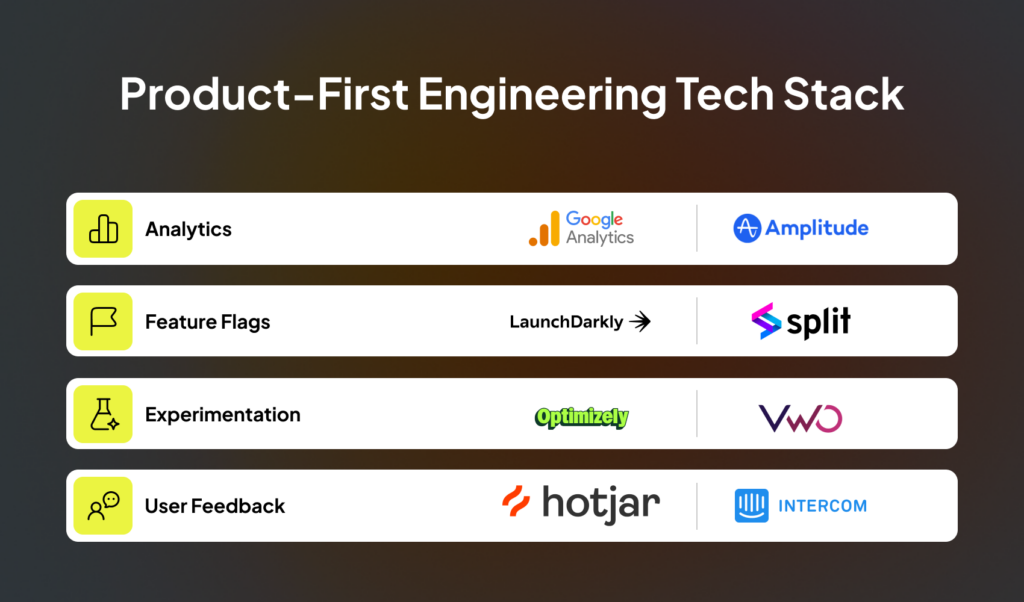
Product-First Engineering does not depend on tools. Still, the right tools are needed for the work to become:
- Visible
- Measurable, and
- Repeatable.
The goal of the stack is to help teams:
- Understand behavior
- Test ideas safely, and
- Listen to users without friction.
Essential Tool Categories
Analytics
Analytics tools show what users actually do. They answer questions like:
- Where do users drop off?
- Which features get ignored?
- What changes behavior over time?
Common tools include:
- Google Analytics for basic funnels
- Amplitude or Mixpanel for product behavior
Feature Flags
Feature flags allow teams to release without risk. They separate deployment from exposure. Below are its use cases:
- Gradual rollouts
- Internal testing
- Fast rollback when impact is negative
Popular tools:
- LaunchDarkly
- Split
Experimentation
Experimentation tools support controlled learning. Strong experimentation shortens feedback loops. With the help of these tools, you can answer questions like:
- Does this change improve the outcome?
- Which variant performs better?
Tools often overlap with analytics, but focus on testing:
- Optimizely
- VWO
User Feedback
Data shows what users do. Product engineers use feedback to validate assumptions early. Below are some common tools:
- Hotjar for session recordings
- Intercom for direct conversations
Integration Patterns That Work
Effective stacks connect tools instead of isolating them. When tools talk to each other, teams spend less time stitching data and more time learning. Common patterns include:
- Analytics linked to feature flags
- Experiment results feeding dashboards
- Feedback tagged to releases
Build Software Around Real Outcomes
Real-World Case Studies: Product-First Engineering in Action
The real test of Product-First Engineering lies in whether it works when money, scale, and risk are involved. Large product companies provide useful proof. You can see and measure their changes.
The following examples show you exactly that:
Atlassian Compass
Context
Atlassian launched Compass to solve a problem inside its own organization. As its systems scaled, its engineering teams struggled to understand:
- Service ownership
- Dependencies, and
- Health
Before
Engineering teams worked in silos.
Service ownership was unclear.
Incident response was slow.
Internal tooling lacked adoption.
Metrics before change included:
- Long incident resolution times
- Low visibility into service dependencies
- High cognitive load on engineers
Transformation approach
Instead of shipping another internal tool, Atlassian treated Compass as a product.
Product-First Engineering principles applied:
- Engineers joined discovery interviews with internal users
- Early prototypes were tested with small teams
- Success was defined as reduced operational friction, not feature count
Compass was built incrementally. Each release focused on one measurable outcome such as ownership clarity or service health visibility.
Timeline
- First discovery phase: ~3 months
- Internal beta rollout: ~6 months
- Gradual expansion across teams
After
Measured improvements included:
- Faster incident triage
- Clear ownership mapping across services
- Higher adoption due to solving real daily pain
Compass became a public product because the internal value was proven first.
Netflix
Netflix rarely talks about Product-First Engineering directly. The behavior shows it clearly.
Before
Early Netflix systems focused on infrastructure stability and scale. As the platform grew, technical excellence alone stopped being enough.
Problems emerged:
- Features shipped without improving viewing time
- Experiments took too long to validate
- Engineering effort increased without proportional user impact
Shift in mindset
Netflix reframed engineering work around viewer outcomes.
Core questions changed:
- Does this increase viewing hours?
- Does this reduce friction in discovery?
- Can this be tested quickly?
Engineering product development became experiment-driven. Teams built small changes and measured real behavior.
Key changes
- Strong A/B testing culture tied to engineering work
- Engineers involved in hypothesis creation
- Features were removed aggressively when the impact was weak
Outcomes
Netflix reports that many features are killed early. This is not failure. It is efficiency.
Results include:
- Faster learning cycles
- Reduced waste in engineering effort
- Clear alignment between code and business value
Spotify Squads
Spotify’s squad model is often copied and often misunderstood.
Before
As Spotify scaled, centralized engineering created bottlenecks. Teams waited for approvals. Product decisions slowed.
Product-First change
Spotify reorganized engineering around product missions, not technical layers.
Each squad owned:
- A clear user problem
- A measurable outcome
- The technical decisions needed to reach it
Product engineers were expected to think about user value, not just code quality.
Challenges faced
- Inconsistent practices across squads
- Risk of duplicated work
- Need for strong alignment mechanisms
Spotify accepted these trade-offs. The goal was speed of learning.
Results
- Faster experimentation
- Higher ownership and engagement
- Better alignment between product and engineering
Roles in a Product-First Engineering Team
Understanding clear roles helps because they set expectations. Knowing about them also reduces confusion during decision-making.
The product engineer
The product engineer blends technical depth with product awareness. This role thinks beyond tasks. The engineer must possess the following traits:
- Comfort with ambiguity
- Strong communication
- Focus on impact, not ownership
- Willingness to challenge weak ideas
This role explains much of the rise of the product engineer across modern teams.
Product managers as outcome owners
Product managers define goals, not solutions. They partner with engineering to explore options.
Strong collaboration replaces handoffs.
Engineering leaders as value enablers
Leaders create space for this mindset. They reward learning, not just delivery. They protect teams from feature factories.
The Product Engineer Role Explained
The product engineer role exists because software is no longer just technical. Use the following as guide when hiring for this position.
Skills Matrix
Technical
- System design
- Testing strategy
- Performance awareness
Product
- User empathy
- Problem framing
- Experiment design
Business
- Cost awareness
- Risk trade-offs
- Outcome thinking
Career Progression
- Junior Product Engineer: Learns product context
- Mid-Level: Contributes to discovery
- Senior: Shapes product decisions
- Staff or Principal: Guides multiple teams
Salary Benchmarks
Ranges vary by region and company size. Approximate global ranges are:
- Junior: $60k–90k
- Senior: $120k–170k
- Staff: $170k
What Does a Product Engineer Do?
A product engineer has the following responsibilities:
- Review user data in the morning
- Join a discovery session
- Ship a small experiment
- Analyze results by end of day
Measuring What Matters in Product-First Engineering
Product-First Engineering relies on clarity. Metrics tell you where you are heading:
OKRs vs KPIs in Product Engineering
| Area | OKRs | KPIs |
| Purpose | Direction and learning | Health monitoring |
| Time frame | Short to medium | Ongoing |
| Flexibility | High | Low |
| Use case | Product discovery | Operational stability |
Both matter. Never confuse one for another.
Choosing a North Star Metric
A strong North Star metric:
- Reflects user value
- Grows with the business
- Is influenced by product changes
Examples:
- Weekly active creators
- Successful task completion
- Viewing hours per user
The metric should guide engineering priorities.
Leading vs Lagging Indicators
Leading indicators show early signals. These include:
- Feature adoption rate
- Activation completion
- First-week engagement
Lagging indicators confirm outcomes. These are:
- Revenue growth
- Retention over months
- Churn reduction
Product-First Engineering relies more on leading signals.
Useful Formulas
Time to Value
Time from release to measurable impact.
Feature Adoption Rate
(Number of active users using feature) / (Eligible users)
Engineering Impact Score
(Outcome improvement) / (Engineering effort)
Reporting and Dashboards
Effective dashboards are essential to build visibility. They should:
- Focus on trends, not snapshots
- Show outcomes next to releases
- Are shared across teams
Anti-Patterns and Pitfalls to Avoid
Product-First Engineering fails when teams copy the language but keep old habits. The warning signs appear early if teams know where to look.
Anti-Pattern: Outcome Theater
Diagnosis
Teams talk about outcomes but still measure delivery. Watch out for these red flags:
- OKRs that look like task lists
- Reviews focused on shipped features
- No post-release learning
Recovery
Limit goals to one measurable behavior change. Force teams to show evidence, not intent.
Anti-Pattern: Engineers Pushed Into Product Roles
Diagnosis
Engineers are expected to make product decisions without context. Look out for:
- Engineers guessing user needs
- Friction between PMs and engineering
- Decision paralysis
Recovery
Product-First Engineering requires collaboration, not role replacement. Share discovery. Do not outsource it.
Anti-Pattern: Over-Experimentation
Diagnosis
Teams test everything and decide nothing. This is visible in:
- Endless experiments
- No clear success criteria
- Slow execution
Recovery
Limit experiments to high-risk assumptions. Decide fast when data is clear.
Anti-Pattern: Ignoring System Health
Diagnosis
Teams chase impact while technical debt grows. Don’t let the following happen:
- Rising incident count
- Slower releases
- Burned-out engineers
Recovery
Treat system health as a product outcome. Stability enables speed.
When Product-First Engineering Delivers the Highest ROI
This approach shines in certain contexts.
It works best when:
- Products evolve over time
- User needs are complex or unclear
- Regulation raises the cost of mistakes
- Engineering time is expensive
A Practical Implementation Framework for Product-First Engineering
Adopting Product-First Engineering is a series of decisions that compound over time. Teams need structure without rigidity.
This framework offers a realistic path.
30-60-90 Day Transformation Roadmap
First 30 Days: Reset the Signal
Focus: Understanding reality. Take the following actions:
- Review current success metrics
- Identify features with no measurable impact
- Involve engineers in user interviews
Questions to ask:
- What are we building that users ignore?
- What decisions are made without data?
Days 31–60: Change How Work Starts
Focus: Discovery before delivery.
Actions:
- Introduce lightweight discovery sessions
- Define hypotheses for new work
- Align teams on outcome-based goals
Days 61–90: Lock in Feedback Loops
Focus: Measurement and learning. Here’s what to do:
- Track adoption and behavior
- Kill low-impact features early
- Share learning openly
At this stage, Product-First Engineering becomes visible in daily behavior.
Product-First Engineering Maturity Model
Level 1: Code-Driven
Engineering executes specs. Success equals delivery.
Level 2: Feature-Driven
Teams ship often. Impact is assumed, not measured.
Level 3: Outcome-Aware
Teams measure results but still ship large batches.
Level 4: Product-First
Small releases tied to learning. Engineers influence decisions.
Level 5: Value-Optimized
Teams continuously trade scope for impact. Waste is actively reduced.
Most teams sit between levels two and three.
Decision Tree: When to Apply Product-First Engineering
Ask these questions:
- Is user behavior uncertain?
- Is change expensive to reverse?
- Does this affect revenue or risk?
If the answer is yes, Product-First Engineering applies.
For routine maintenance, traditional execution may be enough.
Integration With Agile and Scrum
Product-First Engineering does not replace Agile. It sharpens it. Below are the adjustments you must make:
- Sprint goals tied to outcomes
- Backlogs framed as hypotheses
- Reviews focused on learning, not demos
Scrum becomes a delivery tool, not a planning crutch.
Product-First Engineering by Industry
The core principles of product-led engineering are the same for every industry. What changes is the execution.
SaaS Companies
SaaS products evolve daily. Feedback is fast. Focus on:
- Activation and retention
- Feature adoption
- Time to first value
Product engineers in SaaS must watch usage closely. Successful teams:
- Release weekly
- Kill weak features fast
- Optimize onboarding relentlessly
E-commerce Platforms
In e-commerce, behavior is immediate. Monitor the following metrics:
- Conversion rate
- Cart abandonment
- Checkout completion
Engineering product development focuses on reducing friction. Small changes matter. Here are some good examples of good changes:
- Faster page loads
- Clear error handling
- Trust signals during payment
B2B Enterprise Products
Enterprise buyers move slowly. Users are not buyers. Key challenges B2B faces include:
- Long sales cycles
- Multiple stakeholders
- Complex workflows
Product engineers must balance usability with flexibility. Outcomes often lag releases. Success requires:
- Strong discovery with customers
- Incremental value delivery
- Patience with metrics
FinTech and Healthcare
Risk defines the work. Product-First Engineering integrates compliance early. Teams should focus on:
- Error reduction
- Audit readiness
- Trust and reliability
Engineering decisions weigh impact against risk. Learning still matters, but safety comes first.
Moving From Code-First to Product-First Engineering
Change happens step by step.
Start with success definitions
Teams must agree on what winning looks like. Not outputs. Outcomes.
Bring engineers into discovery
Hearing users changes how problems feel. This builds shared ownership.
Change prioritization logic
Rank work by impact, not effort alone.
Align leadership incentives
Reward learning and results. Not just delivery speed.
Small shifts compound fast.
Product-First Engineering in Regulated Systems
Risk changes behavior.
In regulated spaces, Product-First Engineering adds clarity instead of chaos.
Teams ask:
- What risk does this reduce?
- What failure is acceptable?
- What proof is needed?
Compliance becomes part of product design, not a late checkpoint.
Where This Leaves Engineering Teams
Product-First Engineering reframes the job. Engineers stop being order-takers. Products stop being feature lists. Software starts earning its keep.
The shift feels uncomfortable at first. It asks harder questions. It removes false certainty. It forces trade-offs into the open.
Yet that discomfort often signals progress.
The real question is not whether Product-First Engineering works. The question is how long teams can afford to keep building software without it.
That is where Imenso Software can help. We work with teams to build software that solves real business problems. Our focus is clear goals, smart engineering, and measurable outcomes. From early product discovery to development and scaling, we help teams move faster with less waste.
Build Your Product-First Strategy
Similar Posts

Magento vs WooCommerce vs Shopify vs OpenCart
Into the Dilemma of Picking the Right E-Commerce Platform- Magento vs WooCommerce vs Shopify vs OpenCart? What is the appeal of a pre-built E-Commerce platform? The moment you begin to nurture the idea of your online store, a struggle invades your path. Should you hire web developers and get a brand new website made? Or, […]...

Creating a Mobile-Friendly CMS: Best Practices and Strategies
How often do you reach for your smartphone when you want to explore the world, shop, read news, or just kill some time? Chances are, it’s quite frequent. Now, here’s another question: Is your website or digital content ready to provide an exceptional experience to the ever-growing army of mobile users? In a world where […]...

Low-code vs No-code Development – Key Differences and Benefits
What’s a crucial software for your business? These are likely to be your mission-critical applications. Your website, HR, customer database, and financial management systems are some of them. These programs are pivotal for your business’s success. Not very long ago, companies globally had teams of developers creating these apps for them. The process was intensely […]...