Integration Fatigue: How Custom Software Simplifies API Complexity

Most businesses today use many different tools to run their work. A CRM in one place and a billing system in another, along with a support dashboard somewhere else. This might feel manageable initially, but eventually, you might find it very confusing and something that doesn’t support your system at all.
Do you know the global iPaaS market was valued at $2.4 billion in 2021 and is projected to reach $37.9 billion by 2031 with a CAGR of 27.5%.
However, the problem creates what many teams describe as integration fatigue. People jump between screens. Data gets lost or repeated, and work takes longer than it should. Even the best ready-made SaaS tools cannot fully solve this because they are built for everyone and not for your exact process.
This is where custom software product development services make a real difference. Custom software fits your workflow, your goals, and your system, which removes the clutter and creates one smooth path instead of many scattered ones.
In this blog, we explore why integration fatigue is growing, what it costs businesses and how custom software integration can bring clarity, speed, and long-term growth.
What is Integration Fatigue and Why Are Businesses Struggling With It?
Modern businesses rely on software for daily work with tools for sales, payments, and customer support. Although these tools are fit to operate at a singular level, issues arise when companies try to connect everything for smoother operations. This struggle is termed “Integration fatigue”.
This usually happens when teams have to spend more time managing the system than using it. Generally, tools talk to each other with APIs, but they are becoming harder to manage.
Teams also deal with apps that update too fast. A tool may change its API rules overnight, which breaks another system that depends on it, which demands that developers fix it. This creates stress, slowdowns, and rising operational costs over time.
Integration fatigue shows up in three common ways:
- Data does not sync correctly between apps
- Workflows break without warning
- Teams spend hours doing manual fixes
The result is simple: business slows down with scattered tools. This is why many companies now look for custom software that can bring everything together and remove the daily chaos of managing too many systems.
What Integration Fatigue Really Looks Like Inside a Business
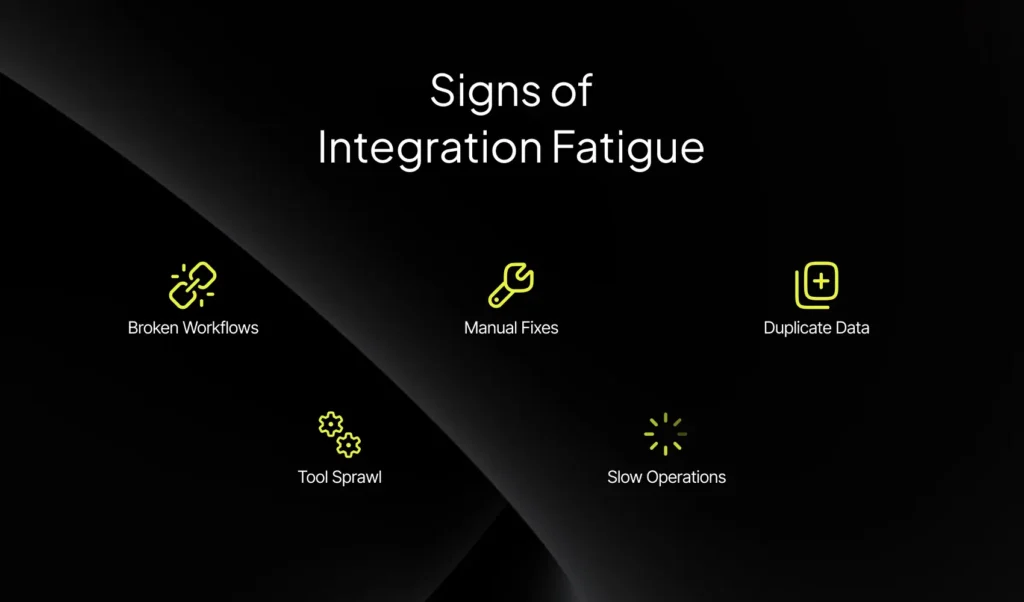
Integration fatigue is not something fancy; this is a real struggle for the teams whenever they are trying to work with apps while dealing with the information there. However, businesses had attempted to fix this, but the introduction of marketing platforms, analytical dashboards, and other apps makes it even harder to manage.
The real problem appears when these tools begin to behave differently than expected. Teams have to spend time fixing problems instead of doing actual work, and IT departments get stretched thin because they are always reacting to something breaking again.
Here are a few signs that show a business is struggling with integration fatigue:
- Teams waste hours jumping between apps because nothing feels connected the way it should.
- Data in reports does not match what is shown in the original system.
- API changes from third-party tools break important workflows and force emergency fixes.
- Manual work becomes the default solution because automated workflows stop working.
- Security becomes harder to manage because every new tool increases the number of risks.
Employees start losing confidence in their systems if all this stuff happens again. Leaders also begin to question the data reliability, and teams end up feeling frustrated because they are not able to simplify the work process. This, in return drains productivity and creates unnecessary pressure across the entire organization.
A thoughtful approach to integration can change this experience completely, and this is where custom software begins to show its real value.
Why Off-The-Shelf Tools Make Integration Problems Worse?
Usually, companies begin with ready-made software as they find it affordable and quick, but they are not compatible with other tools and start causing problems. Since every tool follows its unique pattern of operation, results in causing troubles.
Take a look at the problem in a simplified manner.
| Challenge | Causes | Issues |
| Limited APIs | Vendors are deciding the type of data you can access | Missing workfield, blocked workflows |
| Version Mismatched | Every tool have different update time | Integrations break without warnings |
| Data format conflicts | Tools are designed with different architectures | Extra cleanup and manual work |
| Vendor Restrictions | There are a few reserved features that can’t be altered | Teams depend on vendor timelines |
| Extra security risks | More tools mean different access points | Compliance is harder with more vulnerabilities |
Off-the-shelf tools work well when a business is small and is more connected. Custom software takes away the stress of handling multiple tools and gives companies a system built around their real needs. Instead of relying on temporary solutions, teams get a stable setup that can grow with the business and adjust to new goals.
How Custom Software Removes API Overload and Makes Systems Work Together?
Businesses grow with multiple tools, which often fail to communicate well with each other and affect the entire workflow. The custom software offers a unified system to fit exactly with the company’s needs to serve them better.
Here’s how custom software reduces complexity:
- A custom platform creates a single source of truth, which means information is stored in one organized structure to allow teams to find accurate data without switching between multiple tools.
- Developers can design APIs that match exactly how your business works, so systems exchange information smoothly instead of relying on limited and generic third-party connections.
- Companies can manage approvals and reporting with automation that lives inside one unified system.
- As your company grows, custom software lets you add new features, connect new partners, or build new modules without starting from scratch.
Custom software removes the pressure of managing dozens of tools and gives companies a system that works the way they need it to.
Still Fighting Broken Integrations?
The Real Cost of Integration Fatigue
Many companies do not realize how much time and money they lose every day simply because their systems do not talk to each other smoothly. These small delays grow into a much bigger problem known as integration fatigue.
The Hidden Costs of Integration Fatigue
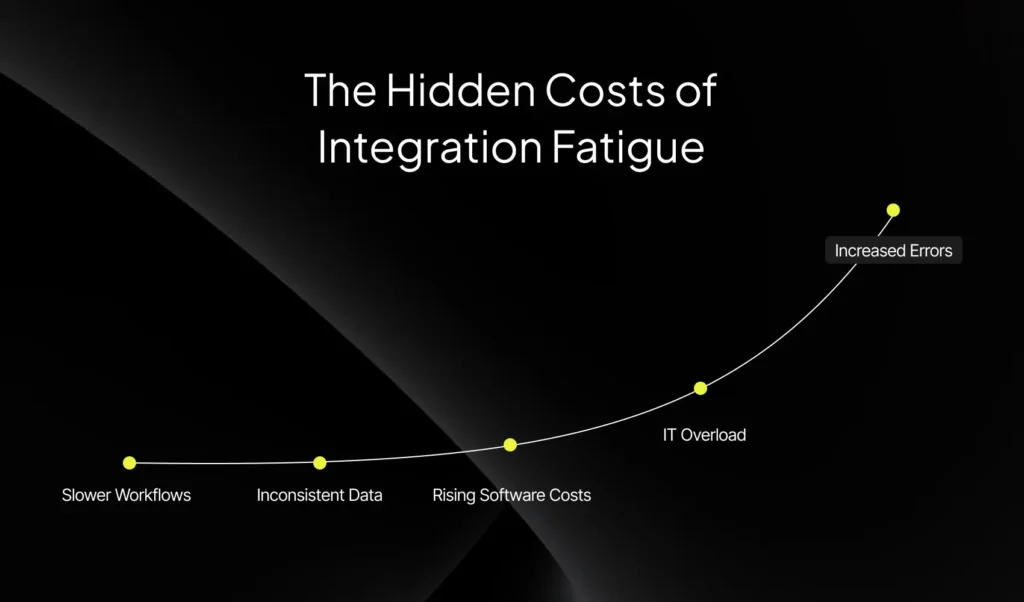
Businesses often feel integration fatigue in ways they do not expect. It affects productivity, accuracy, and even team morale. Some of the most common issues include:
- Slower Workflows: Teams spend extra time switching between apps and managing data instead of focusing on valuable work.
- Inconsistent Data: When tools process information differently, reports become unreliable and employees must double-check everything.
- Growing Subscription Bills: Adding more tools to fix old problems increases monthly costs and creates even more complexity.
- Increased IT Pressure: IT teams deal with constant maintenance, broken APIs, and updates that cause unexpected failures.
- Higher Risk of Mistakes: More tools mean more room for human error, which affects decisions and customer experience.
These problems drain energy and resources without companies even noticing how much it slows them down.
How Custom Software Helps Reduce These Costs
Custom software offers a clear way out by creating one connected system that supports the entire workflow. They also eliminate unnecessary app subscriptions and reduce the number of tools IT teams need to maintain.
Some key benefits include:
- One unified system that keeps everything connected: Employees no longer jump between apps because all their tools live in one place.
- Cleaner and more reliable data: The system follows one standard for storing and sharing information, which improves accuracy.
- Lower long-term costs: Companies avoid paying for tools they do not need and gain complete control over upgrades and maintenance.
- Stronger security with fewer tools to protect: Data is easier to secure, and access control becomes more effective with a single platform.
- Better team productivity and smoother decisions: Workflows become faster and more consistent when technology stops getting in the way.
Why is Integration Fatigue Getting Worse?
Businesses are adopting new tools faster than ever, but most of them are not built to work together. SaaS apps update frequently, APIs change without warning, and companies end up managing a digital ecosystem that grows more complex every month. A typical team now handles dozens of platforms, each with its own data rules, workflows, and security standards.
This rapid expansion makes it difficult to keep systems stable. Even a small update in one tool can break a connection in another, and teams must spend hours fixing issues instead of focusing on core work. As the number of tools increases, so does the pressure on IT teams, who struggle to maintain integrations that were never designed to scale. This is why integration fatigue continues to rise across modern companies.
Mini Real-World Examples of Integration Fatigue
In many companies, the tools were supposed to make life easier, but instead they added hidden friction. Below are three real-world snapshots showing what happens when multiple systems don’t talk cleanly.
1. Duplicate Customer Records in a Global Retailer
A large retailer linked its eCommerce platform, POS, and CRM, but lacked a unified data model. Duplicate customer profiles proliferated, making segmentation and marketing inaccurate. This kind of data-silo issue is a key challenge of enterprise integration.
2. API Versioning Chaos in a Financial Firm
In a finance company migrating to microservices and APIs, one service changed its API contract. Dependent systems failed silently, and workflows broke during peak hours. Research shows that API evolution is a major integration challenge in microservice architectures.
3. Tool Sprawl in a Mid-Size Tech Company
A tech firm used more than 30 individual SaaS tools, many overlapping in functionality. Each update triggered “small breakages” in integrations, causing the IT team to spend hours on firefighting instead of innovation. This mirrors what research on enterprise application integration calls “islands of automation
Most companies reach a point where integrations start breaking more often than they work. At that stage, the real question becomes simple: do you keep patching together off-the-shelf connectors or switch to custom integrations designed around your workflow?
A Quick Comparison: Custom Integrations vs Plug-and-Play Tools. Here’s a quick side-by-side view to make that choice clearer.
| Criteria | Off-the-Shelf Integrations | Custom Integrations |
| Best For | Standard, predictable workflows | Complex, business-specific workflows |
| Speed | Very fast to set up | Takes longer to build |
| Flexibility | Limited to vendor rules | Fully adaptable to your processes |
| Scalability | Breaks under high data volume or unique logic | Designed to grow with your system |
| Maintenance | Dependent on external vendor updates | Fully controlled internally |
| Security & Compliance | Breaks under high data volume or unique logic | Cheap at first, but costly as connectors fail |
| Risk | Dependent on external vendor updates | Fully controlled internally |
| Maintenance | Dependent on external vendor updates | Fully controlled internally |
| Long term cost | Cheap at first but costly as connectors fail | Higher upfront, lower long-term cost |
What Does Smooth Integration Actually Look Like?
- Everything works in the background without teams noticing it.
- Work feels faster because systems finally move information the way they should.
Data stays consistent across every tool when integrations run smoothly. Your CRM, billing system, and reports all show the same information because they pull from one reliable structure. Teams no longer deal with mismatched numbers or outdated records.
Manual work also disappears as there are no exporting spreadsheets and no re-entering fields. Information updates automatically, which gives employees more time for meaningful tasks.
Another clear sign of smooth integration is real-time data flow. Inventory changes, customer updates, ticket statuses, and analytics refresh instantly, so decisions are made on accurate information instead of outdated snapshots.
Workflows stay stable, too. Approvals, notifications, routing, and automations continue to run quietly in the background even as the business grows. Teams don’t think about the process; they just see it working.
Security also becomes easier because access, policies, and monitoring sit inside one system instead of being spread across many tools. This reduces risks and lowers the burden on IT.
When all these elements work together, integration stops being a headache and becomes a strong foundation for better productivity and smoother operations.
The Real Cost of Integration Fatigue
Integration fatigue usually starts quietly. One extra tool here, one manual step there… and suddenly your team is juggling a tech stack that works against them.
Most companies don’t realize how expensive this becomes until the numbers show up on the balance sheet.
A Harvard Business Review study found that employees lose over 3 hours every day just moving between apps that refuse to work together. McKinsey adds another layer to the problem: teams spend 30% of their week searching for information that should’ve been one click away.
And the bigger the company, the deeper the hole. This isn’t just annoying, but it’s expensive. Disconnected systems force companies to hire extra people to do tasks automation should handle. They slow down decision-making. They introduce errors. Forbes estimates that these inefficiencies can eat up 20–30% of a company’s annual revenue.
Integration fatigue isn’t about tools. It’s about lost time, lost focus, and lost money, every single day.
Your Systems Should Work Together and Not Against You
Every business eventually reaches a point where disconnected tools stop being a minor irritation and start becoming a real growth blocker. The more apps you add, the more manual work, delays, and mistakes creep in, and that’s when integration fatigue becomes impossible to ignore.
The companies that scale smoothly aren’t the ones with the most tools. They’re the ones with systems that communicate, data that moves freely, and workflows that don’t break every time a new platform is added.
This is exactly why many teams partner with Imenso Software. Not to replace everything they already use, but to make their tech stack work as one, whether through custom integrations, modernizing outdated systems, or building new solutions that fit perfectly into the existing setup.
When integration works, teams move faster. Decisions come sooner. Customer experience gets better. And growth stops feeling like a struggle.
Smooth integration isn’t just an IT win. It’s a business win and one that compounds over time.
Ready to Replace Chaos with Control?


Similar Posts
Top 10 User Design Strategies Of 2021 To Reduce Bounce Rate
If we have a look at the past decade, we can see how far the digital marketing domain has come. Every single business is making the best use of this technology in boosting its growth. In a field which is expanding at a high rate, it becomes important to keep a check on the upcoming […]...

Deeply Bound to Produce Qualitative IT Products, Imenso Software Justifies Why their Customers Trust their Products: GoodFirms
When client-centric development solutions are needed, Imenso Software always stays on top to serve its customers. Jimmy Kamboj, the founder and CEO of Imenso Software, shares its transformation story with us from a small enterprise to a top IT service provider. Specialized in delivering hi-tech solutions through its unique consultative approach, Imenso Software was established […]...
![Generative AI Use Cases for Business: Marketing & Operations Guide [2026]](https://www.imensosoftware.com/wp-content/uploads/2026/08/Blog-5-Aug-Gen-AI-in-bness-1.jpg)
Generative AI Use Cases for Business: Marketing & Operations Guide [2026]
Key Takeaways Generative AI (GenAI) is a type of artificial intelligence that can create content. It can write text and generate images, and even produce code. It learns from large amounts of data and then creates new outputs based on that learning. Businesses are adopting it quickly for three main reasons. It reduces costs. It […]...