Data Engineering for Regulated Industries: Compliance, Traceability & Auditability
Regulated industries cannot treat data engineering as a background technical task. It shapes how data is collected, processed, stored, and trusted. In highly regulated environments, this directly affects:
- Risk
- Compliance, and
- Business continuity.
Compliance is a data architecture problem. If systems are not designed for traceability, auditability, and control, no policy document can fix the gaps later. This is why data engineering for regulated industries must start with compliance at the core.
Many organizations still follow a reactive model. They build systems first and add controls later. This creates fragile pipelines and manual processes. Compliance-by-design changes this model. It embeds governance rules, access controls, lineage tracking, and validation logic directly into the data engineering layer.
Legacy pipelines increase risk in regulated environments. They often lack proper logging, version control, and lineage visibility. Data flows become hard to track. Changes become risky. Audits become slow and expensive.
Weak traceability and poor auditability hurt the business. Teams lose trust in reports. Decisions get delayed. Regulatory reviews take longer. Operational costs rise. Customer confidence drops.
This is why modern organizations now invest in compliance-first data engineering services. They rely on data engineering experts and data engineering consulting services to build governance-driven platforms that support scale, control, and trust from day one.
What Makes Regulated Data Engineering Fundamentally Different?
Data engineering for regulated industries follows a different logic. Generic data engineering focuses on movement and scale. Regulated data engineering focuses on structure and proof. Both move data. But only one can survive audits, legal reviews, and regulatory inspections.
Why regulated industries need different engineering models
Regulated sectors face rules that shape system design. These rules come from financial laws, healthcare regulations, data privacy acts, and industry standards. Engineering teams must design systems that can prove compliance at any time.
This changes priorities. Performance and scalability still matters. But governance becomes equal to reliability and availability.
Data as a regulated asset
In regulated environments, data is not just information. It is a controlled asset and has ownership rules. It has access limits and retention timelines. Most importantly, it has legal accountability.
This means data engineering services must treat data like regulated infrastructure, not raw material.
Compliance as a non-functional requirement
Compliance works like security and availability. It is a system property.
Systems must always:
- Enforce access rules automatically.
- Track data movement across systems.
- Store proof of transformations.
- Maintain clear ownership and accountability.
Regulatory pressure vs scalability pressure
Standard systems focus on scale pressure. They optimize for volume, speed, and flexibility.
Regulated systems face regulatory pressure. They must prove control, stability, and reliability before scale even matters.
This creates design trade-offs. Sometimes slower systems are safer. Sometimes rigid structures are better than flexible ones.
Engineering constraints unique to regulated environments
Regulated systems operate under constraints that normal systems do not face:
- Data models must be stable and predictable.
- Changes must be controlled and logged.
- Access must follow policy rules, not team preferences.
- Pipelines must be explainable, not just functional.
- Data lineage must be visible end to end.
This is why data engineering experts in regulated industries focus more on structure than speed.
Standard data engineering vs regulated data engineering
This comparison shows the structural difference clearly:
| Standard data engineering | Regulated data engineering |
| Speed-first pipelines | Compliance-first pipelines |
| Schema evolution | Controlled schema governance |
| Best-effort lineage | Mandatory lineage |
| Optional governance | Enforced governance |
| Access after ingestion | Policy before ingestion |
| Reactive audits | Continuous audit readiness |
End-to-End Architecture for Regulated Data Engineering
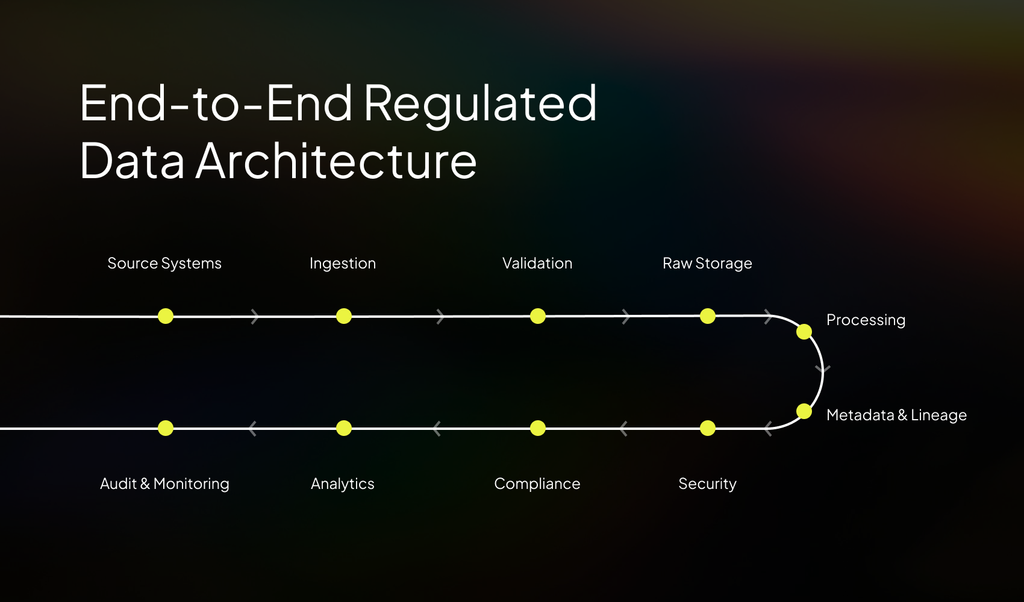
This architecture shows how data engineering for regulated industries must work as a full system. Each layer has a clear role. Each layer supports compliance, governance, and control.
This structure is used by mature data engineering services to build platforms that can scale and pass audits without chaos.
Source Systems Layer
This is where data originates. It includes business systems, devices, platforms, and external data providers. This layer must focus on structure and reliability.
Key responsibilities:
- Define trusted data sources.
- Classify data types at the source.
- Tag sensitive and regulated fields early.
- Enforce ownership and accountability.
Ingestion Layer (Streaming + Batch)
This layer moves data into the platform in real time and scheduled flows. This layer must ensure controlled movement. It is the first compliance checkpoint.
Core controls:
- Schema validation before ingestion.
- Identity verification of source systems.
- Secure transport protocols.
- Logging of every ingestion event.
Validation & Policy Enforcement Layer
This layer applies rules before data is accepted. It acts as a compliance filter. If data fails checks, it does not enter the platform. This prevents compliance risk from spreading downstream.
This layer focuses on:
- Data quality checks.
- Format validation.
- Policy rules.
- Regulatory constraints.
Immutable Raw Storage Layer
This layer stores original data in its raw form. Data is never overwritten here. This layer creates a permanent source of truth.
Immutable raw storage layer supports:
- Legal traceability.
- Historical reconstruction.
- Forensic audits.
- Regulatory investigations.
Governed Processing Layer
This layer transforms data for business use. All transformations follow controlled rules. It prevents uncontrolled data manipulation.
This layer includes:
- Approved transformation logic.
- Version-controlled pipelines.
- Standardized data models.
- Controlled schema changes.
Metadata & Lineage Layer
This layer tracks data meaning and movement. It creates visibility across the platform. The layer supports audit readiness and operational clarity.
Metadata & lineage layer provides:
- Data definitions.
- Source-to-target lineage.
- Transformation history.
- Ownership mapping.
Security & Access Layer
This layer controls who can see and use data. Access is policy-driven, not manual. This protects regulated data from misuse.
This layer enforces:
- Role-based access control.
- Attribute-based access rules.
- Encryption at rest and in transit.
- Identity-based permissions.
Compliance Control Layer
This layer applies regulatory logic. It maps laws and standards into system rules. This converts legal requirements into technical controls.
Compliance control layer manages:
- Retention policies.
- Data residency rules.
- Consent management.
- Regulatory reporting structures.
Analytics & Reporting Layer
This layer delivers business value. It provides trusted insights for decisions.
This layer ensures:
- Certified datasets only.
- Approved data models.
- Controlled access to reports.
- Traceable data sources.
Audit & Monitoring Layer
This layer ensures continuous oversight. It supports internal and external audits for continuous audit readiness.
This layer tracks:
- Data access logs.
- Policy violations.
- Pipeline failures.
- Compliance exceptions.
End-to-end data flow explanation
Data flows through structured control points. Every step is traceable.
Flow sequence is as follows:
- Data enters from source systems.
- The ingestion layer moves it securely.
- The validation layer checks compliance rules.
- Raw storage stores original data.
- The processing layer transforms it safely.
- The metadata layer tracks meaning and movement.
- The security layer controls access.
- The compliance layer enforces regulations.
- The analytics layer enables usage.
- The audit layer monitors everything.
Control points in the architecture
These are the system checkpoints where risk is managed:
- Ingestion validation gates.
- Policy enforcement rules.
- Access control boundaries.
- Transformation approvals.
- Governance checkpoints.
- Audit logging systems.
Compliance checkpoints
These points enforce regulatory safety:
- Before ingestion.
- Before transformation.
- Before access.
- Before reporting.
- Before data sharing.
Governance enforcement zones
Governance is a layered structure that creates system-wide accountability.
Governance zones include:
- Data entry governance.
- Processing governance.
- Access governance.
- Usage governance.
- Retention governance.
Traceability: Engineering for Full Data Lineage
Traceability is the backbone of data engineering for regulated industries. It shows where data comes from, how it moves, and how it changes. Without lineage, systems cannot prove trust, control, or compliance.
Traceability is not documentation. It is a living system capability. It must work in real time, automatically and across platforms.
Technical lineage vs business lineage
Both forms of lineage matter, but they solve different problems. Technical lineage tracks system movement:
- Source systems.
- Pipelines.
- Transformations.
- Storage layers.
- Output systems.
Business lineage tracks meaning:
- Business definitions.
- KPI calculations.
- Reporting logic.
- Regulatory mappings.
- Ownership relationships.
System lineage vs process lineage
These two layers explain different dimensions of flow. System lineage shows infrastructure flow:
- Platform to platform movement.
- Service dependencies.
- Data pipeline connections.
- Storage transitions.
Process lineage shows operational flow:
- Business workflows.
- Approval steps.
- Data handoffs.
- Manual interventions.
- Automated triggers.
Metadata-driven lineage
Metadata is the foundation of traceability. When metadata drives lineage, systems stay accurate even when pipelines change. So, lineage systems must be built on metadata, not manual mapping.
Metadata includes:
- Field definitions.
- Data classifications.
- Sensitivity labels.
- Ownership tags.
- Regulatory flags.
Versioned transformations
Every data change must be versioned. This includes:
- Transformation logic.
- Business rules.
- Data models.
- Schema definitions.
- Pipeline configurations.
Versioning allows:
- Rollbacks.
- Audit reconstruction.
- Historical comparisons.
- Regulatory verification.
Pipeline observability
Lineage must be observable. Teams must see what is happening in real time.
This includes:
- Pipeline health status.
- Data freshness tracking.
- Failure points.
- Processing delays.
- Data quality alerts.
Impact analysis
Lineage enables safe change.
When teams change a field, table, or rule, they must see the impact.
Impact analysis supports:
- Dependency mapping.
- Risk evaluation.
- Controlled releases.
- Safe deployments.
- Compliance protection.
Forensic traceability
Forensic traceability supports investigations. It allows teams to:
- Reconstruct historical states.
- Track access events.
- Trace data misuse.
- Identify control failures.
- Support regulatory inquiries.
Why lineage must be automated
Manual lineage fails at scale. Automation ensures:
- Consistency
- Accuracy
- Real-time updates
- System reliability
- Audit readiness.
Why lineage must be visual
Visual lineage enables understanding. It helps:
- Engineers debug faster.
- Compliance teams review controls.
- Auditors verify flows.
- Business users trust reports.
- Leaders assess risk.
Traceability is not optional in regulated systems. It is infrastructure. Data engineering services must treat lineage as a core platform layer. This is how regulated platforms maintain trust, control, and long-term compliance.
Auditability: Building Always-Ready Compliance Systems
In regulated environments, systems must always be ready for review. This is the foundation of data engineering for regulated industries.
Traditional audits depend on preparation. Modern systems depend on structure. Always-ready compliance means the system itself produces proof.
Continuous audit readiness model
This model treats audits as continuous, not periodic. It works because systems collect evidence in real time.
Core elements of this model:
- Automated logging across all layers.
- Real-time control validation.
- Continuous monitoring.
- Structured evidence storage.
- Live compliance dashboards.
This removes the panic cycle before audits.
A report from the National Institute of Standards and Technology highlights that continuous monitoring improves security posture and compliance reliability. It does this by enabling ongoing control validation instead of periodic checks. This supports the idea that compliance must be system-driven, not event-driven.
Audit-by-design vs audit-by-process
These two models create very different systems. Audit-by-process relies on:
- Manual documentation.
- Periodic reviews.
- Spreadsheet tracking.
- Human validation.
- After-the-fact reporting.
Audit-by-design relies on:
- Automated controls.
- System-generated evidence.
- Built-in compliance rules.
- Continuous validation.
- Real-time visibility.
Immutable evidence layers
Evidence must not change. Immutable layers store proof in its original form.
This includes:
- Ingestion records.
- Raw datasets.
- Access logs.
- Transformation records.
- Policy decisions.
Data access logs
Access must always be traceable. They prevents silent misuse.
These logs show:
- Who accessed data.
- When access happened.
- What data was accessed.
- Why access was granted.
- How access was approved.
Transformation logs
All data changes must be recorded. This enables reconstruction of data states.
These logs track:
- Transformation logic.
- Pipeline versions.
- Processing timestamps.
- Data outputs.
- Error handling actions.
Policy enforcement logs
Compliance rules must leave evidence. This proves that controls were applied.
These logs record:
- Policy checks.
- Rule evaluations.
- Approval decisions.
- Rejection events.
- Exception handling.
Model governance logs
Models must also be auditable.
These logs cover:
- Training data sources.
- Model versions.
- Approval workflows.
- Deployment dates.
- Performance monitoring.
Regulatory reporting traceability
Reports must be traceable to source data. Every reported number must have a data trail.
Traceability ensures:
- Source verification.
- Transformation transparency.
- Rule validation.
- Calculation proof.
- Reporting accuracy.
Build a Compliance-Ready Data Platform
Governance as Code: Automating Compliance in Data Engineering
Modern data platforms cannot rely on manuals and checklists. They must rely on systems. Governance as code turns compliance into software logic. It makes rules executable, not descriptive. Data engineering services use it to build scalable platforms. This is how regulated platforms move from manual compliance to automated compliance.
Policy-as-code
Policy-as-code converts written policies into system rules. Instead of documents, platforms use logic.
This means:
- Rules are machine-readable.
- Enforcement is automatic.
- Violations are detected instantly.
- Changes are version-controlled.
- Policies are auditable.
Governance-as-code
Governance-as-code embeds control into pipelines. Governance becomes part of system design.
This includes:
- Pipeline approval rules.
- Schema governance logic.
- Access governance controls.
- Change management workflows.
- Validation automation.
Compliance-as-code
Compliance rules become technical controls. Data engineering experts use it to reduce risk and complexity. Regulations are translated into system logic.
This allows systems to:
- Enforce data residency.
- Manage consent rules.
- Control sensitive fields.
- Apply regulatory limits.
- Generate compliance evidence.
Metadata-driven enforcement
Metadata becomes the control layer. Systems use metadata to decide actions.
This includes:
- Sensitivity tags.
- Regulatory labels.
- Ownership markers.
- Retention flags.
- Classification rules.
Automated classification
Classification must be automatic at scale. Systems classify data using rules and patterns. This prevents human error in data handling.
It supports:
- Personal data detection.
- Regulated field identification.
- Sensitivity labeling.
- Risk categorization.
- Policy mapping.
Automated access control
Access must follow policy logic. Access decisions are rule-based.They ensures:
- Role-based access.
- Attribute-based control.
- Purpose-based restrictions.
- Time-bound permissions.
- Audit traceability.
Automated retention
Retention rules must run automatically. Systems enforce lifecycle policies. This prevents over-retention and under-retention risks.
It includes:
- Retention schedules.
- Deletion rules.
- Archival policies.
- Legal hold controls.
- Compliance retention logs.
Automated reporting
Reporting must be system-driven. Compliance reports are generated from platform data.
This supports:
- Regulatory reporting.
- Audit reporting.
- Risk reporting.
- Compliance dashboards.
- Governance metrics.
Security Architecture for Regulated Data Platforms
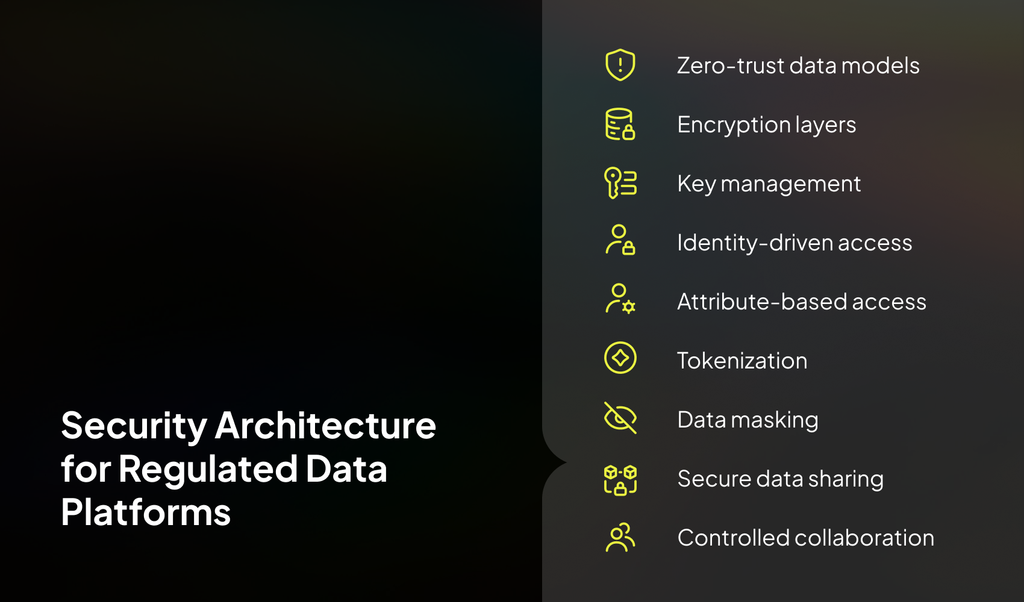
In regulated environments, security architecture defines trust, safety, and compliance. Data engineering for regulated industries requires security to be built into every layer. This is how modern data engineering consulting services build secure, compliant platforms.
Zero-trust data models
Zero trust means no default access. Every request must be verified and every action must be validated.
This model assumes:
- No trusted networks.
- No trusted users.
- No trusted systems by default.
- No permanent access rights.
Encryption layers
Encryption must exist everywhere. This includes:
- Encryption in transit.
- Encryption at rest.
- Encryption during processing.
- Encryption in backups.
- Encryption in archives.
Key management
Encryption only works with strong key control. It prevents unauthorized decryption.
Key management systems must:
- Separate keys from data.
- Control key access.
- Rotate keys regularly.
- Log key usage.
- Support audit reviews.
Identity-driven access
Access must follow identity. Every user and system has a verifiable identity.
This enables:
- Strong authentication.
- Identity verification.
- Access traceability.
- Accountability.
- Audit readiness.
Attribute-based access
Access must consider context. Decisions use attributes, not just roles.
This includes:
- User role.
- Data sensitivity.
- Access purpose.
- Regulatory classification.
- Risk level.
Tokenization
Tokenization replaces sensitive data with safe values. Real data stays protected.
This supports:
- Privacy protection.
- Secure processing.
- Compliance control.
- Data sharing safety.
- Reduced breach impact.
Data masking
Masking limits visibility without removing data. This protects sensitive information in non-production use.
This enables:
- Safe testing.
- Secure analytics.
- Controlled reporting.
- Regulated access.
- Development safety.
Secure data sharing
Sharing must be controlled and auditable. Secure sharing features that prevents uncontrolled data spread are:
- Access approval workflows.
- Policy validation.
- Encryption controls.
- Identity verification.
- Usage monitoring.
Controlled collaboration
Collaboration must not break governance. Controlled collaboration means:
- Shared access rules.
- Scoped permissions.
- Project-level controls.
- Data boundary enforcement.
- Audit tracking.
Regulated Industry Use Cases
Data engineering for regulated industries looks different in every sector. Each industry has unique rules, risks, and controls. But the engineering pattern stays consistent: control first, scale second. Below are real-world structures used by data engineering experts across regulated sectors.
Banking & Financial Services
Regulatory challenge
Banks must meet strict rules on data privacy, reporting, risk control, and auditability. Regulations require full traceability and controlled access.
Engineering challenge
Systems must handle high data volumes while maintaining strict governance. Legacy platforms often lack lineage and access control.
Architecture solution
- Immutable raw data layers.
- Policy-driven ingestion.
- Real-time monitoring pipelines.
- Secure analytics zones.
Governance model
- Role-based and attribute-based access.
- Automated data classification.
- Metadata-driven controls.
- Continuous audit logging.
Compliance outcome
Banks achieve real-time audit readiness, controlled reporting, and traceable financial data flows.
Healthcare & Life Sciences
Regulatory challenge
Healthcare data must follow strict privacy, consent, and security rules. Patient data must be protected at all times.
Engineering challenge
Data comes from many systems. Formats differ and sensitivity levels vary. Manual controls do not scale.
Architecture solution
- Secure ingestion pipelines.
- Encrypted storage layers.
- Tokenized sensitive fields.
- Controlled analytics access.
Governance model
- Consent-based access control.
- Automated classification.
- Retention automation.
- Policy-as-code enforcement.
Compliance outcome
Organizations achieve secure data use without blocking research, analytics, and care delivery.
Government & Public Sector
Regulatory challenge
Public data must follow transparency rules, privacy laws, and security mandates. Accountability is mandatory.
Engineering challenge
Data silos, outdated systems, and fragmented ownership create risk and inefficiency.
Architecture solution
- Centralized data platforms.
- Controlled data sharing layers.
- Secure integration frameworks.
- Unified metadata systems.
Governance model
- Identity-based access.
- Data ownership models.
- Policy-driven workflows.
- Cross-agency governance.
Compliance outcome
Agencies gain secure collaboration, controlled transparency, and audit-ready systems.
Energy & Utilities
Regulatory challenge
Energy data must meet safety, reporting, and operational compliance rules. Infrastructure data is highly sensitive.
Engineering challenge
Data comes from operational systems, sensors, and control platforms. Reliability is critical.
Architecture solution
- Secure streaming pipelines.
- Real-time validation layers.
- Immutable operational logs.
- Segmented data zones.
Governance model
- Risk-based access control.
- Automated monitoring.
- Data lifecycle governance.
- Infrastructure security policies.
Compliance outcome
Organizations achieve safe operations, regulatory reporting, and system reliability.
Manufacturing & Aerospace
Regulatory challenge
Product data must meet quality, safety, and certification standards. Traceability is mandatory.
Engineering challenge
Complex supply chains and production systems create fragmented data flows.
Architecture solution
- End-to-end traceability pipelines.
- Controlled production data layers.
- Secure partner data exchange.
- Versioned transformation systems.
Governance model
- Data ownership enforcement.
- Controlled collaboration models.
- Process lineage tracking.
- Compliance-driven workflows.
Compliance outcome
Companies gain full product traceability and regulatory proof across the lifecycle.
Telecom & Infrastructure
Regulatory challenge
Telecom data must follow privacy, data residency, and security regulations. Network data is highly sensitive.
Engineering challenge
Massive data volumes and real-time systems create high risk without automation.
Architecture solution
- Secure data ingestion.
- Policy-enforced storage.
- Encrypted processing layers.
- Controlled analytics platforms.
Governance model
- Automated access control.
- Metadata-driven governance.
- Retention automation.
- Continuous monitoring.
Compliance outcome
Operators achieve secure data usage, regulatory compliance, and scalable analytics.
KPIs for Regulated Data Engineering Success
These KPIs show whether data engineering for regulated industries is working in practice. This is how data engineering services track real success.
Core compliance and governance KPIs
These metrics focus on system readiness, control strength, and regulatory reliability:
| KPI | What it measures | Why it matters |
| Audit readiness time | Time needed to prepare for an audit | Shows if systems are always ready |
| Regulatory reporting time | Time to generate regulatory reports | Measures reporting efficiency |
| Compliance incident rate | Number of compliance breaches | Indicates risk exposure |
| Lineage coverage % | Data assets with full lineage | Shows traceability maturity |
| Metadata completeness % | Data assets with full metadata | Enables governance automation |
| Access violation rate | Unauthorized access attempts | Measures security effectiveness |
| Data quality score | Accuracy and consistency of data | Protects reporting trust |
| Retention compliance % | Data following retention rules | Prevents legal risk |
| Governance automation % | Controls handled automatically | Shows system maturity |
Conclusion
Data engineering for regulated industries is not just IT work. It is strategic infrastructure. It shapes how organizations grow, scale, and stay compliant. Strong data platforms reduce risk. They improve speed. They protect trust. They support growth without breaking rules.
Modern regulated systems are engineered for control, not chaos. They are designed for proof, not promises. This is why data engineering services now sit at the core of regulated transformation.
Imenso Software helps organizations build compliance-first data platforms. We:
- Design secure architectures.
- Embed governance into systems.
- Automate controls and reporting.
- Build traceable and auditable pipelines.
Our teams combine engineering depth with regulatory understanding. This helps businesses scale without risk. It helps compliance become part of the platform, not a manual task.
Strengthen Your Data Compliance Strategy


Similar Posts

Why Modern Data Engineering is the Backbone of Digital Transformation
Modern data engineering is the backbone of digital transformation because clean and reliable data is the lifeline of every digital system. Every digital product needs it to deliver real results. Without it, transformation stays stuck at the surface level. Apps look modern, but decisions stay slow. Tools multiply, but insight stays shallow. That is the […]...
Top ETL Tools for Data Engineering: Ranked for Performance & Ease
Data is growing too fast for manual handling. Companies now deal with millions of events daily from apps, websites, and cloud systems. ETL tools solve this problem. They move, clean, and structure data automatically. Without ETL tools: Over a quarter of organizations lose more than $5 million annually due to poor data quality This is […]...
Data Engineering vs. Data Analytics: What Your Business Needs First
Data engineering and data analytics are often used together. But they are not the same. One prepares the data. The other uses it to make decisions. Many businesses struggle to decide where to invest first. Should you fix your data systems or start building reports? This guide gives you a clear answer to the one […]...