How Custom Software Supports Digital Transformation Without Disrupting Operations
Today, a business that does not evolve falls behind its peers. What’s the key to staying competitive?
Customized software development
There’s an ocean of difference between custom software and off-the-shelf solutions. Custom software is designed around
- Your existing systems
- Your existing processes
- Your people.
It is not a generic solution. Software custom development addresses and solves specific business challenges. In doing so, they drive operational efficiency and innovation. All this, in turn, allows a company to grow sustainably.
Understanding Digital Transformation in the US Startup Context
Digital transformation is not an option for U.S. startups. It is imperative for growth. Startups are often ‘digitally native.’ This only goes in their favor. They can benefit from their inherent agility to scale swiftly. means that
Digital transformation for U.S startups isn’t about just adopting new technology. In reality, it’s a continuous process of strategic renewal. It uses digital advancements to general new value propositions and models of operation.
What Drives Digital Transformation in the U.S
There are many drivers of digital transformation in the U.S. These include:
Evolving Customer Expectations
Modern customers want fluid experiences from businesses. They demand personalized and on-demand interactions. In such a scenario, adopting digital solutions is essential for startups. They must use mobile apps, e-commerce platforms, and AI chatbots, which all help them meet customer needs.
Competitive Pressure and Market Disruption
Tech-savvy startups dominate the US market. These businesses are swiftly using digital technology to create novel business models. In order to differentiate themselves, new startups have no option other than to use advanced technology to forge ahead of others.
Operational Efficiency and Cost Optimization
Startups usually work with limited resources. Being efficient is thus imperative to their growth. Digital tools like cloud computing and automation simplify internal processes. These include those like payroll, customer service, among others. This, in turn, lowers manual errors. Staff can then focus on mission-critical tasks. All of this cuts costs and enhances productivity.
Scalability and Agility
Cloud computing offers scalable and flexible infrastructure for startups to swiftly expand. They do not need to invest heavily in physical IT architecture. This imbues startups with agility. They can quickly test new ideas and scale operations.
Data-Driven Decision Making
We live in an era of data overload. The ability to gather, assess and act on volumes of data is key driver of custom solutions. Software with advanced analytics and machine learning features offers precious insights into customer behavior. This, in turn, enables founders to make strategic decisions related to their services.
Security and Regulatory Compliance
With the expansion in digital operations, cybersecurity risks also increase. The business should also adhere to regulatory requirements. Custom software with strong security and compliance features helps businesses protect confidential data. It helps them maintain customer trust and avoid legal penalties.
Why Custom Software is a Safer Choice for Transformation
Custom software is a safe choice for transformation because it offers:
- Precise alignment with distinct business processes
- Improved security measures
- Greater scalability
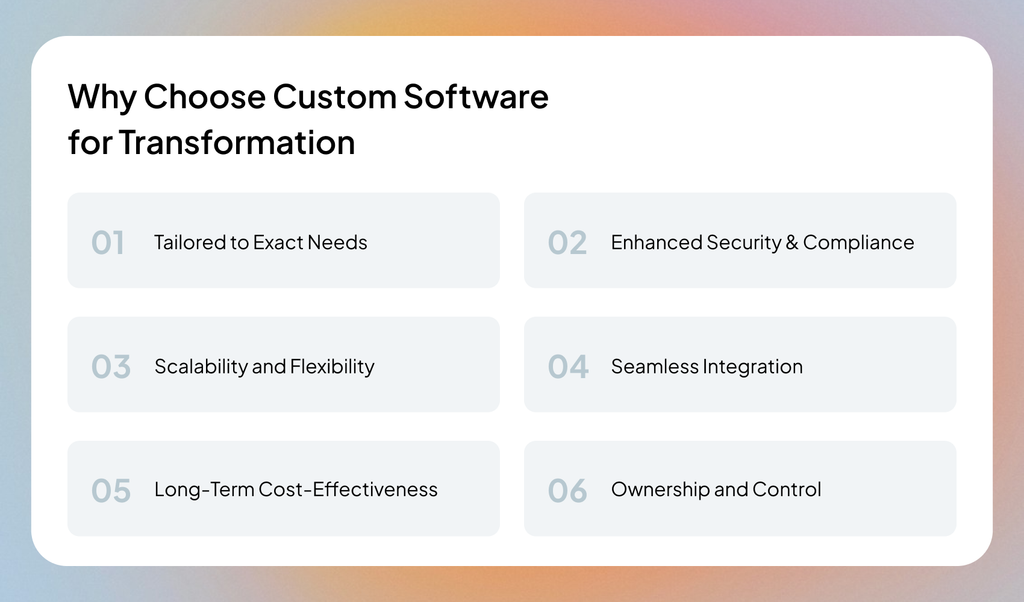
Key Reasons for Choosing Custom Software for Transformation
Tailored to Exact Needs
Off-the-shelf software is designed with a broad market in mind. This type of solution forces startups to adapt their processes to the software’s confines. Custom healthcare software development and those for other sectors are built from scratch. It means that it is designed to fluidly fit into a business’s specific workflows. It automates unique processes and removes inefficiencies.
Enhanced Security & Compliance
Generic solutions are highly prone to security breaches. This is because everyone knows of its loopholes. Custom software is built with specific security rules. They have encryption and access controls tailored to your data’s sensitivity. It conforms to industry-specific regulations. Thus, it majorly reduces the possibilities of breaches.
Scalability and Flexibility
Software should adapt to growing business needs. Custom software has room for future expansion. It means that you can add new features, users and integrations fluidly. No need for a full system makeover. This prevents inadequate technology from limiting business growth.
Seamless Integration
Commercial software is often incompatible with current startups’ platforms. This, in turn generates data silos. Contarily, custom software development enables the solution to fluidly integrate with current platforms. It ensures a unified and efficient workflow.
Long-Term Cost-Effectiveness
Startups are often worried about the initial custom software development costs. While that may seem higher, the solution actually proves to be very cost-effective in the long-term. A custom solution:
- Removes recurring licensing fees
- Reduces the need for multiple disparate tools
- Improves overall efficiency
This translates into major savings over time. A Forrester study noted a 25% reduction in total cost of ownership over five years compared to commercial solutions.
Ownership and Control
With custom software, the right to intellectual property and source code lies with the business. Thus, it gives them full control over future updates. They also have total control over modifications and data policies. What does this mean? It means that ultimately, the business is not at the mercy of a third-party vendor suddenly discontinuing support.
How Custom Software Bridges Legacy Systems and Modern Needs
Custom software development fluidly closes the gap between old systems and new business needs. Here’s how:
APIs as Connectors
A custom software development team creates APIs, which are application programming interfaces. They function as translators. It means that they let the old platforms to ‘talk’ to new programs. This allows for real-time data sharing. It also makes automated workflows possible.
Modern Front-Ends (Portals)
A new web or mobile interface is built above the legacy platform. It pulls data and functionality from it. Thus, it offers a modern user experience. At the same time, the core system remains as is.
Gradual Modernization (Strangler Pattern)
Custom software has custom code. It incrementally replaces parts of the old system. This happens by using microservices. The process allows new features to be built. Slowly, the old structure can be unwinded.
Data Transformation & Management
Custom solutions clean, transform, and centralize data from silos within old systems. Thus, it makes it accessible for modern analytics and reporting.
Modernize Without Disrupting Operations
Core Benefits of Custom Software for Smooth Transformation
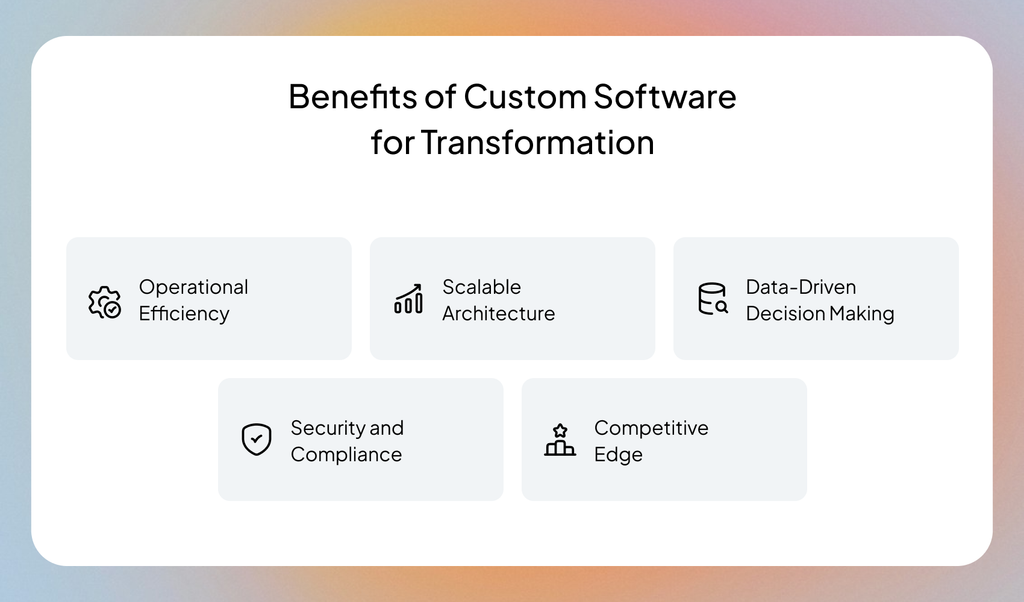
Custom software doesn’t just replace old systems. It enhances them. The benefits span operational, strategic, and competitive areas:
Operational Efficiency
Manual tasks are replaced with automated processes, saving time and reducing human error.
- Automate repetitive workflows like invoicing, inventory checks, or HR onboarding
- Real-time dashboards provide instant insights
- Reduce dependency on multiple disjointed tools
Scalable Architecture
Businesses evolve. Custom software grows with them.
- Add new modules without interrupting operations
- Scale server capacity and features based on demand
- Support expansion across cities or regions
Data-Driven Decision Making
Insights from real-time data help leaders act confidently without operational hiccups.
- Custom analytics tailored to business KPIs
- Visual dashboards that highlight key trends
- Predictive models for planning resources or marketing campaigns
Security and Compliance
Every industry has its regulations. Custom software ensures compliance while keeping operations stable.
- Tailored security protocols for sensitive data
- Audit trails for regulatory purposes
- Controlled access that prevents accidental disruptions
Competitive Edge
Unique software capabilities provide differentiation that off-the-shelf tools can’t.
- Customer experiences that feel personalized
- Proprietary tools that streamline core business functions
- Faster adoption of industry innovations
Implementing Custom Software Without Disruption
It’s one thing to talk about benefits. It’s another to implement software without causing chaos. Here’s how startups in the US can achieve it:
Strategic Planning & Development
- Define Scope & Goals
Before development, clearly outline your:
- Core objectives
- Success metrics
- Requirements
This prevents scope creep.
- Adopt Agile
Work in sprints. This allows you to deliver incremental updates. It enables continuous feedback and adaptation. Thus, it reduces risk.
- User-Centric Design
Involve those who will use the product early on. This ensures that the solution has an intuitive user interface and design. It also increases its adoption.
Integration & Data Migration
- Phased Rollout
Implement the platform in stages. For example, by function or department. Do not use the big-bang approach.
- Data Migration Plan
Map data fields and use encryption. Validate data integrity and schedule transfers when usage is low.
- API Integration
Use APIs for fluid connection with existing platforms. It also maintains operational continuity.
Testing & Training
- Thorough Testing (QA)
Perform unit testing and integration testing. They will catch bugs before the software arrives at the production phase.
- User Training
Offer intensive training and support materials to the users. Ask and address their concerns proactively.
Go-Live & Post-Launch
- Plan for Downtime
Plan go-live activities and big updates during low-demand hours.
- Monitor & Support
Monitor performance continuously. Collect feedback and maintain the platform for long-term success.
Choosing the Right Software Partner
A strong partner can make or break transformation efforts. Look for companies that:
- Have experience with custom healthcare software development and other industry solutions
- Offer expertise in system integration and scalable architecture
- Prioritize testing, QA, and user adoption support
- Provide long-term maintenance and continuous improvement
- Understands local challenges
Common Misconceptions About Custom Software
Myth 1: It Always Disrupts Operations
Custom software, when planned properly, integrates gradually and respects existing workflows.
Myth 2: Off-the-Shelf Is Safer
Generic solutions may be quick to deploy, but they rarely fit unique business needs and can create hidden operational risks.
Myth 3: It’s Too Expensive
While upfront custom software development pricing can be higher, the long-term savings in efficiency, scalability, and reduced errors often outweigh the initial investment.
The key is recognizing that digital transformation doesn’t have to mean chaos. With careful planning, phased implementation, and the right partner, businesses can automate, innovate, and scale without bringing day-to-day operations to a halt.
Wrapping up
Imagine a healthcare startup deploying a patient management system. Doctors, nurses, and admin staff can continue their routine work. At the same time, new digital tools gradually take over scheduling, reporting, and analytics. The transformation happens in the background, and staff barely notice the change until operations suddenly feel smoother. That’s the power of custom software done right. Imenso Software is a leading custom software development provider for startups in the U.S. We create solutions that fits existing systems and daily workflows. With strong experience in custom healthcare software development, secure integrations, and scalable builds, Imenso helps businesses modernize smoothly, grow faster, and avoid operational disruption.
Plan Your Digital Transformation
Similar Posts

How Many Developers Do I Need for a Startup?
20% of new ventures fail within the first two years. 45% of startups don’t survive the fifth year. 75% of new businesses in the U.S go out of business during the first 15 years. While this is happening, it’s also worth noting that Founders of startups like Pandora and Alibaba were able to create smashing […]...

AngularJS vs Angular 2 vs Angular 4 vs Angular 5 : The difference? Which one to use and when?
Starting from the launch way back in 2009 AngularJS has evolved over the years with Angular 2, Angular 4 and Angular 5 . Angular is now one of of the most popular front end javascript development framework for web and mobile applications. Although Angular 5 is the latest version launched in 2017, most of us […]...
Agile Development in Outsourced Teams: How It Really Works
The business environment today is highly volatile. A new trend emerging from nowhere can cause massive disruptions. Sticking to standard operating rules just doesn’t make sense. Today, there’s only one route to success: your ability to innovate and adapt. Software development outsourcing helps startups achieve exactly that. By giving you access to global talent, it […]...