Generative AI Use Cases Across Industries: Healthcare, FinTech, Retail, and More
Generative AI use cases now shape how products are built across healthcare, FinTech, retail, and many other industries.
Teams use it to move faster, learn sooner, and build products that respond better to real users.
This article explains
- How generative AI in product development works across industries
- Why companies adopt it, and
- How real decisions get made along the way.
The goal is to help teams decide where generative AI truly fits.
Generative AI Is No Longer a Side Project.
Not long ago, generative AI was confined to experimentation. That isn’t the case anymore. Now, major industries are becoming aware of its practical, high-ROI adoption. As a result, sectors like healthcare, FinTech and more are eagerly adopting it. The transition is most pronounced towards agentic AI. This technology can execute complex, multi-step tasks. It doesn’t just produce images or text. AI is a core tenet of work processes. GenAI:
- Increases efficiency
- Automates administration and
- Enhances personalization
What Are Generative AI Use Cases in Real Business Contexts?
A generative AI use case is not a tool demo. It is a real task inside a product or workflow where AI produces something useful.
In product development, that output might be a design draft, a feature suggestion, a test case, or a customer response. The value comes from speed and learning, not from replacing people.
Generative AI vs Traditional AI Use Cases
Traditional AI predicts outcomes. It answers questions like “What will happen next?”
Generative AI creates options. It answers “What could be built?” or “How could this look?”
That shift matters. Product teams rarely need more predictions alone. They need better starting points and faster iteration.
Why Use Cases Differ by Industry
Not all industries adopt generative AI in the same way. Three factors shape the use case:
- Data type
Text-heavy industries move faster. - Regulation
Healthcare and finance move with caution. - Customer expectations
Retail and SaaS focus on speed and experience.
Real Company Case Studies and Practical Examples
Seeing real companies use generative AI makes the impact easier to grasp. These are not pilots or lab tests. These are live systems used at scale, inside real products and workflows.
Healthcare: Generative AI in Real Clinical Work
Healthcare teams adopt generative AI where time pressure is highest.
At Kaiser Permanente, generative AI is used through Abridge to support clinical documentation. This platform is now being used in real settings. Almost 40 hospitals use the system. Abridge is an integral tenet in the workflows of over 600 medical offices. Doctors use it to summarize their discussions with patients. The system turns talks into structured notes. This has diminished documentation time by half. Now, doctors are able to give more of their time to patients. No longer are their working hours eaten by by typing after hours.
Mayo Clinic has committed over one billion dollars to AI initiatives. Generative systems support research, clinical workflows, and education. The focus stays on decision support, not automation of care. Doctors remain in control, but they move faster with better context.
Many hospitals also use Nuance DAX Copilot, now part of Microsoft. It listens during visits and drafts clinical notes automatically. Clinicians review and approve every entry. Burnout drops when paperwork shrinks.
Banking and Finance: High Accuracy, Clear Explanations
Banks move carefully. The cost of mistakes is high. Generative AI here supports people rather than replacing judgment.
At JPMorgan Chase, the COIN system reviews legal and financial documents. It saves officials from over 300,000 hours of pure manual labor. This figure is for each year this system is used. Lawyers still decide. AI just removes the grind.
Klarna integrated ChatGPT into customer support. The assistant handles common questions, order issues, and refunds. Support resolution time dropped, and customers get faster answers without waiting in queues.
Bloomberg built BloombergGPT, a 50-billion-parameter model trained on financial data. It helps with research, summaries, and analytics. The value comes from domain focus, not general conversation.
Retail and E-Commerce: Experience at Scale
Retail brands use generative AI to improve discovery and reduce friction.
Amazon launched Rufus, a shopping assistant inside its app. Customers ask questions like “Is this good for camping?” or “What fits a small kitchen?” Rufus answers using product data and reviews. Discovery feels more natural, especially on mobile.
At Stitch Fix, GenAI is doing a pretty creative task. They help in producing outfit combos. The main decisions still rest with stylists. But AI gives them a supporting hand by recommending combinations based on what’s viral. The pairings are also recommended based on tart audience preferences. This, in turn, quickens personalization. Simultaneously, the stylist supervision ensures that the human touch isn’t lost.
Zalando uses online try-on programs. These tools are AI-fueled. It allows shoppers to see whether the clothes will flatter their body type. The major positive outcome is that shoppers are able to better decide on what they want. When they buy something that fit them like a glove, they are less likely to return it.
Brands like H&M use chatbots to:
- Handle sizing
- Availability, and
- Order questions.
Store staff focus on customers who need real help.
Manufacturing: Faster Design, Fewer Failures
Manufacturing teams care about timelines, quality, and safety.
At Bosch, AI reduces development cycles dramatically. Tasks that once took years now finish in months. Engineers test ideas faster before committing to physical builds.
BMW uses generative design to create parts that are about 40% lighter and 20% stronger. AI proposes shapes humans might never sketch. Engineers test and approve the final design.
Rolls-Royce applies AI for predictive maintenance. Systems analyze engine data and predict failures before they happen. Planes stay in the air. Downtime drops. Safety improves.
Specific Tools and Platforms Used Across Industries
Generative AI becomes real when tools move from slides into daily work. These platforms show what companies actually use today. Each one supports a clear task inside product development, not vague experimentation.
Generative AI Tools by Industry
| Industry | Tool or Platform | What It Is Used For | Why Teams Choose It |
| Healthcare | Abridge | Clinical note summarization from patient conversations | Cuts documentation time and reduces clinician burnout |
| Healthcare | Nuance DAX | Ambient clinical documentation | Lets doctors focus on patients instead of typing |
| Healthcare | DeepScribe | AI medical scribe | Improves note accuracy with minimal workflow change |
| Healthcare | Suki | Voice-based clinical assistant | Fits naturally into busy clinical environments |
| Healthcare | Aidoc | AI-assisted medical imaging analysis | Flags risks early for faster diagnosis |
| Healthcare | Rad AI | Radiology reporting automation | Reduces reporting time while keeping accuracy |
| Healthcare | Insilico Medicine | Drug discovery and research modeling | Speeds up early-stage drug development |
| Banking | Microsoft Azure OpenAI | Secure generative AI services | Enterprise-grade compliance and scalability |
| Banking | BloombergGPT | Financial-domain language model | Trained on market and financial data |
| Banking | JPMorgan COIN | Contract and document analysis | Saves thousands of legal review hours |
| Retail | Amazon Rufus | In-app shopping assistant | Improves product discovery on mobile |
| Retail | ChatGPT plugins | Conversational shopping support | Answers product and order questions fast |
| Retail | Google Gemini | Search and shopping assistance | Connects browsing intent with product data |
| Manufacturing | Autodesk Fusion 360 | Generative design for parts | Creates lighter and stronger designs |
| Manufacturing | NVIDIA Omniverse | Factory and process simulation | Tests layouts before physical builds |
| Manufacturing | Google Vertex AI | Model training and deployment | Scales AI safely across teams |
| Manufacturing | AWS Lookout | Anomaly detection in operations | Prevents failures before downtime occurs |
Cross-Industry Use Cases That Apply Almost Everywhere
Some generative AI use cases appear in almost every product, no matter the industry. This happens because they solve basic problems that teams face every day. The difference is not what they do, but how they are integrated.
Conversational Interfaces That Actually Work
Conversational AI shows up in healthcare apps, banking platforms, retail sites, and internal tools. The key is architecture.
Most successful systems use retrieval-augmented generation (RAG). This means the AI does not rely on memory alone. It pulls answers from trusted sources like knowledge bases, product docs, or internal data before responding.
Good setups include:
- A searchable knowledge base
- Clear prompt rules
- Optional multimodal inputs like text and images
This pattern keeps answers accurate and reduces hallucinations. Without RAG, trust drops fast.
Synthetic Data for Safe Testing and Training
Real data is sensitive. Synthetic data fills the gap.
In healthcare, it supports HIPAA-compliant testing without exposing patient records. In finance, it helps with stress testing and rare event simulation. In software, it expands training data when real examples are limited.
Common tools include Mostly AI, Tonic AI, and SDV. These tools mirror patterns without copying real people.
Synthetic data works best when combined with clear validation rules. It should support real data, not replace it.
Code Generation and Developer Workflows
Code generation now appears in almost every development team.
Common patterns include:
- Drafting boilerplate code
- Generating documentation from existing logic
- Creating test cases and edge scenarios
Tools like GitHub Copilot work best when developers review output line by line. Speed improves, but responsibility stays human.
A Practical Implementation Pathway
Across industries, successful teams follow the same path:
- Start with one clear problem
- Choose a low-risk, high-impact use case
- Measure results early
- Scale only after proof
Integration Challenges to Expect
Cross-industry use cases still face real hurdles:
- Legacy systems that lack clean APIs
- Poor data structure
- Change management and team trust
Clear API design, phased rollout, and simple training reduce friction.
Find the Right Generative AI Use Case
Measurable Business Impact of Generative AI in Product Development
The value shows up in clear ways.
- Faster release cycles
- Lower manual effort
- Better user engagement
- Higher team satisfaction
Many web application development firms now include generative AI as part of standard delivery. Enterprise web application development projects increasingly expect AI-ready architecture. Application development companies that ignore this shift risk falling behind.
Challenges and Risks of Generative AI Across Industries
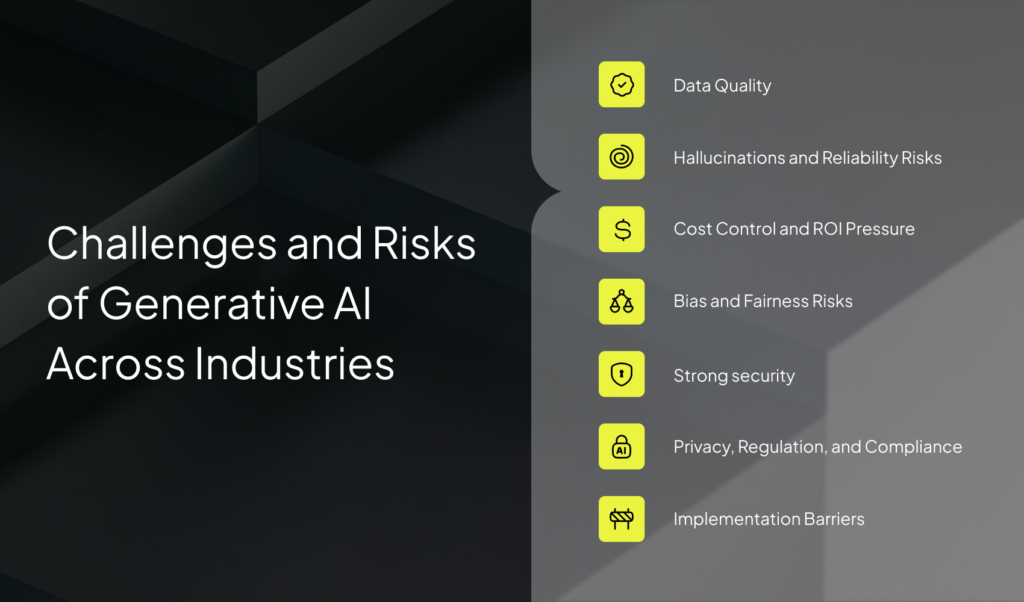
Generative AI brings real value, but it also introduces real risks. Teams that succeed do not ignore these risks. They plan for them early and manage them step by step.
Data Quality Is the First and Biggest Barrier
Most problems start with data, not models.
Across industries, teams struggle with fragmented and unstructured data. Information lives in PDFs, emails, tickets, and old systems. Large language models need clean and consistent input to work well.
Before using generative AI, teams usually need to:
- Remove duplicates and outdated records
- Standardize formats and labels
- Define clear data ownership
- Keep training data representative of real use
Hallucinations and Reliability Risks
Generative AI can sound confident while being wrong. This is not rare. It is a known failure mode.
Common examples include:
- Citing facts that do not exist
- Mixing data from different sources
- Giving outdated or incorrect answers
The strongest mitigation strategy is retrieval-augmented generation (RAG). The model pulls answers from verified sources instead of guessing. Human verification remains essential for high-impact decisions.
Cost Control and ROI Pressure
Generative AI is not free at scale.
For example, GPT-4 pricing typically ranges from about $2 to $8 per one million tokens, depending on usage type. Costs rise fast with high traffic or long context windows.
Teams manage this by:
- Using smaller models for simple tasks
- Applying batch processing where possible
- Setting usage limits per feature
- Measuring cost per outcome, not cost per request
Bias and Fairness Risks
Models reflect the data they learn from. Bias can enter quietly and cause harm.
Mitigation requires effort:
- Regular bias audits
- Balanced training samples
- Fairness metrics by user group
- Human review of sensitive outputs
Privacy, Regulation, and Compliance
Generative AI often touches sensitive data.
Strong systems include:
- Role-based access controls
- Full request and response logging
- Data encryption at rest and in transit
- Clear retention policies
Healthcare teams must follow HIPAA. Financial teams face strict audit rules. Compliance shapes architecture choices from day one.
Implementation Barriers Inside Organizations
Technology is only part of the challenge.
Many teams report:
- 55% cite insufficient internal AI expertise
- 37% lack confidence in infrastructure readiness
Training, documentation, and gradual rollout reduce friction.
Over-Automation and User Trust
Too much automation feels confusing. Users want clarity and control.
AI should assist, not hide decisions. Clear explanations and opt-outs build trust.
A Practical Risk Management Framework
| Stage | Focus | Goal |
| Low-risk pilots | Internal tools, drafts, summaries | Learn safely |
| Validation | RAG, audits, cost tracking | Build trust |
| Scale | Governance, monitoring, controls | Sustain value |
How Companies Choose the Right Generative AI Use Cases
Decision moments matter.
“Where should this start?”
“Is this safe enough?”
“Is the effort worth it?”
Teams succeed when they:
- Start with one clear problem
- Choose low-risk, high-impact tasks
- Measure results early
- Scale only after proof
This approach builds trust and momentum.
Generative AI Trends Shaping 2026 and Beyond
Generative AI is not standing still. The next two years will bring clearer patterns, stronger rules, and more focused adoption. Teams that understand where things are heading can make better choices today.
One signal already stands out. “91% of financial firms are evaluating or using AI in production,” according to NVIDIA.
That shows AI is no longer a pilot. It is becoming standard infrastructure.
Key Trends that shaped 2025–2026
| Trend | What Is Changing | Why It Matters for Products |
| Multimodal AI models | AI works with text, images, audio, and even genomics at once | Products gain richer understanding and context |
| Agentic AI | Systems plan and act with limited human input | Workflows become faster, but need guardrails |
| Synthetic data generation | AI creates realistic test data | Privacy risks drop while testing improves |
| AI-native products | AI is built into the core, not added later | Products feel smarter, not bolted-on |
| Regulation-driven design | Rules shape how AI is built and deployed | Trust and compliance become product features |
| Edge AI | AI runs closer to users in real time | Latency drops and reliability improves |
Multimodal AI Becomes Practical
Until recently, most systems worked with text alone. That is changing fast.
Multimodal models can read text, understand images, analyze scans, or process structured data together. In healthcare, this means combining notes with imaging. In retail, it means matching search text with visuals. Products gain context instead of guessing intent.
Adoption is already underway. Expect wider use through 2025, with mainstream rollout by 2026.
Agentic AI and Autonomous Systems
Agentic AI can plan steps, call tools, and complete tasks with less human input.
This sounds powerful. It is. But it also raises questions. When should a system act alone? When should it pause and ask?
Early use cases stay narrow. Scheduling. Monitoring. Simple decision paths. Broader autonomy will grow slowly as trust and controls improve.
Synthetic Data for Privacy and Testing
Privacy rules tighten across regions. Real data becomes harder to use.
Synthetic data solves part of this problem. It mirrors patterns without exposing real people. Teams use it to test edge cases, train models, and validate systems safely.
This trend accelerates in regulated industries first. Wider adoption follows.
AI-Native Products vs AI Features
Many products still add AI as a feature. A chatbot here. A summary tool there.
AI-native products take a different path. AI shapes the core experience from day one. Decisions, personalization, and workflows all depend on it.
By 2026, this divide becomes clear. AI-native products move faster. Feature-based products struggle to keep up.
Regulation Shapes the Road Ahead
Rules now influence design choices.
Healthcare teams follow FDA guidance on AI-supported tools. European companies adapt to the EU AI Act. Financial firms strengthen audit trails and explainability.
This slows reckless adoption but improves trust. Products built with regulation in mind age better.
Edge AI and Real-Time Processing
Not all decisions can wait for the cloud.
Edge AI runs models closer to users and devices. This matters for manufacturing sensors, medical devices, and real-time retail experiences.
Latency drops. Reliability improves. Adoption grows steadily through 2025 and accelerates in 2026.
Adoption Timeline at a Glance
| Timeline | What to Expect |
| 2024–early 2025 | Focused use cases and controlled rollouts |
| Late 2025 | Multimodal and agent-based systems expand |
| 2026 | AI-native products become the norm in many sectors |
Conclusion
Generative AI in product development works when it solves real problems. Using it to chase trends is meaningless. Across varied industries, the winning teams stay thoughtful, test carefully, and keep humans in control. The real question now is simple. Which use case deserves attention first, and which one can wait?
Building with generative AI should feel exciting, not risky. Imenso Software helps teams move with confidence, from early planning to real delivery. The work stays grounded in real user needs and real business goals. When the tech makes sense and the product feels right, adoption follows naturally.