Offshore Software Development in 2026: Trends, Pitfalls, and How to Succeed

Offshore software development means building software with teams in other countries. It helps companies access global talent and reduce costs.
In offshore development 2026, things are different. AI tools are changing how teams work. Costs are shifting across regions. Global hiring is more competitive than ever.
The problem is simple. Many companies still focus only on saving money. They ignore quality, communication, and long-term outcomes.
This blog is like your mini guide to this topic. Here, we’ll cover the trends in this model, and make you aware of costly mistakes. Finally, we’ll give you an effective strategy to succeed using this model.
What Is Offshore Software Development?
Offshore software development means hiring a team in another country. Firms hire them to build software for their business. This team works remotely. But it follows your requirements, timelines, and goals.
It is a common part of software outsourcing 2026. Companies use it to reduce costs. Another crucial benefit of this model is access to skilled IT specialists worldwide.
Offshore vs. outsourcing
- Outsourcing means giving work to an external company. This company can be in your country. It can also be in another nation.
- Offshore means the team is in a different country. It may or may not be outsourced.
Offshore vs. nearshore vs onshore
| Model | Location Of Team | Time Zone Difference | Cost Level | Communication Ease |
| Offshore | Far Country (E.g., U.S to India) | High | Low | Moderate |
| Nearshore | Nearby Country (E.G., Us To Mexico) | Low To Medium | Medium | High |
| Onshore | Same Country | None | High | Very High |
Each model has its own use case. Offshore works best when cost savings and global talent access are the main goals.
Offshore software development companies provide full teams. They handle hiring, infrastructure, and project delivery.
This helps businesses:
- Avoid long hiring cycles
- Scale teams quickly
- Focus on core business tasks
Why Offshore Development Is Growing Fast in 2026
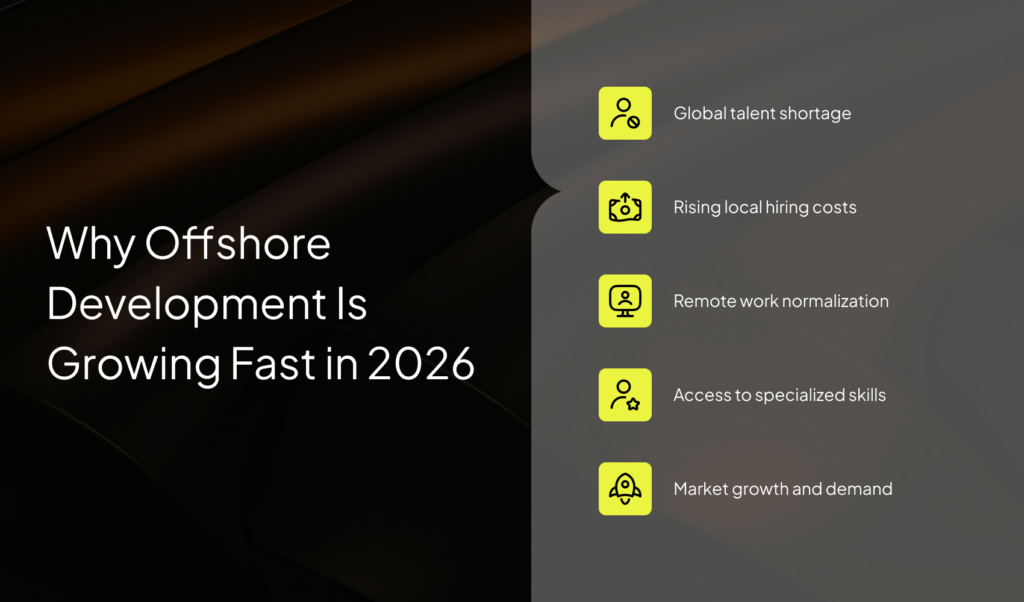
Offshore development is swiftly growing. Modern business needs are the reason behind this. Companies are not just chasing lower costs. They are solving talent and speed challenges.
Global talent shortage
Today, every nation faces a developer shortage. This has led to outsourcing becoming the go-to model for every firm.
In tech, the US could lose out on $162 billion worth of revenues annually. Only one thing can stop this from happening. Finding more high-tech workers. This is forcing firms in the U.S. to hire globally instead of locally.
Rising local hiring costs
Hiring developers in countries like the US and UK is expensive. Salaries, benefits, and overhead costs are high.
Offshore development offers a cost advantage. Firms can leverage this advantage without reducing quality. This is why many startups and enterprises are shifting offshore.
Remote work normalization
Remote work is now standard. Teams are used to working across time zones. More than 20% of the global workforce can work remotely three to five days a week. They can do this without losing productivity. This also means that a large portion of work, especially in tech and software roles, can be done effectively from anywhere.
It is why businesses trust remote work models. It also explains why software outsourcing 2026 is growing fast.
Access to specialized skills
Modern software needs advanced skills. These include AI, cloud computing, and data engineering.
It is hard to find all these skills in one local market. Offshore teams help companies:
- Access niche expertise quickly
- Build advanced products faster
- Stay competitive in fast-moving markets
Market growth and demand
The demand for outsourcing is rising by giant leaps. The IT outsourcing market of the world will touch a mark above 500 billion dollars. This is expected to happen by 2027.
Top Offshore Software Development Trends in 2026
Below are the major trends shaping this development model this year.
AI is changing how offshore teams work
AI is now part of daily development work. Offshore teams use AI tools for coding, testing, debugging, and documentation.
This is not just a trend. It is already improving outcomes.
A GitHub research reveals something surprising. Developers using AI tools like Copilot can finish tasks up to 55% faster in controlled experiments.
This shows how AI is speeding up software development across teams.
In offshore software development, this has a direct impact. Teams can deliver faster without increasing team size.
AI also helps in:
- Generating test cases
- Finding bugs early
- Improving code consistency
The impact of this trend on offshore development 2026 is:
- Teams deliver projects faster. They do not have to hire locally for it.
- Quality improves. This happens due to fewer manual errors.
- Offshore teams become more efficient and scalable.
Hybrid teams (onshore + offshore) are becoming the norm
Most companies no longer rely only on offshore teams. They combine onshore and offshore teams to get better results.
Onshore teams focus on planning, business logic, and stakeholder communication. Offshore teams focus on development, testing, and support.
This model works because it balances control and cost.
This shift is clearly shown in Deloitte’s research. Firms are now focusing on value, agility, and access to skills along with cost reduction when outsourcing.
This shows that outsourcing is not only about saving money. It is also about working smarter.
The impact of this trend on outsourcing in 2026 is:
- Better alignment between business and development
- Faster feedback loops
- Improved project visibility and control
Security and compliance are now top priorities
Security is a major concern in offshore software development. Companies handle sensitive data and must follow strict regulations. This includes standards like GDPR, HIPAA, and ISO certifications.
The risk is real and growing.
Did you know that the global average cost of a data breach touched 4.45 million dollars in 2023? Security is thus a top priority when working with offshore teams.
Businesses now expect offshore teams to:
- Follow secure coding practices
- Use encrypted communication
- Comply with global data protection laws
The impact of this trend can be seen in:
- Stricter vendor selection processes
- Higher demand for certified offshore partners
- Increased investment in security tools and audits
Cloud-native development is the default
Development in the cloud is now the usual method. Many modern apps are built as cloud-native. It means that they can fluidly run on cloud platforms.
This includes the usage of microservices and containers. Continuous deployment is also a key part. Offshore teams must have a good grasp of the cloud tech stack. It means being proficient in AWS, Azure, and Google Cloud.
This shift is backed by strong data. Already, Gartner forecasted that global public cloud spending will touch 723 billion dollars in 2025. It rightly predicted that it will grow at over 21% year over year. This trend continues into offshore development 2026.
Cloud-native systems help businesses:
- Scale applications easily
- Reduce downtime
- Deploy updates faster
Impact on offshore software development:
- Faster product releases
- Better system performance
- Easier collaboration across global teams
Clean Tech and EV Software Are Driving New Offshore Demand
Sustainability is now a major focus for many businesses. Offshore companies are building solutions for clean energy and electric vehicles. These include energy monitoring systems, EV charging platforms, and smart grid software.
This trend is growing due to global climate goals and regulations. Global EV sales crossed 14 million units in 2023. They are expected to keep growing strongly. This growth creates demand for software systems that support EV ecosystems.
Offshore teams help build:
- EV charging management platforms
- Battery performance monitoring tools
- Energy optimization systems
Its impact on offshore development 2026 is reflected in:
- More projects in clean tech and mobility
- Demand for domain-specific expertise
- Long-term contracts with energy and EV companies
DevOps Is Becoming Standard in Offshore Development
DevOps is now a core part of modern software delivery. It connects development and operations into one continuous process.
In software outsourcing 2026, companies expect offshore teams to follow DevOps practices from the start. This includes automation, continuous integration, and continuous delivery.
It has been seen that high-performing DevOps teams deploy code 208 times more frequently than low-performing teams. This shows how DevOps improves speed and efficiency.
Offshore teams now use DevOps to:
- Automate testing and deployment
- Reduce manual errors
- Release updates faster
The impact on offshore development is:
- Faster time to market
- Better system reliability
- Smoother collaboration across global teams
IoT and Healthcare Software Are Expanding Offshore Opportunities
IoT and healthcare are growing fast. Both require complex and scalable software systems. Offshore companies are playing a key role here.
In IoT, teams build systems for connected devices. In healthcare, they build apps for patient care, remote monitoring, among others.
Digital health solutions are critical for improving access and efficiency in healthcare systems worldwide. In IoT, billions of devices are now connected globally. This creates constant demand for software platforms.
Offshore teams help with:
- IoT platform development
- Healthcare app development
- Data integration and security
The impact on offshore development 2026:
- Higher demand for specialized developers
- Strict compliance requirements in healthcare
- Long-term projects with global enterprises
Data Engineering and Analytics Readiness Are Now Essential
Data is at the center of modern software. Companies want systems that can collect, process, and analyze data in real time. This is why data engineering is now a key part of offshore software development.
Businesses are not just collecting data. They want to use it for decision-making. Data-driven firms are 23 times more likely to acquire customers. They are 19 times more likely to be profitable.
That’s why, offshore teams now focus on:
- Building data pipelines
- Preparing data for analytics
- Integrating data across systems
Here is a simple breakdown:
| Area | What Offshore Teams Do |
| Data Engineering | Build pipelines and data infrastructure |
| Data Analytics | Create dashboards and reports |
| Data Integration | Connect multiple data sources |
Its impact on software outsourcing is seen in:
- Higher demand for data engineers
- Focus on real-time analytics
- Better business decision-making
Ready to build your offshore development team?
Common Offshore Development Pitfalls (And Why Projects Fail)
Offshore software development can deliver great results. But many projects fail due to avoidable mistakes.
Below are the most common pitfalls and what they lead to.
Choosing based on low hourly rates
Many companies choose offshore vendors only based on cost. This often leads to poor outcomes.
Low rates can mean less experienced developers or lack of proper processes. Many software projects fail due to poor planning and low-quality execution. Cost alone does not guarantee success.
If you base your decision on cost alone, you risk getting:
- Poor code quality
- Higher rework costs later
- Longer project timelines
Poor communication and unclear requirements
Clear communication is critical in offshore software development. Without it, teams may build the wrong features. It especially happens when requirements are not documented properly.
Offshore teams depend on clear inputs to deliver correct outputs.
Poor communication leads to:
- Vague project scope
- Missing documentation
- Inconsistent feedback
Its impact on projects can be seen in:
- Features not matching business needs
- Repeated revisions and delays
- Increased overall project cost
Lack of project ownership
Some offshore teams only follow instructions. They do not take ownership of the product. This creates gaps in decision-making and accountability.
Today, companies expect proactive teams. Here’s what lack of ownership in offshore teams looks like:
- No suggestions for improvement
- Delays without clear reasons
- Lack of accountability for outcomes
The impact of poor low ownership is experienced in:
- Slow progress
- Missed deadlines
- Poor product quality
Time zone mismanagement
Time zone differences are part of offshore development. But poor planning can create delays. Without overlapping hours, communication becomes slow. Teams may wait many hours for feedback or approvals.
it causes the following problems:
- Delayed responses
- Missed meetings
- Slow issue resolution
The impact is felt in:
- Longer development cycles
- Frustration between teams
- Reduced productivity
Ignoring quality assurance
Some firms focus only on development speed. They ignore testing and quality checks. This leads to unstable and buggy software.
Fixing a bug after release can cost up to 30 times more than fixing it during development. That’s why testing is critical. If not done properly, it leads to:
- Frequent bugs in production
- Poor user experience
- Higher maintenance costs
Weak security practices
Overlooking security poses a serious risk. Offshore teams must follow strict security standards. Without proper controls, data can be exposed.
The cost of a data breach has not touched 4.45 million dollars. This highlights the financial impact of weak security.
Common issues it poses are:
- Insecure code
- Lack of data protection policies
- Weak access controls
As a result, the project suffers from:
- Data breaches
- Legal and compliance issues
- Loss of customer trust
The Real Cost of Offshore Development (Beyond Hourly Rates)
The real cost of an offshore model includes several hidden factors. Ignoring these leads to budget overruns and delays.
What most companies think they pay
At the start, companies usually calculate cost like this:
- Hourly rate × number of developers × project duration
It does not include real-world challenges.
Example:
- 3 developers × $25/hour × 6 months
This looks affordable on paper. But actual costs are often much higher.
What they actually pay (hidden costs)
In real projects, several additional costs come into play. These include:
Management overhead (15–20%)
Offshore teams need coordination. Project managers, team leads, and internal stakeholders spend time managing work. Management overhead can add 15–20% to total project cost.
This includes:
- Planning and task allocation
- Progress tracking
- Meetings and reporting
Impact of management overhead:
- Higher total cost than expected
- Need for experienced project managers
QA and testing costs
Testing is essential for product quality. Teams need dedicated QA engineers and testing tools.
Testing includes:
- Manual testing
- Automated testing
- Performance and security testing
Impact of QA and testing costs are:
- Additional time and cost
- Better product stability if done properly
Rework and bug fixing
Poor planning or unclear requirements lead to rework. This increases both time and cost. Fixing defects is thrice more expensive after the development of the full product.
Impact of rework is seen in:
- Increased development hours
- Delayed product launch
Communication delays
Offshore software development involves teams in different time zones. Delays in communication can slow down progress.
Common issues include:
- Waiting for feedback
- Misunderstanding requirements
- Repeated clarifications
Impact of communication delays include:
- Slower decision-making
- Longer project timelines
Tooling and infrastructure
Modern development requires tools and infrastructure. These costs are often not included in initial estimates.
This includes:
- Cloud services
- Project management tools
- Collaboration platforms
Impact of tooling and infrastructure:
- Recurring monthly costs
- Dependency on external tools
A cost breakdown example
| Cost Component | Estimated Share Of Total Cost |
| Developer salaries | 60% |
| Management overhead | 15% |
| QA and testing | 10% |
| Rework and bug fixing | 5–10% |
| Tools and infrastructure | 5% |
Cost of Offshore Development by Region (2026 Comparison)
| Region | Hourly Rate (Usd) | Strengths | Best For |
| India | 20–40 | Large talent pool, strong tech skills | Startups, long-term projects |
| Eastern Europe | 40–80 | High quality, strong engineering culture | Complex and enterprise projects |
| Latin America | 35–70 | Time zone alignment with us | Real-time collaboration projects |
| Southeast Asia | 25–50 | Cost-effective, growing talent base | Budget-conscious development |
Step-by-Step Offshore Development Strategy That Works
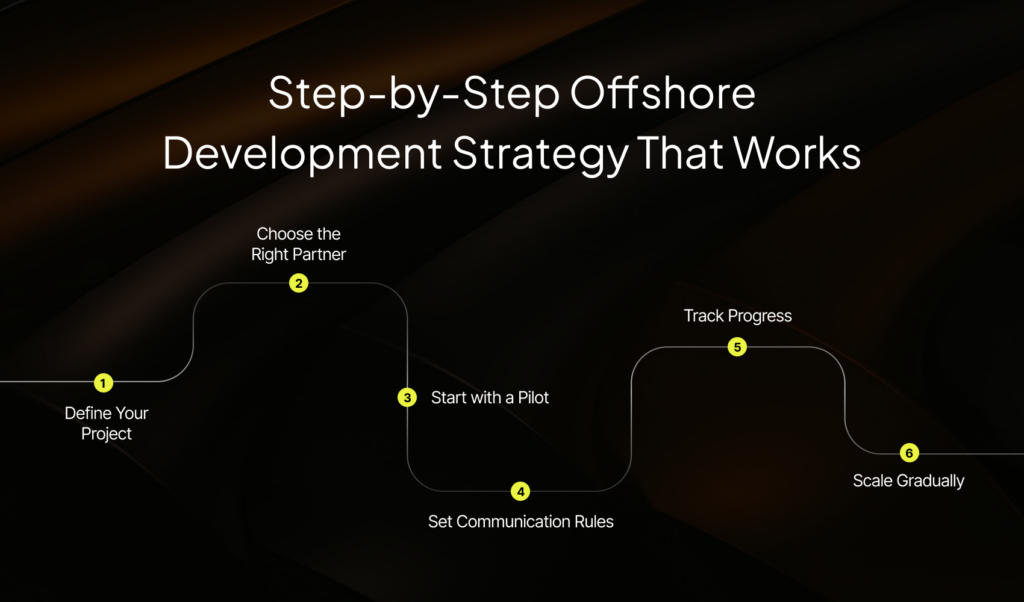
Offshore software development works best when you follow a clear process. Here is a simple strategy that works in 2026.
Step 1: Define your project clearly
Start with a clear understanding of what you want to build. Unclear goals lead to confusion and rework.
You should define:
- Project scope
- Key features
- Timelines
- Expected outcomes
Good documentation helps offshore teams understand your requirements.
Step 2: Choose the right partner
Choosing the right offshore software development company is critical. Do not select based only on cost. A good partner will act as a collaborator, not just a vendor.
Evaluate on the basis of:
- Technical expertise
- Past projects
- Communication skills
- Security practices
Step 3: Start with a small pilot
Do not start with a full-scale project. Begin with a small pilot. A pilot project reduces risk. It also builds trust between teams.
This helps you test:
- Team capabilities
- Communication flow
- Delivery speed
Step 4: Set clear communication rules
Without clear rules, delays are common. You should define:
- Meeting schedules
- Reporting format
- Escalation process
Use tools like Slack, Jira, or Teams for daily updates. A structured approach helps avoid confusion.
Step 5: Track progress with the right metrics
Tracking progress shows whether the project is moving in the right direction. You should focus on simple and clear metrics.
Here are useful metrics for offshore software development:
- delivery speed (tasks completed per sprint)
- bug rate (number of defects per release)
- sprint completion rate
- code quality scores
- response time for issues
Step 6: Scale the team gradually
Once the pilot is successful, you can scale the team. Do not expand too quickly. Gradual scaling helps maintain quality and control. To scale gradually,
- Add developers step by step
- Maintain communication standards
- Monitor performance continuously
How to Manage Security and Compliance in Offshore Projects
A strong security approach protects your data and reduces risk. It helps you build trust with offshore software development companies.
Data protection basics
You must ensure that all data is handled safely. This includes both data in transit and data at rest.
Key practices include:
- Encrypting data during transfer
- Using secure storage systems
- Limiting data exposure to only required team members
Good data protection measures will lead to:
- Reduced risk of data leaks
- Better compliance with regulations
- Improved customer trust
NDAs and contracts
Legal agreements are essential in offshore software development. They define how data and intellectual property are handled. They protect your business from misuse of data or code.
You should always use:
- Non-disclosure agreements (NDAs)
- Clear service contracts
- Intellectual property clauses
They define:
- Ownership of software
- Confidentiality rules
- Responsibilities of both parties
These agreements will provide you with:
- Legal protection for your business
- Clear expectations for offshore teams
- Reduced risk of disputes
Access control
Access control limits who can view or modify data. This is a key part of secure software outsourcing 2026.
Best practices include:
- Role-based access control (RBAC)
- Multi-factor authentication (MFA)
- Regular access reviews
Teams should only access what they need for their tasks. This leads to:
- Reduced risk of internal security breaches
- Better control over sensitive data
- Improved system security
Compliance (GDPR, HIPAA, etc.)
Compliance means following legal and industry standards for data protection. Different industries require different regulations.
GDPR (General Data Protection Regulation)
GDPR is a data protection law in the European Union that focuses on how personal data is collected, stored, and used. It applies to any company handling the data of EU citizens. It also applies if the company operates outside Europe. Businesses must get user consent and protect data securely. They must allow users to access or delete their information.
HIPAA (Health Insurance Portability and Accountability Act)
HIPAA is a US regulation that protects sensitive healthcare data. It applies to companies handling medical records, patient information, or health-related systems. Offshore teams working on healthcare projects must ensure strict data privacy, secure storage, and controlled access to patient data.
ISO Standards (Information Security Standards)
ISO standards, such as ISO 27001, are international guidelines for managing information security. They help companies create systems to protect data, reduce risks, and maintain security processes. Working with offshore partners that follow ISO standards ensures better data protection and reliability.
So, offshore teams must follow global compliance rules. Doing so will help the business:
- Avoids legal penalties
- Ensures safe data handling
- Builds trust with clients and users
Security checklist for offshore projects
| Area | Key Action |
| Data protection | Use encryption and secure storage |
| Legal agreements | Sign NDAs and define IP ownership |
| Access control | Limit access based on roles |
| Compliance | Follow GDPR, HIPAA, and standards |
Conclusion
Offshore software development is powerful when done right. It can help you scale faster and build better products. But cost savings alone are not enough in offshore development 2026. Real success depends on clear strategy, strong execution, and choosing the right partner. Companies that focus on these areas get better results from software outsourcing 2026.
Take time to evaluate your goals, budget, and technical needs before you start. Choose a partner who understands your business and takes ownership of outcomes. If you want a reliable team, you can partner with Imenso Software. We help you plan, build, and scale offshore development the right way.
Partner with Imenso to build secure, scalable software solutions.


Similar Posts

In the World of PHP MVC Frameworks: Codeigniter Vs Yii Vs CakePHP Vs Laravel
“What’s 2018’s best PHP framework?” I can’t possibly recall the number of times I spot that question every year.In the late 1900s, the conversation used to flow around every party’s favourite programming language. C, Lisp, Pascal? You’d name a programmer’s most preferred coding tool, and they’d willingly offer one argument after another to convince you […]...

Scaling SaaS Infrastructure: Challenges & Solutions
In today’s fast-paced digital landscape, Software as a Service (SaaS) has emerged as a dominant model for delivering software applications over the Internet. SaaS offers numerous benefits such as cost-efficiency, accessibility, and automatic updates, making it a preferred choice for businesses of all sizes. However, as SaaS platforms gain popularity and user bases expand rapidly, […]...

Product-First Engineering: How to Build Software That Delivers Real Business Impact
Product-First Engineering means building software by starting with real business and user outcomes. Development does not stem from code, tools, or features.Here’s the underlying aim. Every engineering decision should move the product forward in a way that users feel and businesses can measure. Many teams build solid systems that still fail. The real reason lies […]...