5 Ways to Protect Intellectual Property in Software Outsourcing
Businesses across the US outsource software development. It helps them deliver a quality product even without a big budget. However, when you outsource, you don’t just hire experts. Your technology partner has access to a lot of sensitive business information.
So, how to outsource and protect your intellectual property? Put simply, how can you share your vision with someone without them stealing the credit for it?
Don’t worry, it is possible to outsource software development safely. All you need is to recognize the importance of confidence and follow the best practices explained below.
Who Owns Intellectual Property in Outsourced Development?
Intellectual property is the software’s source code, UI, and design. This can be both the functional and the visual parts of the software. Other forms of IP in software development are patents, trade secrets, and trademarks.

To understand IP’s ownership, you must know about the laws in your area. You should also have a contractual agreement with your outsourced software development partner.
The points below will help you understand IP ownership in software development.
- Generally, the party that creates the work will be the owner. So, if your tech partner builds the software, they will have the copyright to it. Exceptions to this rule include works created by staff during their employment.
- The next factor in determining IP ownership is whether the work was created for hire. In this case, the party that commissioned the work will be the author. They will own the copyright. Businesses that are commissioning a software provider to create a product must pay attention to this. Remember to state clearly in your contract that the work is created for hire.
- Other legal mechanisms protect IP. For example, patents can safeguard the functional parts of software. Trademarks can protect the branding and visual aspects. Trade secrets can also shield some aspects of software. This comprises source code or UI.
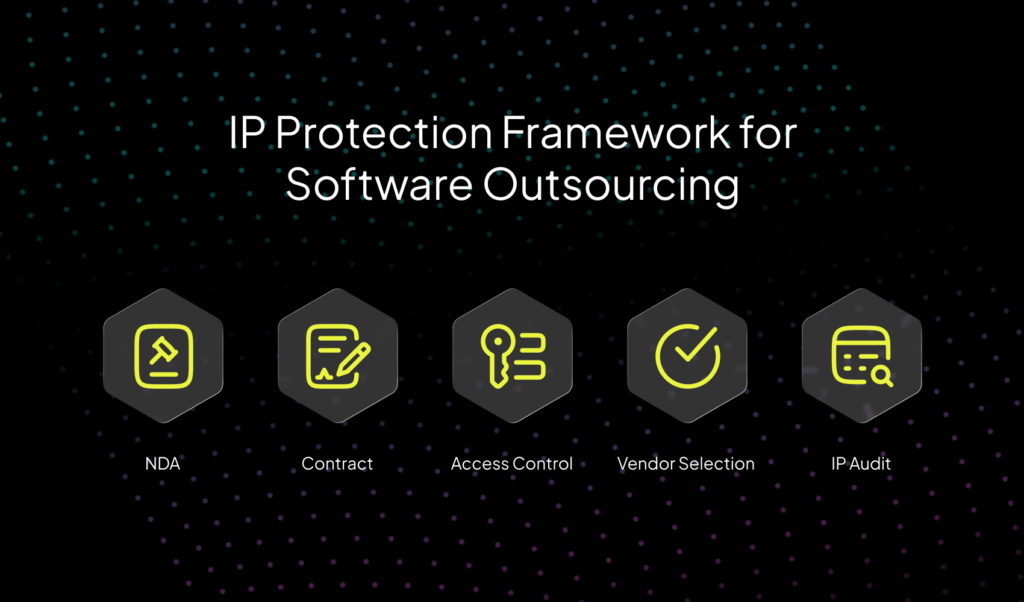
1. Choose an Outsourcing Partner with Strong IP Practices
The absolute best practice for IP protection during outsourcing is to choose the right partner. Your focus in this phase should be on an outsourced software development partner who maintains transparent IP ownership from the first engagement. For this, you must consider the following:
Check IP Protection Measures in Contracts
The contract with the outsourced development partner should clarify that all custom-developed code and IP created will be assigned to you upon completion. This covers the source code, documentation, designs, and any changes they made. Also, your vendor should own only the background IP technology, and not the tech developed as part of the project.
There should be an assignment clause that automatically transfers all IP rights to you. You don’t need to take any additional steps or pay any additional fees after the product is built.
Clarify IP Ownership from the Start
Set ownership expectations for IP from the beginning. If a partner hesitates when asked about having the future rights to the code, eliminate them from your list. The right provider does not retain any rights to the code developed together. You can also ask them to share sample contracts from different vendors. Then, compare their IP provisions.
Do a Pilot Project
Start with a pilot project before engaging fully. Such a project takes about 4-8 weeks. Use it to find out whether the partner respects IP agreements and their transparency in general. It will help you assess the following:
- Vendor’s quality
- Communication process
- How does it follow the contractual terms
Questions to Ask Your Outsourced Development Partner for IP Protection
Ask the following questions to your prospective offshore software development partner. The answers will provide you with many insights into whether you can trust the firm for IP protection.
1. Does your contract state that we are the owners of all code and assets made during development?
2. How will you keep my company’s information confidential?
3. Are subcontractors used, and how is IP protection applied with them?
4. Do you consent to a strong NDA for all confidential information?
5. Can you share client references for applications or solutions where IP sensitivity mattered?
6. How transparent is your workflow?
2. Sign a Non-Disclosure Agreement (NDA)
An NDA is a contract you sign before hiring any service of a software development company. It allows you to openly discuss business data. At the same time, there’s no risk of data loss. In the absence of an NDA, you risk losing your sensitive business information.
An NDA is essential because your technology partner does more than just deliver the product. During development, you share company goals, internal workflows, and proprietary algorithms with them. NDA ensures that your software provider does not disclose this information.
What Does an NDA Consist of
NDA has the following components:
- Description of sensitive information: Be clear. Cover code, plans, client lists, etc. Basically, cover your unique value proposition.
- Period of confidentiality: Typically, NDAs last 1-5 years. Some demand indefinite protection. But that’s generally not enforced.
- Exclusions: Public information, original ideas, and legally required disclosures do not come within the NDA’s scope.
- Legal repercussions – Clearly describe the penalties of disclosing sensitive data. Breaches can cause financial and reputational damage.
3. Define IP Ownership in Your Development Contract
If you are hiring the services of an outsourced software development company, it’s vital to protect your intellectual property (IP). A software development contract has many names. It can be an Invention Assignment Agreement or a Proprietary Rights Agreement. Regardless, it indicates the owner of the IP. The contract also provides the rights of you and your tech provider. Ask your ownership lawyer to review your contract. They will ensure that everything is properly worded.
What Should You Include in Your Software Development Contract
Below are some essential points to include in your outsourcing contract.
Service Delivery and Acceptance Terms
The service that your tech provider offers should be clearly stated. State the conditions of the service also. It eliminates any ambiguities on this part.
Ownership
This is ‘work made for hire.’ So, the client (you), and not the outsourcing company, is the author and the owner of the work. However, this only applies if the defined statute (17 U.S.C. § 101) ‘work made for hire’ is mentioned in the contract.
Payment Terms
This includes the payment and its conditions. It saves your time and money.
Confidential Data
This clause specifies the particular pieces of information that should not be disclosed.
Disclosure of Product
It implies that after the cooperation is over, you’ll get all the materials used in the process. This includes designs and documentation, among other things.
Warranties
This section of the contract consists of:
- The performance standard: The obligation to provide a good standard of service.
- Competitive activities: The provider will tell you about any interaction with your industry peers.
- Non-infringement – The company will not infringe or breach the IP rights.
Concerned About IP Risks in Outsourcing?
4. Control Access to Sensitive Code and Data
35.5% of data breaches in 2024 were related to third-party access! So, it’s a very best practice to restrict server and data access when outsourcing development. Keep your data within your cloud. Restrict access to your server and API, and give it only when needed. A layered system of access controls reduces unauthorized access and IP theft. Use these measures in this regard:
- Implement role-based access controls. Don’t give blanket permissions to developers. Instead, give specific project roles.
- All outsourced developers must connect through a Virtual Private Network (VPN) before they access your company systems. VPNs encrypt all data between the developer’s location and your infrastructure.
- If a big part of your IP needs access, delegate it to your in-house developers.
- Create isolated sandbox environments. Here, outsourced developers can work. It’s a great way to minimize direct access to production.
- Control the kind of data that is accessible within an API. Also, use a second layer of protection by preventing the API from releasing all data to everyone who accesses it.
- Use Just-in-time (JIT) privilege elevation. This security strategy grants external parties brief and restricted access to sensitive data.
- Restrict outsourced developers’ access to specific repositories on GitHub, GitLab, and Bitbucket.
- Monitor commit logs. Make a rule not to commit API keys, passwords, and database connection strings.
5. Conduct Regular IP Audits
According to the World Intellectual Property Organization (WIPO), an IP audit is a systematic review of intellectual property under you. The aim is to assess and manage risk and use the best practices in IP asset management. When you outsource development, IP protection also covers assets developed through external partnerships. The audit identifies, evaluates, and protects your IP assets when they are a part of the outsourcing lifecycle. You can then carry out protective practices across your vendor partnerships.
3 Types of IP Audits to Follow
General Purpose IP Audit
This audit is done before setting up a new outsourcing relationship. Through it, you make a detailed inventory of all your existing IP assets. You also establish an understanding of what you own and how it’s protected. This audit brings to the surface the gaps in documentation that you must fix before partnering.
Event-Driven IP Audit
This audit is done before committing to a specific vendor for outsourcing. You assess the value and risk of IP that will be shared with or developed by the vendor. Before this audit, a mutual non-disclosure agreement must be signed for confidentiality protection.
Limited Purpose Focused Audit
This addresses specific outsourcing scenarios. Before starting with an offshore development program or launching new products through it, a focused audit like this is essential. It reviews different aspects of an ongoing outsourcing relationship. For example, wanting to know the purpose of using a particular tool. A focused audit also sensitizes the company to market-specific IP laws and customs that impact outsourced IP rights.
Wrapping up
The tech-driven world is fiercely competitive. If you have a unique idea, you need to trust the right people to bring it to fruition. Hopefully, by now, you must know the various steps to take for it. If you are thinking of outsourcing your next project, Imenso Software is here to help. As a reliable software development company, we have the expertise and experience to bring it to life. Contact us today and let’s sow the seeds of a successful partnership.
Need a trusted outsourcing partner?


Similar Posts
A Complete Offshore Software Development Company Hiring Guide
Building and running a business is probably the hardest and the most fun thing any business owners do in their lifetime. And the toughest part of the job is to keep it relevant as trends and technologies change. ...

Global Workforce: Exploring the What, Why, and How
Wondering how to lead and manage a global workforce with confidence and effectiveness? The idea of a worldwide workforce altered how companies function and interact in a world growing more interconnected by the day. But what is a global workforce exactly, and why is it important? There are many advantages to having a global workforce: […]...
How To Manage Cross-Cultural Remote Teams While Outsourcing
The coronavirus pandemic, like the internet, had disruptive effects on human life. And a screen full of colleagues is one of them. Once nobody thought the complete work strength of a multinational organization would work from home. Now, everyone around the world was having zoom meetings instead of sharing ideas in the cafeteria....