Digital Field Ticketing and Vendor Tracking System

Book a Call

About Client

Healthcare/Fintech USA

About Client

The client operates one of India’s largest multi-regional warehouses, logistics and supply chains, managing large-scale equipment deployment, on-ground vendor coordination, and facility dispatch operations.

Problem Statement

Lack of Centralized Ticket Tracking

There was no structured system in place to monitor ticket progress, track IN/OUT timestamps, or enforce vendor SLAs. This resulted in limited operational visibility, delayed issue resolution, and difficulty in measuring service accountability.

No Real-Time Daily Task Visibility

Outdated and unresolved jobs continued to remain in active task queues, making it difficult for teams to prioritize current-day operations effectively. The absence of real-time visibility impacted workflow efficiency and delayed critical service actions.

Manual Vendor Coordination Process

Vendor follow-ups were handled manually through calls and emails without access to historical service records or interaction logs. This created communication gaps, inconsistent follow-ups, and reduced operational transparency.

Absence of Vendor Performance Metrics

There was no mechanism to measure vendor efficiency through KPIs such as turnaround time (TAT), visit adherence, or SLA compliance. As a result, evaluating vendor performance and maintaining service quality became challenging.

No Digital Proof of Service Completion

The system lacked digital validation methods such as timestamped photos or geo-tagged records to confirm work completion. This made audit tracking difficult and reduced confidence in field service verification.

There was no structured system in place to monitor ticket progress, track IN/OUT timestamps, or enforce vendor SLAs. This resulted in limited operational visibility, delayed issue resolution, and difficulty in measuring service accountability.

Outdated and unresolved jobs continued to remain in active task queues, making it difficult for teams to prioritize current-day operations effectively. The absence of real-time visibility impacted workflow efficiency and delayed critical service actions.

Vendor follow-ups were handled manually through calls and emails without access to historical service records or interaction logs. This created communication gaps, inconsistent follow-ups, and reduced operational transparency.

There was no mechanism to measure vendor efficiency through KPIs such as turnaround time (TAT), visit adherence, or SLA compliance. As a result, evaluating vendor performance and maintaining service quality became challenging.

The system lacked digital validation methods such as timestamped photos or geo-tagged records to confirm work completion. This made audit tracking difficult and reduced confidence in field service verification.

Solution

Solution
1

Intelligent Ticketing & Service Operations

2

Automated Logistics Workflow

Solution
1

Intelligent Ticketing & Service Operations

Centralized Ticket Management

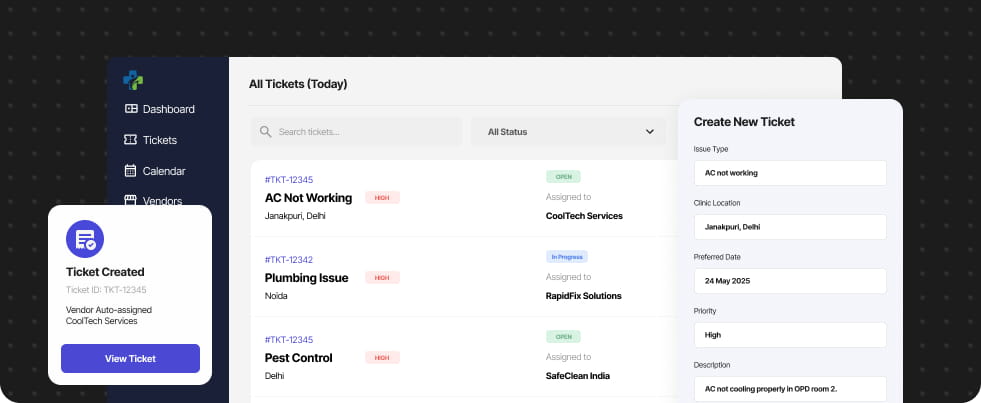
A unified web and mobile-based ticketing system enabled clinic teams to raise service requests with issue details, priority levels, preferred schedules, and image attachments. Vendors could be auto-assigned based on issue categories, ensuring faster and more organized task allocation.

Smart Scheduling & Visit Tracking

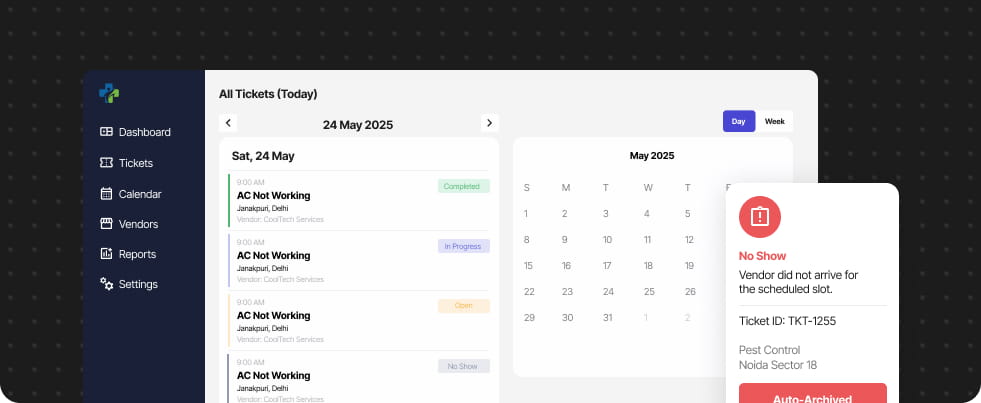
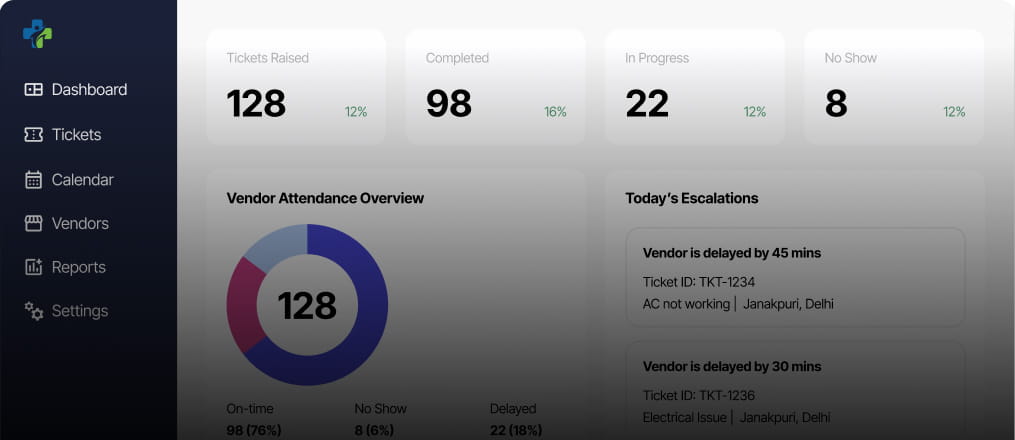
The platform provided a daily-first calendar view that displayed only active tickets for better operational clarity. Vendor visits were tracked through IN/OUT photo logging with timestamps, while missed appointments were automatically marked as “No Show” for accountability and audit readiness.

2

Automated Logistics Workflow

Real-Time Escalation Engine

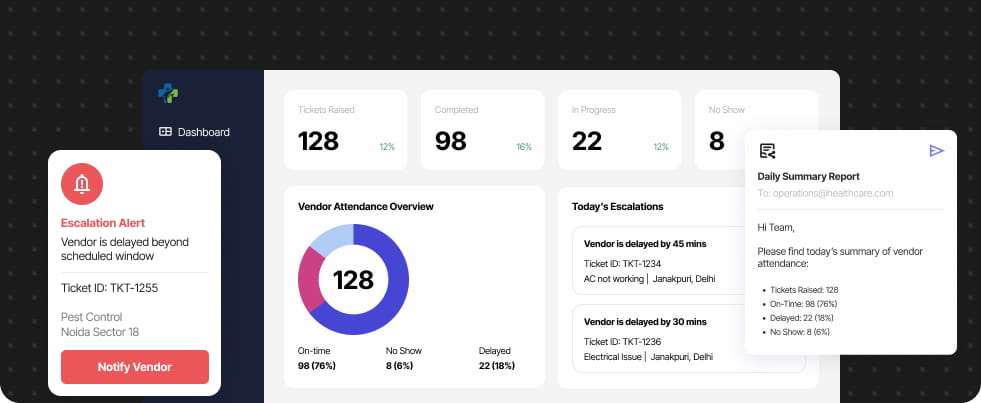
Automated alerts notified admins whenever vendors exceeded scheduled response windows. Regional teams also received daily summaries comparing vendor attendance against tickets raised, reducing the need for manual follow-ups.

SLA Monitoring & Performance Analytics

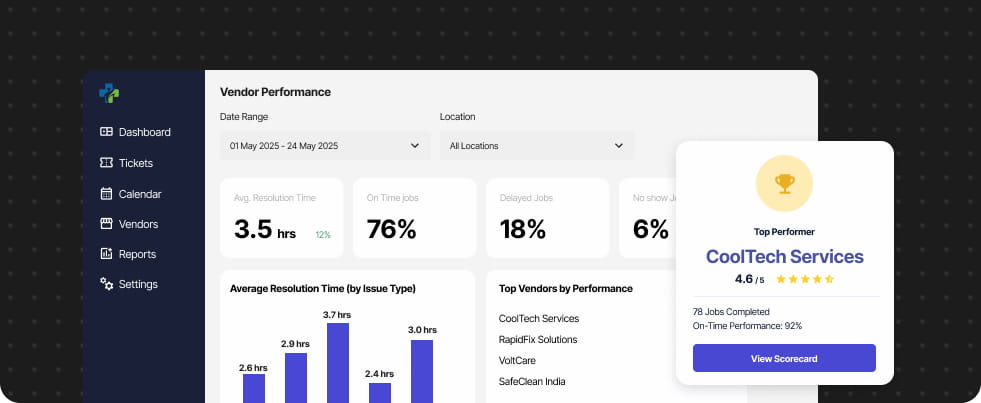
Interactive dashboards tracked resolution timelines, vendor responsiveness, and service compliance across locations and issue types. Exportable reports and historical logs enabled data-driven performance evaluation and operational transparency.

Tech Stack

Outcome Summary

93%

93% improvement in visibility of real-time job statuses

3.5 hrs

Reduced average service resolution time from 11 hrs. to 3.5 hrs.

15-20 hrs saved

Eliminated manual follow-ups, freeing up 15–20 hrs./month for Ops staff

40%

Dispatch Logging Time reduced by 40% with mobile-first workflows

80%

80% reduction in report preparation time thus increasing efficiency

Conclusion

By digitizing and automating facility service operations across 25+ clinics, Imenso helped the healthcare chain gain complete control over vendor coordination, ticket resolution, and SLA compliance. The solution transformed fragmented manual processes into a transparent, data-driven operations ecosystem—improving efficiency, accountability, and service reliability at scale.