7 Strategies to Scale Remote Engineering Teams Effectively

As your business grows, the need to scale your engineering team increases. A recent study shows that 72% of tech companies have permanent remote engineers as of early 2026. Software engineering benefits immensely from remote teams, as they enable access to a high-quality talent pool.
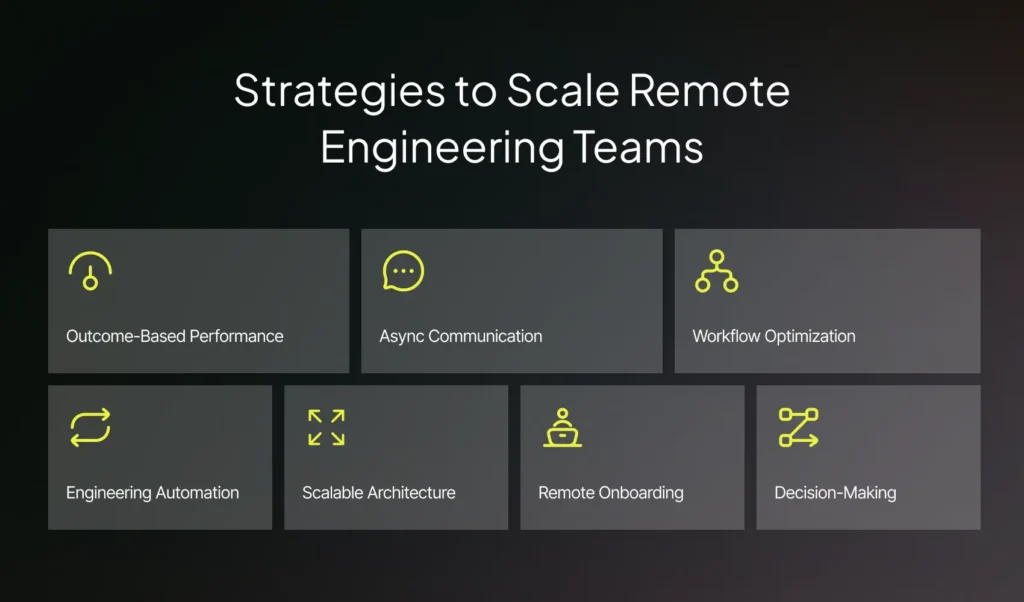
However, expanding the team poses challenges such as communication barriers, broken structure, and productivity loss. If your approaches are broken, the risks will outweigh the benefits. In this blog, we’ve explained the top seven strategies to scale remote engineering teams to help you reap the rewards of high code quality, accelerated development, and revenue gains.
1. Build Trust with Outcome-Based Performance
Outcome-based performance emphasises results over activity. Building trust through it will enable the remote teams to scale with efficiency. It also creates psychological safety as people feel safe in admitting their mistakes.
Set clear and measurable goals for each person instead of tracking hours. Focus reviews on results and not on how many hours someone is online. Monitor the progress of the team members regularly. While doing so, make communication a significant part.
Tools like Zoom and Slack are ideal for quick updates and face-to-face meetings. Use them to communicate and share updates regularly.
2. Improve Asynchronous Communication
Asynchronous communication allows remote teams to communicate on their own schedule. It is done through:
- Messaging apps
- Recorded video updates
- Project management platforms
- Shared documents
- Digital whiteboards
Since the messages don’t get exchanged in real-time, it removes distraction in the form of constant pings, meetings, and consequent fatigue.
For scaling remote engineering teams successfully, optimizing this asynchronous communication is vital. For example, sprint updates should take place without lengthy meetings. Code checks should happen without engineers sitting on a call. There should be no need to join a meeting when a product manager shares a new update.
Here are some strategies to make asynchronous communication support a remote engineering team’s growth:
- Use specialized tools and platforms. Slack, Trello, Loom, Confluence, and Notion are ideal for task updates, documentation, and video explanations.
- Set clear guidelines for expected response times per tool. For example, chat replies should be in four hours and emails within 24 hours. It creates predictable workflows.
- Specify which channels are used for what type of communication (quick updates vs formal messages). Also, document all key decisions for future reference.
- Encourage team members to make their written or recorded communication rich in context. Instead of ‘this is done’ for an API integration, say ‘Frontend API integration for user authentication is complete. This resolves Jira ticket #456 and enables testing of login flows by QA.’
3. Eliminate Workflow Bottlenecks
When remote teams grow, people experience new bottlenecks. They have slow delivery and confused ownership. Thus, the engineering quality suffers.
To get past this issue, map how work currently moves across your remote team. Look closely at handoff points, communication paths, and approval layers. A growing team has more approval layers. So, even small gaps can become major delays. When you notice it early, it helps you see where processes may crack under higher load.
Some professionals may be taking on more responsibilities with growth. Shift those responsibilities into formal roles to prevent a few of them from feeling burnt out. You may need to add new roles like tech leads, delivery managers, or SREs to support scaling.
Feedback from the team is also imperative for spotting issues leadership might miss. Ask engineers where they lose time, context, or clarity during daily work. For example, repeated feedback about unclear ownership through simple surveys shows a need for stronger role design.
For even deeper insights, hold short monthly or quarterly alignment sessions. Encourage honest talk about blockers and team strengths, so you know if it’s time to hire more engineers.
Scaling Too Fast and Losing Control?
4. Use Automation to Scale Engineering Operations
Automation removes delays that grow with team size. In fact, a 2025 Testing in DevOps Report found that teams using AI-powered test automation deployed code 50% faster than the previous year. This shows that automation directly raises speed, which makes it a necessity for any large organization trying to scale remote engineering.
Let’s look at the key automation strategies:
- Continuous Integration tools run builds and tests automatically. Engineering teams can catch bugs early and avoid slow manual checks. Test automation ensures code quality stays high even as more engineers contribute.
- Continuous Deployment lets teams ship smaller and safer updates without waiting for long release cycles.
- Infrastructure as Code also keeps environments consistent. It is a major requirement when developers work from many locations.
5. Build Scalable Engineering Architecture
To scale a remote engineering team, you must have a supporting architecture. It should scale to many developers but maintain a decoupled team structure. An architecture built on modular, cloud-based systems supports independent components. It can handle rising loads without any performance loss.
Such an architecture has the following elements that enable remote engineering team growth:
A. Microservices with clear boundaries – Break the system into small services. Teams can work independently without stepping on each other’s code.
B. Domain-driven design principles – Organize software around real business domains so teams own clear problem areas.
C. API contracts between components – Define stable rules for how parts talk to each other. This assists with development without constant coordination.
D. Event-driven architectures for loose coupling – It allows components to communicate through events, so changes in one part don’t break others.
6. Create a Scalable Remote Onboarding Process
Proper onboarding that fits the remote engagement is almost always neglected. If the early days feel chaotic, new hires may never truly connect with the team. When scaling remote engineering teams, more hires and less structure mean more people feeling left out.
Overcome this challenge with a personalized onboarding plan.
For instance, you can ask engineers how they learn best. It can be videos, code labs, or docs, anything that helps them the most. Based on this, give them a small task so they engage with the codebase. Then, let them present what they learned to feel confident.
You can also employ an onboarding buddy system. Pair engineers with each other to build and reinforce relationships. Also, connect them with experienced team members who could provide knowledge when needed.
Don’t forget to measure the success of onboarding. The following metrics let you gauge its effectiveness so you can update the process in the future:
- Time to First Production Contribution
- Code Quality
- Ticket Completion Velocity
- New Product Launch Period
- Knowledge Sharing
- Support Queue
7. Improve Decision-Making Across Remote Teams
When you measure the success of decisions made, it improves communication and maintains highly agile throughput growth periods. Proper tracking, which includes transparency, involvement, and outcome satisfaction, helps identify areas for improvement. It is essential when remote engineering teams expand.
To measure how transparent decision-making is, analyze the information flow. Track the use of collaborative tools. Use feedback mechanisms to assess the team’s perception of transparency.
Remote team members should be willing to participate in decisions. You can gauge it by tracking the relevant members’ participation in project management tools. A blend of quantitative metrics, like performance indicators and project results, and qualitative feedback, like surveys, retrospectives, and one-on-ones, allows you to measure outcome satisfaction.
Conclusion
When you want to scale a remote engineering team, the first step is setting strong foundations. Create an inclusive culture of trust and transparency. Use automation and set up clear workflows so the team can grow easily. Each new hire should have the right tools and knowledge about what is expected of them. As a leading offshore software development company in India, Imenso Software offers cost-effective software engineering services. We focus on full transparency, clear communication, and data security to build scalable digital solutions. Our expertise in offshore and outsourced development enables faster time-to-market of tangible solutions.
Ready to Build a High-Performance Remote Engineering Team?


Similar Posts

Outsourcing Software Development Without Vendor Lock-In: What to Look for in a Partner
Outsourcing software development without vendor lock-in means keeping full control of: That control is what most companies fear losing when they outsource. It is also what separates a healthy partnership from a costly dependency. Many teams decide to outsource with good intentions. They want speed, skills, and focus. Months later, they realize they cannot switch […]...

Essential Strategies for Offshore Development: The Complete 2024 Guide
Ever wondered how businesses keep up with this crazy pace of technology and remain competitive in today’s Global market? Offshore development remains at the apex of all the strategies that have deflected the course of action in a world where time is equated to money. Of this whopping 67%, the company takes out software development […]...

Best Time Zones & Countries for Hiring Offshore Developers in 2025
All businesses are under constant pressure to be innovative, ranked, and remain competitive. Yet, having and managing an in-house development team is costly and time-consuming. This is most often observed in startups and mid-sized businesses. Scenarios like these are where offshore development occurs. It taps into global talent, cuts operating costs, and allows for 24/7 […]...