Outsourcing Software Development Without Vendor Lock-In: What to Look for in a Partner
Outsourcing software development without vendor lock-in means keeping full control of:
- Code,
- Decisions, and
- Future direction, even while working with an external team.
That control is what most companies fear losing when they outsource. It is also what separates a healthy partnership from a costly dependency.
Many teams decide to outsource with good intentions. They want speed, skills, and focus. Months later, they realize they cannot switch vendors, access their own systems easily, or move forward without permission. That moment is when vendor lock-in becomes painfully real.
This guide walks through how to avoid that outcome, step by step, in a calm and practical way.
Vendor Lock-In Is Rarely Intentional, but Always Costly
Vendor lock-in does not usually start with bad faith. It starts with small oversights. A rushed contract. Unclear ownership. A promise to “sort documentation later.”
At first, everything feels fine. Progress looks steady. Then a key developer leaves. Or priorities change. Or costs rise. Suddenly, switching partners feels impossible.
When teams outsource healthcare software development, the risk is even higher. Regulations, data sensitivity, and long product lifecycles make clean exits harder if control is lost early.
What Vendor Lock-In Really Means in Software Outsourcing
Vendor lock-in is not just about contracts. It shows up in daily operations.
Common lock-in scenarios include:
- No access to source code repositories
- Dependency on proprietary tools or frameworks
- Infrastructure owned entirely by the vendor
- Knowledge living only in one team’s heads
Each scenario limits choice. Over time, options shrink.
Lock-in often happens because teams focus on delivery speed and delay hard conversations about ownership. That delay is expensive.
Why Companies End Up Locked In, Even When Projects Start Well
Most lock-in stories begin with optimism. The vendor feels capable. Communication seems smooth. Deadlines are met.
Common early warning signs that are easy to miss are:
- Shared access promised but postponed
- Documentation treated as optional
- Milestones described vaguely
- Decisions made without explanation
These signs rarely cause alarm on their own. Together, they create dependency.
The real cost shows up later. Rewrites. Missed market windows. Lost leverage. In regulated domains, compliance risk grows fast.
Outsourcing Software Development Without Vendor Lock-In Starts Before You Hire
The safest time to prevent lock-in is before the first contract is signed. This is when leverage is highest.
Before discussing rates or timelines, clarity matters.
Key questions to answer early:
- Who owns the source code from day one?
- Who controls repositories and environments?
- What happens if the partnership ends?
If these answers feel vague, that is a signal, not a detail.
Teams that outsource healthcare software development often focus on certifications and skills. They forget that ownership deserves equal attention.
Define Success and Exit at the Same Time
Most teams define success. Few define exit.
A healthy partnership plans for both. Not because failure is expected, but because clarity protects both sides.
An exit plan should cover:
- Code and documentation handover
- Access to infrastructure and tools
- Support during transition
Discussing exit early builds trust. Avoiding it builds risk.
What to Look for in a Partner Without Vendor Lock-In
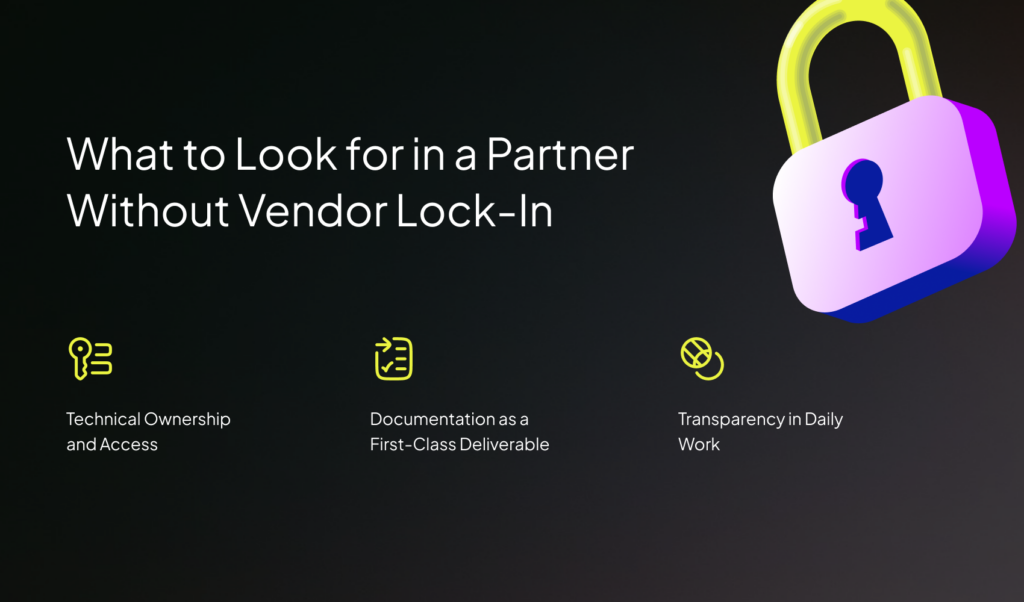
Technical Ownership and Access
Control starts with access. Full access.
This includes:
- Source code repositories
- Build pipelines
- Deployment environments
Access should not depend on trust alone. It should be structural.
Documentation as a First-Class Deliverable
Documentation is often the first thing cut. That is a mistake.
Good partners treat documentation as part of delivery. Not an afterthought.
This includes:
- Architecture overviews
- Setup and deployment guides
- Decision logs
Clear documentation makes systems portable and teams independent.
Transparency in Daily Work
Transparency is not status reports. It is visibility.
Look for partners who offer:
- Open backlogs
- Regular demos
- Honest progress tracking
If progress is hard to see, control is already slipping.
Contract Terms That Prevent Vendor Lock-In
Contracts shape behavior. Clear ones protect both sides.
Intellectual Property and Code Ownership
Ownership should be unambiguous. From the first commit.
The contract must state:
- Who owns the code
- When ownership transfers
- What rights each party has
Delayed ownership invites disputes.
Exit and Termination Clauses
Termination should not feel like a penalty.
Clear clauses define:
- Notice periods
- Handover obligations
- Transition support
These clauses reduce fear on both sides.
Avoiding Hidden Dependencies
Some tools create a silent lock-in through licenses or proprietary platforms.
Contracts should clarify:
- Tooling choices
- Licensing responsibilities
- Replacement options
Transparency here prevents future surprises.
Technology Choices That Reduce Long-Term Dependency
Technology decisions last longer than teams.
Open Standards Over Proprietary Shortcuts
Popular frameworks and open standards lower switching costs. Niche stacks raise them.
Ask why each tool is chosen. “Faster now” is not always better later.
Infrastructure and Cloud Independence
Who owns the cloud accounts? Who controls pipelines?
When a vendor owns everything, exit becomes complex.
Control should stay with the client, even when teams change.
Data Portability as a Design Rule
Data should move easily. Formats should be standard.
If exporting data feels hard, lock-in has already begun.
Communication Models That Keep Control in Your Hands
Good communication is not about friendliness. It is about clarity.
Clear Ownership on Both Sides
Roles must be defined.
Who decides scope changes? Who approves releases? Who resolves conflicts?
Unclear ownership creates dependency fast.
Regular Checkpoints, Not Just Updates
Demos reveal truth. Status reports hide problems.
Frequent demos surface issues early and keep everyone aligned.
Time Zone and Availability Expectations
Overlap matters. So does response time.
Clear expectations prevent delays from becoming dependencies.
How the Best Partners Act Differently
The best partners do something unusual. They plan for a future without themselves.
They encourage understanding, not dependency. They explain decisions. They document thoroughly.
Strong partners avoid phrases like “only we can handle this.” They design systems that others can run.
This mindset separates top healthcare software development companies from average vendors.
Common Myths About Vendor Lock-In
Some beliefs keep teams stuck.
“Long-term partnership means lock-in.”
Healthy partnerships reduce dependency, not increase it.
“Using their stack is faster.”
Short-term speed often trades away long-term freedom.
“Documentation slows delivery.”
Lack of documentation slows everything later.
“We’ll figure ownership out later.”
Later is usually too late.
A Practical Checklist for Outsourcing Without Vendor Lock-In
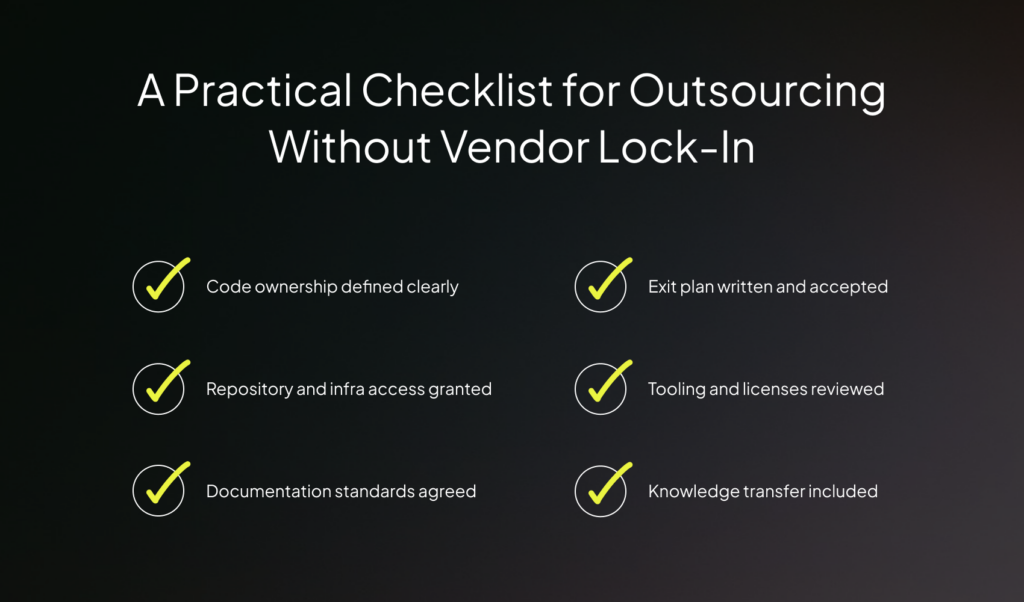
Use this list before signing anything:
- Code ownership defined clearly
- Repository and infra access granted
- Documentation standards agreed
- Exit plan written and accepted
- Tooling and licenses reviewed
- Knowledge transfer included
Build software without vendor lock-in risks.
When Outsourcing Makes Sense and When It Doesn’t
Outsourcing works best when speed and skills are needed quickly. It struggles when direction is unclear or ownership is avoided.
Some teams choose hybrid models. Internal ownership with external execution. This balance often reduces dependency.
When teams outsource healthcare software development, long-term thinking matters more than short-term convenience.
How to Choose the Right Outsourcing Partner for Your Business
Choosing a good outsourcing partner is one of the most important decisions your business can make. Its importance is more pronounced when you plan to outsource healthcare software development.
IT outsourcing had a value of USD 618.13 billion in 2025. Currently, it is valued at USD 638.65. By 2031, it will reach USD 752.08 billion.
IT leaders worldwide choose to outsource software development needs to innovate faster and access skills their internal teams lack.
Below are the key criteria to consider when deciding on a provider>
Define Your Business Needs Clearly
Before talking to any vendor, jot down what you need. A vague talk about “software development” leads nowhere fast. Think about these:
- What problem should the software solve?
- Who will use it, and how often?
- What data must it handle?
- Must it meet specific rules or compliance standards?
Clarity here helps you communicate requirements and prevents partners from guessing. It also makes comparing responses fair and meaningful.
Assess Technical Expertise and Relevant Experience
A partner might be great at building mobile apps, but lack experience with complex healthcare systems. Your goal is not just people who can code. You want people who can solve your problem.
Check portfolios, case studies, and specific examples in your domain. If you plan to outsource healthcare software development, look for partners who have done similar work before. Ask for examples of features they built that are similar to yours.
This prevents surprises later when a vendor claims to “figure it out as they go.”
Evaluate Communication and Collaboration Skills
Even the best technical team can feel like a roadblock if communication is poor. Good communication is not just frequent status updates. It’s clarity, responsiveness, and shared understanding.
Ask yourself:
- Do they respond clearly and quickly?
- Do they ask smart questions?
- Can they explain technical concepts in simple terms?
Your internal team should feel like they’re working with peers, not translators.
Assess Quality Assurance and Security Practices
Software bugs are annoying. In healthcare, they threaten trust, safety, and compliance. A good partner has structured quality assurance (QA) and security review built into their process.
Ask them to describe:
- How they test code
- What security frameworks they follow
- Whether they perform audits or penetration tests
- How they handle sensitive data
If they shrug or avoid specifics, that is a red flag.
Check Flexibility and Scalability
Your needs today are not the same as your needs in six months. A good partner should be able to adapt.
Scalability shows up in two ways:
- The ability to grow or shrink team size as needed
- Flexibility in engagement models (team extension, dedicated teams, service contracts)
If a vendor treats flexibility as optional, your project could stall when priorities shift.
Review Client References and Reputation
Numbers and claims on a website tell only part of the story. Third-party reviews and direct client references tell the rest.
Platforms like Clutch and GoodFirms let you see real feedback from real clients. That can be invaluable when you compare multiple options.
Don’t settle for generic testimonials. Ask for names, industries, and contact info if possible. Real stories beat marketing any day.
Evaluate Pricing Models and Cost Transparency
Cost matters. But cheaper isn’t always better. A low quote that lacks clear line items often hides future surprises.
Strong partners offer clear pricing, with:
- Detailed cost breakdowns
- Clear explanation of what’s included
- Estimates for optional items
Hidden or vague pricing is a sign that you might lose control later.
Consider Cultural Fit and Long-Term Partnership Potential
Technical skills matter. But fit matters too.
Shared values, work styles, and even time zone compatibility make a real difference in day-to-day collaboration.
Ask yourself:
- Do they respect timelines?
- Do they raise concerns early?
- Are they invested in your success?
A partner who fits culturally becomes part of your extended team, reducing risk and friction over time.
Look at How They Approach Handover and Knowledge Transfer
A vendor who plans for a smooth handover from day one is a partner worth considering.
Ask:
- How will they transfer knowledge?
- Will they train your internal team?
- Is documentation part of the delivery?
If answers feel half-baked, you could be stuck later.
Consider Industry Recognition and Long-Term Support Capabilities
Not all great partners shout about awards. But recognition and a track record of post-launch support say a lot about reliability.
If your project demands ongoing updates (as many do when you outsource healthcare software development), confirmation that support and maintenance are part of the offering matters.
Why These Criteria Matter for Your Choice
Choosing an outsourcing partner is not just a transaction. It’s a relationship that affects your product, your timeline, your budget, and your future options.
When you compare healthcare software development companies in usa or look at top healthcare software development companies, focus on how they talk about:
- Transparency
- Documentation
- Collaboration
not just their tech stack or price.
Partners who prioritize clear processes, shared ownership, and flexible engagement are far more likely to help you build solutions that stand the test of time.
Common Outsourcing Models for Custom Software Development
When you decide to outsource healthcare software development, the question isn’t just who you work with, but how you work together. Different models matter because they shape control, flexibility, risk, and day-to-day collaboration. Pick the wrong model and you may feel locked into work that doesn’t serve your needs.
Here are the most common outsourcing models. Learning about them will help you decide on the best one for your needs.
1. Fixed-Price Model
This is the model most people think of first.
You agree on:
- Scope
- Timeline
- Price
before work starts.
This feels comfortable when requirements are clear. Everyone sees the finish line before work begins. But healthcare and other projects often evolve, so this model can cause tension if needs change mid-stream. If scope creeps, the struggle over fees can take focus away from actual care outcomes.
It works best when requirements are stable and well-defined.
2. Time and Materials (T&M) Model
This model means you pay for:
- Hours worked
- Specific resources used
It feels flexible because you can refine requirements as you go. That matches many healthcare projects, where real clinic feedback often drives change.
T&M gives you freedom to pivot. But freedom without guardrails can get expensive. Transparency becomes vital. You need clear tracking and communication so you know what you pay for and why.
3. Dedicated Team or Staff Augmentation Model
This model gives you a group of people working as an extension of your team.
Instead of paying per task or per release, you engage a team of developers, testers, architects, or designers dedicated to your project.
This model works well when:
- Work is long term
- You need control over priorities
- Internal and external teams need to collaborate closely
It helps avoid vendor lock-in because your team feels like a natural extension of yours. But it demands clear governance. You must have clear answers to who decides priorities, who handles reviews, and how work shifts week to week.
4. Managed Services Model
Managed services shifts responsibility for part (or all) of the software lifecycle to the partner.
This can include:
- Development
- QA and testing
- Deployment
- Maintenance
When done right, it reduces your operational burden. But it also requires trust because the partner owns many day-to-day decisions. Here’s the key question to answer. How transparent are they about what they do and why?
Managed services are great when you want less involvement in daily execution but still want outcomes you can rely on.
5. Hybrid Models
Many modern engagements are hybrids. They mix elements of the models above.
For example:
- A dedicated team builds the core product
- A T&M component handles evolving feature work
- A fixed-price block covers a major, well-scoped launch
This gives balance. You have predictability where you need it, flexibility where you want it.
How to Choose the Right Model
Ask these questions before deciding:
- Are requirements stable or likely to change?
- Do you need deep control over the team’s priorities?
- Is long-term collaboration planned?
- How important is budget certainty vs flexibility?
This early thinking prevents surprises later when development ramps up or priorities shift.
How Imenso Software Can Help With Outsourcing Custom Healthcare Projects
Choosing the right model is only half of the battle. The other half is choosing a partner who treats your goals as their own.
Imenso Software is built around one simple principle: partnership over delivery.
Here’s what that looks like in practice:
1. Tailored Outsourcing Models
Imenso doesn’t push one size fits all. Instead, it helps you choose and refine an outsourcing model that matches:
- Project complexity
- Team involvement preferences
- Long-term roadmap considerations
Whether you lean toward a dedicated team, a T&M engagement, or a hybrid approach, Imenso makes sure the model supports control and clarity.
2. Transparency and Shared Ownership
From day one, Imenso ensures you have visibility into:
- code and repository access
- sprint plans and priorities
- daily progress
- test results and release notes
This means you never feel like you’re waiting in the dark. Decisions are shared. Risks are surfaced early. Nothing critical is left unspoken.
3. Documentation and Knowledge Transfer
One common outsourcing fear is that knowledge stays with the vendor. Imenso breaks that pattern by building documentation and knowledge transfer into every engagement. You gain:
- Clear architectural overviews
- Setup and deployment guides
- Onboarding material for new team members
This reduces dependency on any single partner and makes future transitions smoother.
4. Compliance-First Design in Healthcare Contexts
Healthcare adds regulatory demands. These include HIPAA, GDPR, and others. Most generic firms overlook them until it’s urgent.
Imenso’s approach embeds compliance into:
- Security practices
- Workflow design
- Data handling logic
- Audit readiness
This prevents late surprises and reduces costly rework.
5. Long-Term Support and Evolution
Software is never truly “done.” Needs evolve, regulations shift, and care delivery changes.
Imenso plans for long-term support upfront, with clarity around:
- Version updates
- Maintenance windows
- Scalability planning
- Performance monitoring
This means you can evolve without fear of losing control.
A Final Thought on Control and Trust
Outsourcing should expand options, not limit them.
The right partner helps build systems that work even after the partnership ends.
When the time comes to change direction, will the software move with the business, or hold it back?
Keep control while scaling software development.
Similar Posts

The Hidden Costs of Hiring Developers Offshore (And How to Avoid Them)
Are you exploring ways to reduce offshore development costs by hiring developers from overseas? The debate around outsourcing has been ongoing in the U.S. for years—and it’s not going away anytime soon. Still, one fact remains clear: businesses often need an offshore development team because it significantly cuts expenses. Partnering with skilled developers from other […]...

Best Time Zones & Countries for Hiring Offshore Developers in 2025
All businesses are under constant pressure to be innovative, ranked, and remain competitive. Yet, having and managing an in-house development team is costly and time-consuming. This is most often observed in startups and mid-sized businesses. Scenarios like these are where offshore development occurs. It taps into global talent, cuts operating costs, and allows for 24/7 […]...
A Complete Offshore Software Development Company Hiring Guide
Building and running a business is probably the hardest and the most fun thing any business owners do in their lifetime. And the toughest part of the job is to keep it relevant as trends and technologies change. ...