How to Choose the Right Custom Software for Your Business

Custom software is tailored applications that address specific business needs. These solutions are built to match the exact requirements of a company. Custom software development thus transforms business workflows. It provided targeted functionality that drives efficiency and competitive advantage.
This type of software becomes necessary when a business outgrows generic options. They offer the benefit of scalability to meet changing business needs. You may require one depending on your unique business challenges. This blog will help you discover whether you need a custom solution. Further, we will tell you in detail about how to choose the right one for your needs.
How to Know If Your Business Needs Custom Software
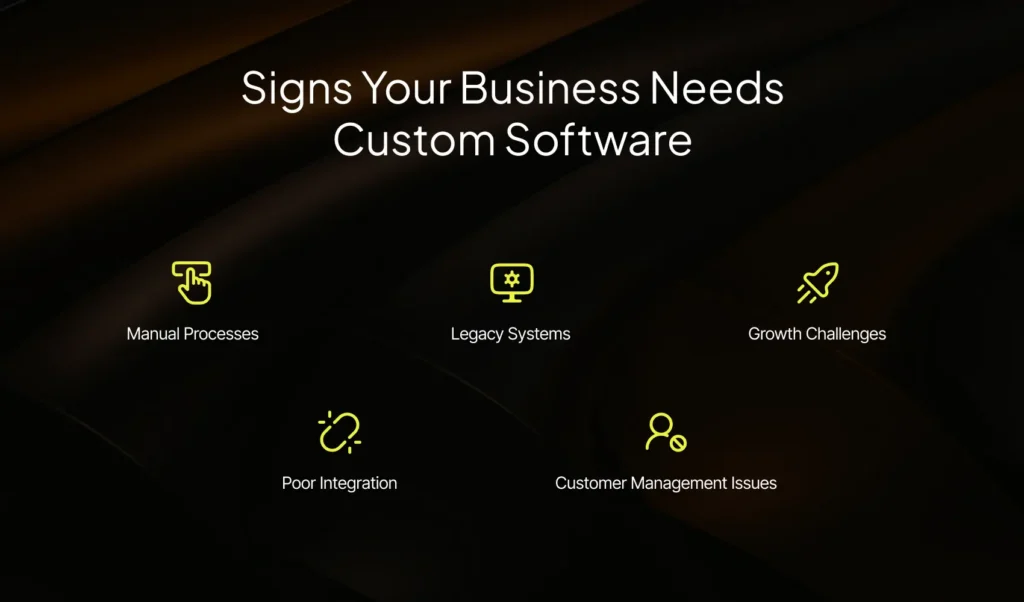
As businesses grow, off-the-shelf software often struggles to keep pace with evolving processes, customer expectations, and operational complexity. While generic solutions work for common requirements, they may become restrictive when organizations need greater flexibility, scalability, or competitive differentiation.
You may benefit from custom software development if your business is experiencing any of the following challenges:
- Manual processes are consuming excessive time and resources
- Existing systems are disconnected and unable to share data effectively
- Business workflows require automation and optimization
- Current software cannot support growth or changing requirements
- Customer management and engagement are becoming increasingly complex
- Legacy systems are limiting performance, security, or innovation
- Teams rely on multiple tools to complete a single process
- New revenue opportunities require unique functionality not available in off-the-shelf solutions
- Operational inefficiencies are impacting productivity and decision-making
- Gaining a competitive advantage requires technology tailored to your business model
Custom software addresses these challenges by aligning technology with your specific business goals, processes, and long-term growth strategy.
Not Sure If Custom Software is the Right Move?
Common Types of Custom Software Solutions
There are varied types of software development. Knowing the types is essential to invest in the best one.
1. Mobile Application Development
Custom mobile apps allow you to offer a tailored user experience. Custom apps address a specific user set. Here are the benefits it offers:
Improve Productivity: Allows for fluid workforce collaboration. The apps integrate various functions to increase efficiency.
Increase Revenue: Third-party collaborations offer additional services to your customers. It also pushes them to spend more.
Broader Scope of Scale: The scalability of your custom apps depends on the scope of your business. Custom apps can be modified easily when needed.
Personalization: Custom app development lets you customize for your audience. This consists of custom messaging, business branding, and user experience.
Improves Security: Offers on-site storage. Alternatively, you can use the cloud for your app.
2. E-commerce Software Development
The e-commerce sector is characterized by changing buyer demands. To meet them, E-Commerce software development has gained traction. Here’s what it offers:
Integrate Unique Business Procedures: E-commerce retailers can address routing business challenges with these solutions. Automating daily workflows helps bring more efficiency.
Integrate With Other Business Systems: E-commerce apps can be fluidly combined with other systems. These can be programs like the ERP, marketing platforms, and CRMs.
Higher Scalability: These solutions are easy to scale. They expand to accommodate the changing business needs.
Competitive Advantage: E-commerce companies, by offering custom apps, can differentiate themselves from their peers. It allows them to offer a unique buying experience.
3. SaaS Development
A custom SaaS software lets businesses offer their clients access to online apps. It removes the need for expensive hardware management. This type of custom solution provides the following benefits.
Lowers Upfront Costs: Removes upfront costs linked with the buying and installation of typical software.
Scalable to Needs: Businesses can scale their SaaS solution to address their customer’ needs.
Higher Level of Security: SaaS offers more security than other data storage methods. Custom SaaS solutions enable you to effectively protect and manage data.
Back-up and Data Recovery: Safely install and store the IT framework and data through cloud storage in a remote location.
4. Custom Product Development
This service is best for businesses wanting to monetize their software for revenue. It covers all processes of developing products. This includes:
- Product strategy
- Product design
- Product development
- Product launch
- Product maintenance
- Product support
- Product expansion.
Product development includes the following types of solutions
- Web-based products
- Mobile apps
- SaaS-based apps
- White label software
How to Choose the Right Custom Software: Step-by-Step
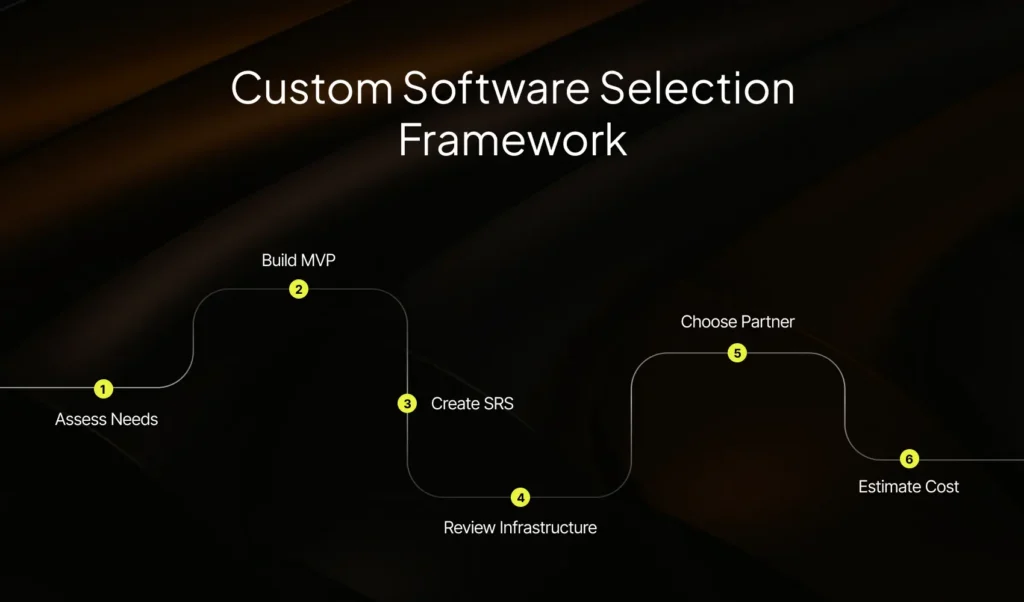
1. Assess Business Needs
When choosing custom software, a company must assess several core areas. Doing so ensures that the software aligns with your operations, customer demands, and long-term growth. Analyze the following areas:
- Unique business processes
- Requirements for improved efficiency and scalability for growth
- Need for integration with existing systems
- Security and compliance demands
- Competitive advantage
- A need for better user or customer experience.
For example, a finTech company might require simplified customer onboarding that can integrate with various data sources. So, it will invest in custom software development for an onboarding platform. It will automate KYC checks and integrate with different financial data sources. This will reduce onboarding time and improve customer satisfaction. These benefits cannot accrue from a generic, off-the-shelf software.
2. Build and Validate an MVP
Once you have finalized the problem that the custom software will solve for your business, it’s time to create an MVP (Minimum Viable Product). As the simplest version of your custom solution, MVP has the most essential features. The functionalities are meant to resolve the major problem. Building an MVP validates the core idea, and you can further refine it to create the complete product.
To design an MVP, business owners must partner with trustworthy software development consultants. They help you refine concepts while providing scalable solutions for your needs. As a result, you benefit from reduced risks and enhanced efficiency.
3. Create an SRS
After taking in feedback from the MVP, create a Software Requirement Specification (SRS). It has both technical and functional requirements and keeps the stakeholders aligned. A detailed SRS includes the project’s scope, target audience, functional, and non-functional requirements. It also allows vendors to identify the costs related to development.
4. Evaluate Existing IT Infrastructure
You don’t always have to choose to build custom software from scratch. A careful review of your current infrastructure may provide insights into reducing overall development costs and efforts. For example, you can build a strong custom solution by combining a few existing generic software. You can also integrate the current solution with new systems to make it more compatible and efficient.
To assess your existing software infrastructure, review the following details:
- Hardware configurations: Server specifications, network devices, and storage setups.
- Check your hardware: Look at the server details, networking gear, and the arrangement of storage devices.
- List all software: Track which operating systems and programs are installed and their version numbers.
- Review databases: Examine how the databases are structured, data links, and storage approaches.
- Map your network: Check device connections, communication protocols in use, and available bandwidth.
5. Choose the Right Development Partner
When you’ve decided on the kind of custom software you want, look for a partner to develop it. When finding a custom software development company, keep in mind the following:
- The partner should specialize in working with businesses of your size. This will allow it to understand and cater to your specific needs.
- It should have a developer team experienced in a range of tools and technologies. These cover cloud computing services, AI and ML, DevOps, Blockchain, and the like.
- The team should be adaptable to change and manage deadlines effectively.
6. Estimate Cost & Long-Term Investment
Based on the size of your project’s scope, custom software development services can cost between $20,000 and $80,000. Large-scale projects with advanced features, like ERPs, BI platforms, or AI/ML platforms, cost way more. Businesses must consider every possible factor for accurate cost estimation. These include:
- Project’s complexity and timeline
- Skills and location of the development team
- Technology stack, as different programming languages have varied costs and availability of skilled developers
- Required integrations
- UI/UX design
- Whether data migration is needed
- Security needs
- Maintenance and support services
A trusted software development company will support you in producing an accurate cost estimate. You must be open and specific about your requirements and expectations. This will let you receive more transparent pricing, with clear details on the costs for different elements of development.
Striding Ahead with Custom Software Development
Custom software development helps startups adapt to market demands. It helps them outpace their peers. Such solutions boost operational efficiency and consequently productivity. However, to choose one, you must be clear about your needs. It is crucial to choose the right software development agency for the best solution.
If you want to enhance your business revenue with custom software, Imenso Software is here to help. Our expert team brings years of experience to create innovative solutions that contribute to your business growth. Contact us today to get started.
Ready to Turn Code into Competitive Advantage?


Similar Posts

Best Practices for Writing Clean and Maintainable Code in Software Development
Did you know that bad code costs companies billions of dollars every year in maintenance and debugging? According to a report, developers spend up to 50% of their time on debugging issues arising from messy and unclear code. That is the time spent that could be used in developing new features or performance improvement. Clean […]...

App Design – How We Build Better Applications With Behavioral Psychology & Design Principles
Hundreds of thousands of apps, no-code tools, digital products, and millions of websites are available over the internet. While some are great successes, others don’t even exist for a large population. Only a few products succeed in hitting their target market and explode, while others live in the abyss of the internet. ...

How the Discovery Phase Defines Project Success
Ever watched a software project spiral into chaos? It’s often because a clear idea of what success looks like up front might be hazy for businesses. Therefore, in software development, the discovery phase is the cornerstone of your project; picture it as the road map that unites your team, makes objectives clear, and charts the […]...