Backend Framework Selection: How To Build Scalable Web Services
Backend framework selection does not just mean picking a popular tool. It means choosing the core system that runs your product. It is the base of your app’s speed, growth, and future.
In simple words, it decides how your system thinks, moves, and grows.
A wrong backend framework can:
- Slow your app
- Break under traffic
- Block new features
- Create tech debt
- Force full rewrites
Many teams build fast at the start.
- They ship quick.
- They get users.
- Then traffic grows.
- Data grows.
- APIs grow.
And suddenly:
- Pages load slow
- Servers crash
- Costs jump
- Fixes take weeks
- Scaling feels painful
This is where backend scalability matters. Bad choices lead to:
- Performance ceilings
- Hard limits on growth
- Complex rewrites
- Broken integrations
- High maintenance
Good choices create:
- Scalable web services
- Clean APIs
- Smooth growth
- Easy upgrades
- Long-term stability
If you are a founder, CTO, or developer building real products, backend framework selection shapes everything ahead.
This is why serious teams work with a trusted web application development firm. Their collaboration is not just to build. It is to create a system that grows with their business.
What “Scalable Web Services” Really Require (Before Choosing Any Framework)
Before picking any backend tech, you must understand what scale you actually need. Scalable web services are built on clear design rules.
Stateless Services
Stateless means that the server stores no user session data.
Each request:
- Comes in fresh
- Gets processed
- Goes out clean
This matters for
- Easy autoscaling
- Simple load balancing
- No session conflicts
- Better reliability
Stateless services are the base of microservices. They are key for cloud-native backend systems.
Horizontal Scaling vs Vertical Scaling
Vertical scaling = bigger machines
More RAM. More CPU. Bigger servers.
Horizontal scaling = more machines
More nodes. More containers. More instances.
| Type | Meaning | Problem |
| Vertical | Scale up | Has limits |
| Horizontal | Scale out | Built for growth |
Modern systems use horizontal scaling. This is because it:
- Supports autoscaling
- Handles traffic spikes
- Works with load balancing
- Reduces failure risk
Service Decomposition
One big system = hard to scale.
Many small services = easy to grow.
This is called:
- microservices
- service decomposition
Each service:
- Has one job
- Owns its data
- Scales alone
Benefits:
- Faster updates
- Better resilience
- Clear ownership
- Easier fixes
This is core to resilience engineering.
API-First Design
API-first means to design the API before the UI. Your backend becomes a product. It does not just support code. This offers the following benefits:
- Clean integrations
- Mobile-ready
- Partner-ready
- Platform growth
API-first design supports:
- SaaS models
- marketplaces
- enterprise systems
This is key for enterprise web application development services.
Cloud-Native Readiness
Cloud-native means built for the cloud. Cloud-native backend systems support:
- Containers
- Autoscaling
- Load balancing
- Managed services
- Global deployment
Observability and Resilience
If you cannot see your system, you cannot scale it. Scalable systems need:
- Logs
- Metrics
- Traces
- Alerts
- Health checks
This gives:
- Faster fixes
- Less downtime
- Better planning
- Strong reliability
Backend Framework Selection Criteria (Decision Model)
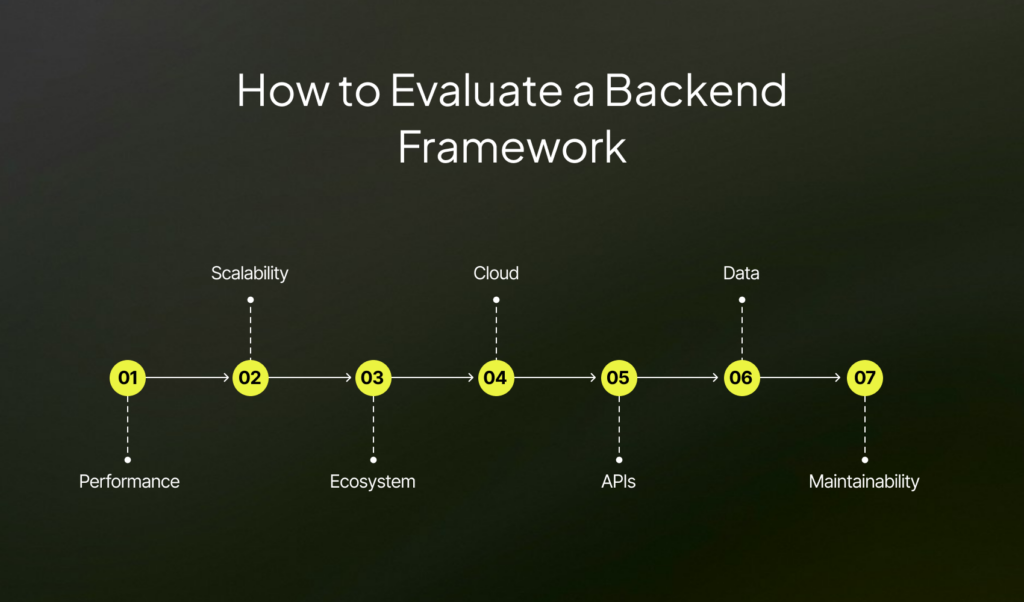
This is the real decision layer. This is the criterion that smart teams choose to build scalable systems. Backend framework selection should follow a decision model, not a guess.
Let’s break it down.
1 Performance & Concurrency Model
This decides how your system handles users at the same time.
Event-driven vs Thread-based
Event-driven systems
- Handle many users at once
- Use non-blocking flows
- Great for real-time apps
- Best for high traffic
Thread-based systems
- One thread per request
- Simple to build
- Easier logic
- Harder to scale at high load
Async vs Sync Architectures
| Type | How it works | Impact |
| Sync | One task at a time | Slower under load |
| Async | Multiple tasks at once | High performance |
2 Scalability Architecture Support
This is about growth design.
Microservices Readiness
Can the framework:
- Split services cleanly?
- Handle service-to-service calls?
- Support autoscaling?
- Work with load balancing?
If yes, it is good for scale.
Modular Monolith Support
Not all systems start as microservices. Good frameworks allow:
- One system
- Clean modules
- Clear boundaries
- Easy future split
Service Orchestration Compatibility
If the service cannot orchestrate, it won’t yield real results. So, it must work with:
- Kubernetes
- Docker orchestration
- Cloud schedulers
- Auto-deploy systems
3 Ecosystem & Maturity
Tech is not just code or tools. It is the people, support, libraries, and real-world use behind it. A strong ecosystem and mature framework mean stability, safety, and long-term growth without risk.
Libraries
- Auth
- Payments
- Caching
- Queues
- Messaging
- Storage
Community
- Docs
- Tutorials
- Support
- Forums
- Stack help
Enterprise Adoption
If enterprises use it:
- It’s stable
- It’s tested
- It’s secure
- It’s proven
This is critical for enterprise web application development services.
4 Cloud-Native Compatibility
Modern apps live in the cloud. So, your backend must support:
Kubernetes Readiness
- Pod scaling
- Service mesh
- Auto-restarts
- Health checks
Serverless Support
- Function-based deploys
- Event triggers
- API gateways
- Cost efficiency
Containerization
- Docker-ready
- Fast builds
- Easy deploy
- Safe isolation
5 API Capabilities
Your backend is an API engine. It must support:
| Type | Use case |
| REST | Standard apps |
| GraphQL | Flexible data needs |
| gRPC | High-speed services |
Good backend framework selection means:
- Clean APIs
- Strong docs
- Version control
- Secure auth
6 Data Layer Integration
Data is the system. Your framework must work with:
SQL / NoSQL
- PostgreSQL
- MySQL
- MongoDB
- Redis
- DynamoDB
ORM / ODM
- Clean models
- Safe queries
- Fast dev
- Less bugs
Distributed Databases
- Sharding
- Replication
- Global data
- Failover
7 Long-Term Maintainability
This is where most systems fail.
Hiring Pool
Can you find devs easily? If not, there’s risk.
Learning Curve
Hard tech leads to slow teams.
Upgrade Path
Can it upgrade cleanly? Or does it break apps?
Security Updates
- Regular patches
- Active fixes
- CVE handling
- Community audits
Simple Decision View
| Area | Why it matters |
| Performance | User experience |
| Scalability | Growth |
| Ecosystem | Speed |
| Cloud | Cost + scale |
| APIs | Integration |
| Data | Stability |
| Maintainability | Survival |
Backend framework selection is not just tech. It is business safety. This is why serious companies work with a strong web application development firm.
Backend Framework Selection Matrix (Comparison Table)
This matrix helps compare real backend systems in a simple way. It shows:
- How each framework behaves under load.
- How it scales.
- What is it best used for?
Backend Framework Comparison Table
| Framework | Language | Concurrency Model | Scalability Type | Cloud Readiness | Best For |
| Node.js (NestJS) | JS / TS | Event-driven async | Horizontal | High | APIs, microservices |
| Django | Python | Sync + async | Vertical + Horizontal | Medium | SaaS platforms |
| FastAPI | Python | Async | Horizontal | High | High-performance APIs |
| Spring Boot | Java | Multi-threaded | Enterprise scale | Very High | Large systems |
| ASP.NET Core | C# | Async | Cloud-native | Very High | Enterprise APIs |
| Go (Gin/Fiber) | Go | Goroutines | Extreme horizontal | Very High | High-load services |
Best Backend Frameworks for Scalable Web Services
Different products need different systems. The right framework depends on the job.
Let’s group them properly.
1 High-Concurrency APIs
These systems handle many users at once.
- High traffic.
- Heavy load.
- Fast requests.
- Low delay.
FastAPI
- Built for speed.
- Async by default.
- Low latency.
- High throughput.
- Perfect for data-heavy APIs and ML services.
Best for:
- AI APIs
- fintech APIs
- analytics platforms
- high-load dashboards
Node.js (NestJS)
- Event-driven system.
- Non-blocking design.
- Strong async model.
- Easy horizontal scaling.
Best for:
- SaaS APIs
- mobile backends
- microservices
- marketplace systems
Go (Fiber / Gin)
- Extreme performance.
- Low memory use.
- Fast execution.
- Handles massive traffic.
Best for:
- payment systems
- streaming services
- real-time APIs
- traffic-heavy platforms
2 Enterprise-Scale Systems
These systems run large businesses.
Spring Boot
- Enterprise standard.
- Strong structure.
- Deep ecosystem.
- High stability.
Best for:
- Banking Platforms
- Erp Systems
- Large Enterprise Apps
- Regulated Industries
ASP.NET Core
- Cloud-first design.
- High security.
- Strong performance.
- Enterprise-ready tools.
Best for:
- Enterprise Apis
- Healthcare Systems
- Government Platforms
- Large Saas Systems
3 SaaS Platforms
Scalable systems support user growth. They have features like built-in billing, subscriptions, dashboards, and continuous product updates.
Django
- Stable and trusted.
- Strong admin tools.
- Fast development.
- Good scalability planning.
Best for:
- SaaS startups
- Dashboards
- B2B platforms
- Data platforms
Laravel
- Clean structure.
- Fast development.
- Strong ecosystem.
- Easy maintenance.
Best for:
- Saas MvpS
- Business Tools
- Content Platforms
- Crm Systems
4 Microservices Architectures
The system is built for scale from day one. It uses small, independently scalable services with reliable service-to-service communication.
Node.js
- Fast APIs.
- Event-driven design.
- Easy service split.
Go
- Lightweight services.
- Fast communication.
- Low resource use.
Spring Boot
- Strong structure.
- Enterprise-grade services.
- Long-term stability.
Best for:
- large platforms
- cloud systems
- global products
- multi-region apps
5 Real-Time Systems
These systems are designed for real-time performance. They handle live data, active users, and instant actions without latency.
Node.js
- WebSockets support.
- Event-based flows.
- Real-time friendly.
Go
- Fast processing.
- Low delay.
- High concurrency.
ASP.NET Core
- Real-time APIs.
- SignalR support.
- Strong cloud integration.
Best for:
- chat apps
- trading systems
- gaming backends
- live dashboards
How to Make the Right Backend Framework Selection
Backend framework selection must follow:
- Product Type
- Traffic Size
- Growth Speed
- Data Volume
- Team Skill
- Cloud Needs
This is also why smart teams work with a trusted web application development firm. It helps them make the right technical decisions from day one.
Build a backend that scales with you.
Architecture Patterns That Influence Backend Framework Selection
Backend framework selection must match your architecture pattern. If they don’t match, scaling becomes painful. A trusted web application development firm helps businesses design the system before choosing the tools.
Let’s break each one clearly.
Modular Monolith
One system. Many clean modules. Clear boundaries inside one codebase.
How it works:
- Single deploy unit
- Shared database
- Internal modules
- Strong structure
Good for:
- Startups
- SaaS MVPs
- Small teams
- Fast launches
Why it matters for framework choice:
You need a framework that supports:
- Clean layering
- Module separation
- Long-term refactor
- Future service split
Microservices
Many small services. Each does one job. Each scales alone.
How it works:
- Independent services
- Separate databases
- Service-to-service calls
- Independent deploys
Good for:
- Large platforms
- High traffic apps
- Global systems
- Enterprise systems
Why it matters for framework choice:
Your framework must support:
- Service discovery
- Async communication
- Fault isolation
- Horizontal scaling
This is core for enterprise web application development services.
Event-Driven Architecture
Systems react to events. Not requests.
How it works:
- Events trigger actions
- Message queues
- Pub/sub systems
- Async processing
Real examples:
- Order placed
- Payment received
- User signed up
- File uploaded
Why it matters for framework choice:
For real-time scale, your backend must support:
- Message brokers
- Async flows
- Event queues
- Non-blocking processing
API Gateway Pattern
The API Gateway pattern uses a single entry point to route requests across multiple backend services.
How it works:
- Clients hit gateway
- Gateway routes traffic
- Services stay hidden
- Central control layer
Benefits:
- Security control
- Rate limiting
- Auth handling
- Traffic shaping
Why it matters for framework choice:
Framework must work well with:
- API gateways
- Auth layers
- Request routing
- Token systems
CQRS (Command Query Responsibility Segregation)
CQRS separates read and write operations to improve performance, scalability, and system clarity.
How it works:
- One system writes data
- Another reads data
- Different models
- Different scaling needs
Benefits:
- Faster reads
- Better performance
- Clean logic
- Scalable design
Why it matters for framework choice:
Framework must support:
- Event handling
- Async flows
- Data sync
- Multiple models
Service Mesh
A service mesh enables services to handle communication, security, and traffic management automatically.
How it works:
- Traffic control
- Service security
- Observability
- Load balancing
Benefits:
- Secure service calls
- Fault tolerance
- Metrics and tracing
- Smart routing
Why it matters for framework choice:
Framework must support:
- Sidecar patterns
- Service identity
- Secure networking
- Cloud-native tools
Serverless Backends
Serverless backends eliminate server management by running applications entirely on event-driven functions.
How it works:
- Event triggers
- Function execution
- Auto scaling
- Pay per use
Good for:
- APIs
- background jobs
- file processing
- event systems
Why it matters for framework choice:
Framework must support:
- Stateless design
- Cold start handling
- Event-driven flows
- Cloud functions
Simple Summary Table
| Pattern | System Style | Framework Must Support |
| Modular Monolith | One system, many modules | Clean structure |
| Microservices | Many small services | Async + scaling |
| Event-Driven | Event-based flows | Queues + messaging |
| API Gateway | Central entry point | Routing + auth |
| CQRS | Split read/write | Event handling |
| Service Mesh | Managed service traffic | Cloud-native tools |
| Serverless | Function-based | Stateless design |
Backend Framework Selection by Business Stage
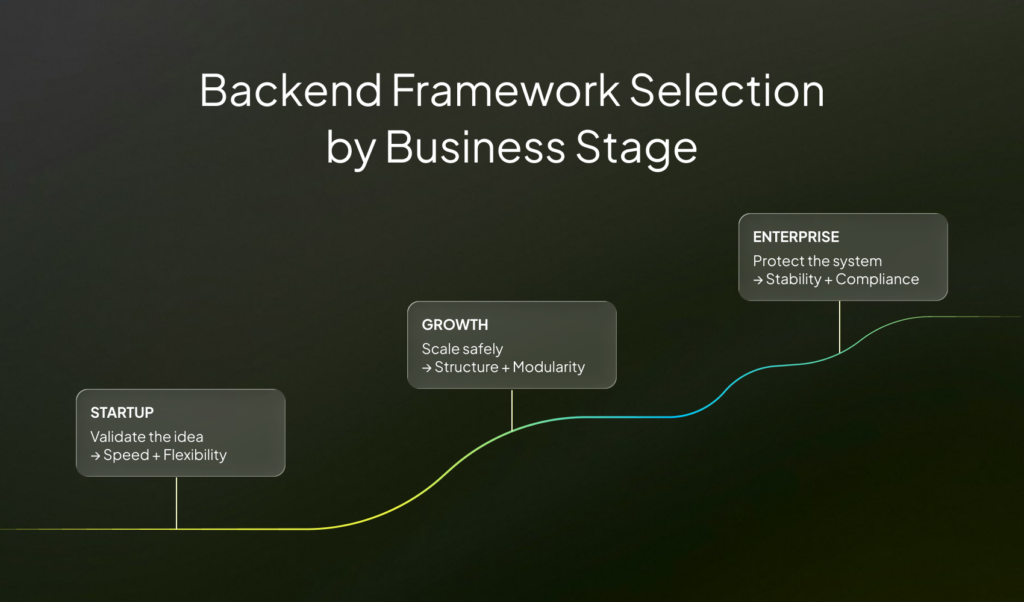
Your business stage changes your needs. Your system must change with it. Backend framework selection must follow where your business is today, and where it is going next.
Startup Stage
Startups move fast. They test ideas. They build, learn, and rebuild.
Speed
You need fast development.
- Short build cycles.
- Quick releases.
- Easy changes.
Frameworks must allow:
- Rapid setup
- Simple structure
- Fast coding
- Quick fixes
Talent Availability
You must hire easily. You cannot depend on rare skills. So your framework should:
- Be popular
- Have a large dev pool
- Be easy to learn
- Have strong docs
MVP Focus
The goal is validation, not perfection. At this stage, customized web application development means building only what proves the idea. It doesn’t mean building heavy systems too early. Your backend should support:
- Fast prototyping
- Simple APIs
- Easy changes
- Quick iterations
Growth Stage
This is the danger zone. Traffic grows. Users grow. Data grows. Costs grow. This is where systems either scale or break.
Scalability Transition
You move from small systems to growing systems. Your backend must support:
- Horizontal scaling
- Load balancing
- Async processing
- Cloud deployment
Modularization
Your system must stop being one block. You need:
- Clear modules
- Service separation
- Clean boundaries
- Upgrade safety
Enterprise Stage
This is the long-term phase of the business. Here, systems must run reliably for years. Stability, security, and risk control matter more than fast releases or rapid feature changes.
Governance
Systems must follow rules. This includes:
- Access control
- Role management
- Audit trails
- Policy enforcement
Compliance
You must meet legal and industry rules.
This includes:
- Data protection
- Security standards
- Privacy laws
- Regulatory audits
Performance Guarantees
The system must always work.
This means:
- Uptime targets
- Load handling
- Disaster recovery
- Failover systems
Clear Stage View
| Stage | Main Goal | Backend Focus |
| Startup | Validate idea | Speed + flexibility |
| Growth | Scale safely | Structure + modularity |
| Enterprise | Protect system | Stability + compliance |
Common Backend Framework Selection Mistakes
Here are the most common mistakes in backend framework selection and why they hurt real products.
Choosing Trends Over Architecture
Teams often pick what is popular, not what fits the system. This leads to:
- Tools that don’t scale
- Poor performance under load
- Complex fixes later
Better approach:
Choose based on system design, not hype.
Ignoring Scaling Patterns
Some systems grow fast while some grow slow. So, if your framework cannot support te following, growth will break the system.
- Horizontal scaling
- Async processing
- Load balancing
- Cloud deployment
Better approach:
Plan scaling before traffic arrives.
Overengineering Early
Startups often build like enterprises. They build complex systems with too many services. This causes:
- Slow development
- High costs
- Hard changes
- Team burnout
Better approach:
Build only what the stage needs. Nothing more.
Underengineering Growth
Some teams do the opposite. They build too small. They don’t have any scaling plan in place. This leads to:
- Rewrites
- Downtime
- Data issues
- Broken upgrades
Better approach:
Design for growth, even if you build small.
Talent-Pool Blindness
Some frameworks look great, bno one knows them. This causes:
- Hiring delays
- High salary costs
- Team risk
- Slow development
Better approach:
Choose tech with a strong hiring pool.
Ecosystem Neglect
A framework without tools is a trap. Lack of libraries, weak documentation and poor support make it tough for the teams to build effective web applications. This situation creates:
- Slow builds
- More bugs
- Higher risk
- Long fixes
Better approach:
Choose mature ecosystems with real support.
Quick Mistake Map
| Mistake | Real Impact |
| Trend chasing | System mismatch |
| No scaling plan | Growth failure |
| Overengineering | Slow delivery |
| Underengineering | Costly rewrites |
| Small talent pool | Hiring risk |
| Weak ecosystem | High maintenance |
Scalable Systems Start with Backend Framework Selection
Scalable systems do not happen by luck. They come from clear planning and smart choices. Backend framework selection decides how your product grows, how it handles users, and how it survives change. When the framework matches the architecture, the business stage, and the long-term goals, growth feels smooth instead of stressful.
Imenso Software helps businesses make the right backend decisions from the start. Our team focuses on planning, system design, and long-term scale. We don’t just build apps. We build systems that grow with your business through smart architecture and customized web application development.
Choose the right backend for growth.


Similar Posts
Micro Services Vs Web Services
There are two different architectures for app development, respectively as Micro Services and Web Services. While both of them have some distinct advantages, it is important to know their differences in detail. Let us define, provide details and explain the pros and cons of both of these app development architectures....
The Role of IT Services in Building Resilient Startup Ecosystems
Scaling up a startup is an exhilarating journey and an enormous challenge. Efficient IT services play an important role in scaling up the startups. Founders leading 200-person teams in rapidly growing companies face many challenges. One of the biggest struggles is scaling operations efficiently without losing agility. While scaling the startup, every process must be […]...
Continuous Integration and Continuous Deployment: A Guide for Modern Enterprises
Are you aware that an organization with automatic CI/CD pipelines deploys more code up to 200 times than one that has nothing to do with these activities? The rate of evolution in the world of business today is outrageous. If slow software delivery is accompanied by low standards, it can be disastrous. Developers need to […]...