How to Build a Digital Workspace for Frontline Healthcare Workers
There are over 2 billion frontline workers globally. Their number far outnumbers that of knowledge workers. Surprisingly, technology has done little to improve their lives compared to white-collar employees.
The benefits of a digital workspace go way beyond growth in business revenue. Digital solutions also boost worker productivity and job satisfaction. Frontline workers have largely been deprived of such innovative tools. This ultimately doesn’t bode well for the business. This segment of employees regularly engages with patients. They have a crucial role in delivering healthcare. Since they perform diverse tasks, a digital workspace is crucial to their success.
This blog explores the various ways businesses can create and improve tech-driven workspaces for frontline workers that empower them to work more efficiently.
Why Frontline Healthcare Needs a Digital Workspace Today?
Frontline healthcare workers, the first point of contact in clinics and hospitals, are burdened with recurring work that leaves them with hardly any time to make the patient experience more enjoyable. The key problems that can be automated to enhance productivity and reduce errors through a digital workspace are:
- Lack of updated access to patient information and care plans
- Inaccurate and inefficient data handling
- Poor care coordination for interdisciplinary healthcare teams
- Risk of sensitive patient data exposure
- Inability of healthcare organizations to confirm the health and safety of healthcare workers in remote areas
- Administrative burdens, like clinical documentation, patient management, and communication. These can be simplified
Tech solutions and capabilities powered by the latest technologies cut the time spent on activities like complicated documentation, communication gaps, and secure data access. With the right tools, frontline healthcare workers can perform their jobs without unwanted stress and effort. There is evidence to prove it as well. A recent survey of 1,400 physicians and advanced practice providers at Mass General Brigham and Emory Healthcare shows that use of ambient AI note-taking and related tools led to a 21.2% decline in burnout in just 84 days!
Digital Tools To Power Frontline Healthcare Workers
A hospital’s tech stack should have robust tech solutions to help frontline healthcare workers work smarter, quicker, and safer. Below are some of the most important digital solutions that support this.
Tools for Care & Monitoring Patients:
1. Electronic Health Records (EHRs)
One of the biggest changes in healthcare today is the use of EHRs. EHR stands for Electronic Health Record. It’s a digital version of a patient’s medical history. These records help doctors and nurses make better and quicker care decisions. With these systems, critical patient data remains readily available at all times. Here’s how it helps frontline healthcare employees.
- Eliminating Errors with EHR
Ineligible handwriting is one of the prime causes of medication errors. An EHR fully eliminates this issue. Their integration lowers adverse drug reactions and enhances treatment outcomes.
- Bar Code Integration for Safer Medication
Modern EHRs can integrate with bar code scanning technology. Suppose a nurse scans the wrong drug. In this case, an alert pops up, making her take corrective action.
- Reducing Duplicate Tests
EHR also lowers the number of duplicate tests. It stores radiology results. Frontline workers can access it from within the app. They can then give it to the doctor if they want to view the actual X-ray. The reports are accessible to them anytime.
- Streamlining Access to Patient Records
EHRs reduce the time that nurses spend searching paper records for relevant data. Physicians don’t need to go to the hospital to access patient records. They can access them from any place and follow up with the patients.
- Early Patient Discharge
Since EHR streamlines care processes, hospitals can discharge patients early. Similarly, it allows clinicians to admit patients quickly. In fact, an EHR can decrease the time to assign a bed for a new patient by 90 minutes.
- Minimizing Redundant Test Orders
EHRs reduce redundancy in test ordering. This happens because clinicians can readily find past test results. This alerts them to similar tests ordered recently. So, the chances of duplicate orders are lowered.
- Efficient Billing Processes
Another way in which these systems increase efficiency is visible with billing. An EHR automatically triggers charges for admissions or orders. It increases the reimbursement for all services. This reduces administrative time spent finding claims.
2. Telemedicine Platforms
Telemedicine is a service delivered via telecommunication and electronic information technologies. It includes all deliverables that increase the efficiency of care for patients and their physicians.
A few main uses are online consultations and remote monitoring. Telemedicine makes healthcare more inclusive and accessible. It makes it easier to get preventive treatment. The technology is especially beneficial for those facing regional or financial constraints to receiving care.
Let’s explore the key reasons why such systems are crucial for a hospital’s digital workplace.
- Protects Clinicians and Expands Their Earning Potential
Someone with an infection who visits a doctor can spread their infection to them. Telemedicine platforms eliminate this possibility. Moreover, it helps clinicians supplement their income. This is because they can virtually see more people than in the office. And when they see patients online, they are not exposed to the infections that the patient might have.
- As a Tool for Training and Supporting Junior Doctors
Virtual appointments through telemedicine systems make junior doctors better prepared to deal with patients. For example, with an online appointment, primary care physicians can get advice from experts if they have doubts about an illness. They can send patient history, exam reports, etc., to the expert for analysis by the doctor. The specialist can answer questions electronically. They can set up a virtual meeting with the clinician as well. These consultations remove the need for unnecessary physical referrals to specialists.
- Smarter Care with AI Integration
When telemedicine combines with AI, care becomes more effective. AI-powered platforms handle routine tasks. They reduce doctors’ workloads and boost their job satisfaction. Such platforms relay data in a high-quality and timely manner. It ensures the smooth running of an appointment. Clinicians can more rigorously review a patient’s health. It greatly enhances the quality of the delivered medical care.
- Immersive Care with Virtual Reality (VR)
VR in telemedicine platforms makes them more interactive. Doctors can now see a 3D monitor when performing surgery. Video conferencing allows an international team of physicians to collaborate on urgent situations. Telemedicine platforms can use VR to simulate patients’ data. It can create a graphical environment with video conferencing. This streamlines communication with a doctor. The approach proves beneficial for providing local healthcare to patients.
3. Remote Patient Monitoring (RPM) Platforms
RPM is a digital solution that records patients’ physiologic data. The data is captured outside of the conventional care environment. RPMs send this data to the doctor for further action. Clinicians use it for reviewing and diagnosing patients. It lets care teams track both short and long-term conditions outside the hospital. This, in turn, makes way for timely intervention.
Below are various ways in which RPMs help frontline healthcare workers.
- Timely Detection Of Health Issues
Doctors can use RPM to access a steady stream of patient data. This data can alert them to make interventions when needed. With an RPM, doctors can gain more visibility into the patient’s current health. It lets them better engage with the patient and provide them with effective care. It also leads to improved clinical decision-making.
- Streamlined Workflows
RPM makes it easy for providers to monitor multiple patients concurrently. So, they can prioritize patients who experience the most severe symptoms. Doctors can focus on patients in the hospital. At the same time, other health staff can monitor remote device alerts. They can escalate concerns to the doctor. Some RPM platforms allow health workers to connect with patients directly if they see abnormal data.
- Care Delivery to More Patients
RPM lowers a patient’s hospital visits. So, doctors can see more patients requiring care onsite. RPM solutions also let hospitals operate more efficiently. For example, a pulmonologist can collect data irrespective of the provider or patient’s location. This leads to more effective communication between caregivers. It ultimately lets the doctor see more patients during their work hours.
Tools for Communication & Collaboration
Instead of long discussions and heavy paperwork, frontline workers can use digital tools for easier and better teamwork. Communication apps and online platforms help in this.
1. Communication Applications and Platforms
Tools like Slack, Microsoft Teams, Zoom, and Messenger make real-time communication easy. Workers can connect through chat, calls, and file sharing. For more focused use, healthcare providers can work with software developers to create custom platforms with advanced features.
- News feed
- Targeted messaging based on location and roles
- Push notifications
- Feedback channels for frontline employees
- Participation in surveys
2. mHealth Technologies and Platforms
mHealth uses wireless devices and smartphones to support healthcare. Apps let users track their health with tools like Fitbits, Apple Watches, and heart rate monitors. They also offer symptom tracking and medication alerts. This helps in the management of chronic conditions.
These devices help frontline healthcare workers access vital health data for patient care and research. The tools enhance teamwork among healthcare specialists. Quick access to medical data also automates routine tasks like scheduling and data entry.
3. Tools for Internal Communication
Frontline and deskless healthcare workers need a central place for communication and task management. Tools like Blink, Speakap, and more meet the communication needs of employees working in different shifts. They also provide safety protocols and other personalized content for specific departments in a single place.
Digital Tools for Efficiency & Data Analysis
1. Artificial Intelligence (AI)
AI is changing how healthcare is delivered. It utilizes machine learning, prediction, and language processing to analyze large datasets. This helps healthcare workers make accurate diagnoses. Further, it enables the creation of personalized treatment plans. AI also automates and simplifies tasks. Thus, frontline staff get smarter tools to work with. It reduces exhaustion and prevents them from feeling burned out.
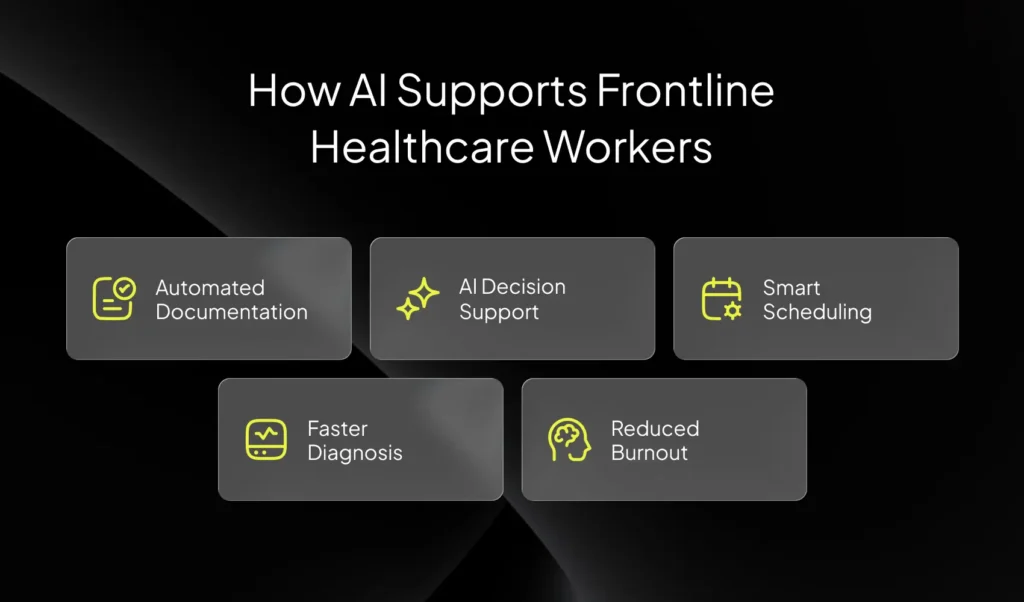
Here’s how AI solutions help healthcare workers.
- Lowers Administrative Burden
Administrative tasks are the prime cause of healthcare professionals feeling burned out at work. AI tools automate tasks like scheduling, referral management, and more. Workers can offload routine inquiries and appointment-related duties to AI chatbots and virtual agents. This lets them focus more on critical patient care.
- Automated Documentation
AI tools make documentation easier. Consequently, it helps reduce healthcare worker fatigue. They can summarize patient visits in real time, cutting down on manual data entry. NLP capabilities enable workers to voice their notes, recommendations, and treatment plans. It saves them from spending time typing out these things. This leads to a seamless integration of data into electronic health records.
- Augmented Decision Support
AI-powered decision support systems enhance clinical expertise. They offer evidence-based insights, so clinicians can make an efficient diagnosis. AI solutions can analyze vast amounts of medical literature and patient data. This allows healthcare workers to make better decisions quickly. Ultimately, it alleviates their cognitive load and improves care quality.
- Increased Diagnosis Accuracy
AI’s ability to assess vast datasets also offers the benefit of better diagnosis accuracy. Analyzing huge healthcare data swiftly and effectively, it makes way for timely and precise diagnosis. AI systems leveraging machine learning can spot patterns and abnormalities in medical imaging. This allows physicians to detect various conditions early. In fact, a study revealed a 50% reduction in missed rates when AI was used in colonoscopy screenings. This shows the potential of this technology for effective and prompt diagnosis.
Modernizing Your Frontline Healthcare Workspace?
2. Device Management Solutions
Mobile devices have become an integral part of care delivery. But their widespread use also increases the risk of data breaches and lost productivity. The solution? Device management systems. This software enables IT admins to secure, enrol, and monitor all connected devices within a hospital’s network. Without it, organizations are exposed to risks that can damage their reputation.
Here are two key benefits of these digital tools for frontline healthcare workers.
- Better Security
A device management system physically stores every mobile device in the hospital. Modern solutions can integrate with common third-party provisioning software products. They have features like a keycard door lock, which tracks checkout/in for all devices. It ensures that they only get into the right hands.
Over half of healthcare data breaches result from the theft of staff mobile devices. These devices store highly sensitive and critical information. A device management system prevents the loss of this information. A secure system also helps ensure regulatory compliance.
Healthcare companies have to abide by stringent HIPAA regulations. A device management solution helps keep you in compliance. Thus, it prevents you from incurring legal consequences and heavy penalties.
- Enhanced Infection Control
The pandemic has forever changed healthcare facilities’ approach toward infection prevention and control. An article from The International Journal for Quality in Health Care tells us of the adoption of non-pharmaceutical intervention measures to prevent infection. A key practice in this regard is environmental sanitization.
A good device management solution can make a world of difference here. Robust systems have advanced features. They are equipped with UV-C sanitization. They keep workers safe by utilizing this surface disinfection that kills most pathogens on connected devices. In some solutions, you can even tailor customization cycle times from 5 to 25 minutes according to your needs.
Steps to Transform Digital Workspace for Frontline Healthcare Workers
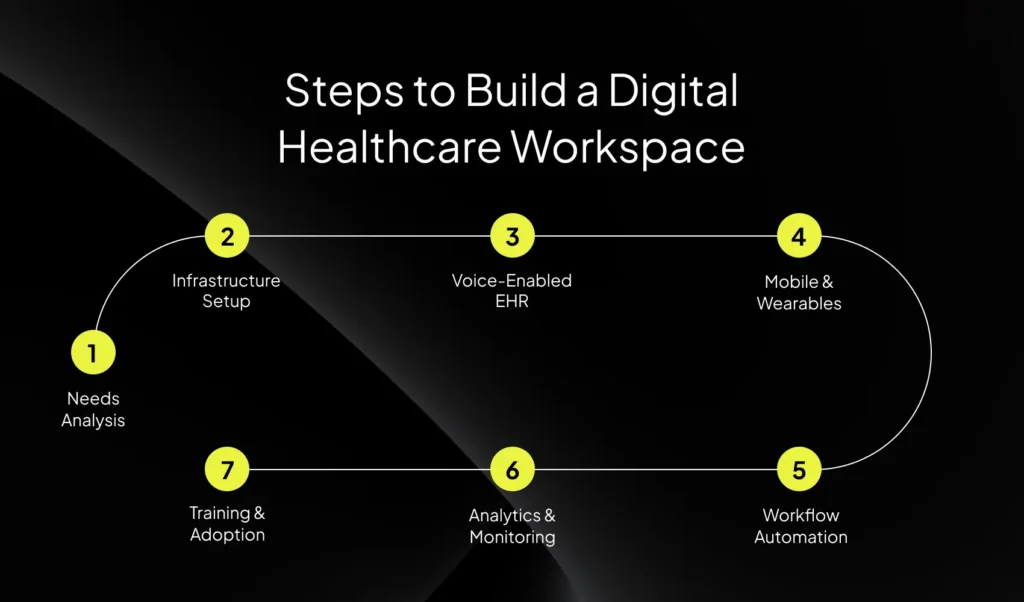
1. Do a Detailed Needs Analysis
Assess the existing workflow of frontline workers and determine the areas which can benefit from technology integration. A great way to do it is surveys. It will capture the pain points from frontline worker feedback. Then, instead of implementing technology just for its sake, healthcare organizations should tailor it to fix the bottlenecks.
Common examples include using collaboration tools to address communication delays, self-service apps to overcome shift coordination issues, and turning off low-value notifications to combat EHR fatigue.
Key areas to assess are:
- Documentation burden – Find how much time is wasted on manual data entry versus patient care
- Communication barriers – Analyze gaps in interdepartmental information flow
- Mobile accessibility – Review the current device capabilities and connectivity issues
- Training gaps – Assess digital literacy levels across all staff categories
2. Implement a Tailored Technology Infrastructure
Based on the feedback and pain points, enforce an IT infrastructure. The major elements include:
- Deployment of Integrated Electronic Health Record (EHR) Systems
Choose EHR systems that fit with the existing clinical processes. They automate data syncing and offer customizable templates and tools. Important features to look for in an EHR are:
- Single-click access to patient charts within normal workflow patterns
- Automated data population from connected medical devices
- Real-time collaboration tools enabling instant communication between care teams
- Mobile-optimized interfaces supporting tablets and smartphones for bedside documentation
3. Enable EHR Interactions Through Voice
Allow voice controls for common EHR functions. Voice-driven systems shrink the lengthy documentation time, so healthcare workers can stay focused on their patients, not keyboards. Voice controls also enable workers to engage with patients more meaningfully; for instance, they can dictate notes, order labs, or analyze charts using voice. This makes conversations with patients more human-like and less transactional.
4. Integrate Mobile and Wearable Technology
Mobile and wearable devices make critical tasks easier to manage. They help with recording and collecting patient data and monitoring patients in real time. The devices also improve interdepartmental communication. Invest in nearshore application development for your frontline workers. Tools for clinical medical reference, drug interaction checking, and medical dosage calculators should be your priority.
For secure collaboration, telehealth tools, messaging, and video conferencing platforms that integrate with EHR are a must. Connect medical IoT devices and wearables directly into frontline healthcare workers’ workspace. Enabling remote monitoring dashboards for vitals, activity, and alerts will give accurate, real-time patient information.
5. Automate & Optimize Workflow
To improve workflow and patient care, the focus should be on the elimination of manual and redundant administrative processes. Also, embedding Clinical Decision Support Systems (CDSS) in the workflow and EHR reduces medical errors and gives actionable information. Through AI, ML, and data analytics, CDSS assist frontline workers in making more informed decisions. This happens with evidence-based recommendations at the point of care.
Here’s how to automate and optimize the workflows of frontline healthcare workers and enhance their digital workspace.
- Deploy intelligent CDSS for real-time, evidence-based guidance in EHR and automated alerts for medication interactions, allergies, and clinical protocols.
- Use CDSS platforms with predictive analytics to foresee potential complications and disease progression.
- Use apps and platforms that automate repetitive tasks. These include sending patient forms to the correct EHR and sharing health alerts. Further, they also help with sending appointment reminders and notifying patients about lab results.
- Deploy ambient AI note-taking, digital scribes, and automated forms to automate documentation and billing.
6. Use Advanced Analytics and Performance Monitoring Platforms
Analytics and monitoring tools turn data into useful insights. In frontline care, custom dashboards reduce medical errors. They can also detect insurance fraud and improve care plans. Further, these dashboards reveal hidden trends in patient data and help gauge potential issues.
As a result, the digital workspace of healthcare workers turns into a launching pad for proactive, accurate, and impactful patient care initiatives. Your focus should be on the following:
- Use real-time healthcare analytics to help staff quickly review EHR data and insights.
- Apply efficiency dashboards to track wait times, resource use, and staff performance.
- Gather real-time feedback through patient satisfaction analytics to improve care.
- Set customized targets and track performance
- Use analytics to highlight priority tasks and reduce information overload.
7. Training & Change Management
Technology delivers results only when it works well with people and processes. To drive real change, involve stakeholders early and train healthcare workers to use new tools effectively.
- Make senior members of the internal staff members of a team that will guide the use of new tools and technology.
- Clearly communicate the results you expect to witness with tech-optimized workflows and tools.
- Create “digital champions” within frontline teams to encourage adoption.
- Get regular updates and conduct surveys to ensure prompt feedback from frontline workers.
- Address resistance and show how tools can save time and make processes efficient and impactful.
- Measure success based on metrics like operational efficiency, clinical outcomes, and financial performance, and improve processes based on it.
Driving Better Care Through Digital Innovation
A digital workspace for frontline healthcare workers is necessary for efficient patient care. Tools like EHR, AI-driven automation and telemedicine platforms reduce workload and improve satisfaction of both workers and patients.
If you want to empower your healthcare staff digitally, partnering with Imenso Software is the ideal next step. With over a decade of experience in developing custom healthcare software development solutions, we develop platforms tailored to help you succeed. Our digital solutions are designed to match your specific needs. We help you modernize operations and improve long-term patient care. Contact us today to see how we can support you.
Ready to Build a Smarter Digital Workspace for Your Frontline Teams?
Similar Posts

Healthcare IT Outsourcing Explained: Benefits and Implementation Guide
Do you know that healthcare organizations are increasingly turning to external IT partners to align in the digital landscape? Managing EHRs and telehealth platforms is costly within the context of running a healthcare system. Hence, organizations are looking for options that offer specialized skills and scalable infrastructure along with consistent compliance support. This way, clinical […]...
AI in Healthcare Data Management: Building Secure and Seamless Data Pipelines
Healthcare generates the most data annually. It comes from new sources of information like Electronic Medical Records, wearable devices, and telemedicine records, among others. However, many hospitals are unable to leverage it to enhance patient care and operational efficiency. There are various reasons for this. A large amount of this data is unstructured, while structured […]...

How Much Does It Cost to Build a HIPAA-Compliant Healthcare App
In February 2025, Community Health Center, a nonprofit in Middletown, Connecticut, had a major data breach. It affected 1,060,936 people. Sensitive data such as names, Social Security numbers, and medical information was exposed. Today, the nonprofit continues to face litigation. But the gravest fallout is the loss of customer trust. In February 2024, Change Healthcare […]...