Custom Software Security by Design: From Zero Trust to Zero Bugs
Do you know that every line of code in your custom software can become a potential entry point for attackers? Since the world is hyper-connected, and according to the IBM 2025 Cost of a Data Breach report, the average cost in the United States is over $10.22 million, which is the highest of any region.
This trend makes it clear: cybersecurity must be built in, not bolted on.
Also, the concept of custom software security by design is crucial when developing solutions for your business. It means integrating protection from the start and having an architecture that assumes no system or user can invade.
As organizations move toward a Zero Trust model, they also aim for “zero bugs.” In other words, software that functions flawlessly and securely from its first deployment day.
Here, we explore how secure custom software development can embrace this powerful combination of security by design plus zero trust to create truly resilient systems that stand firm against today’s cyber risks.
Why Security by Design Matters in Custom Software?
There are so many developers who still don’t fit into the idea of security right from the launch. But cyberattacks are becoming very frequent, and such a mindset can pose danger. The only way to make sure that your digital products are safe is by making them secure with their design itself.
Vulnerabilities can easily slip through when the software is not incorporated with the right security measures. These loopholes become more expensive to fix going forward. In fact, according to the IBM Systems Sciences Institute, fixing a security flaw after deployment can cost up to 30 times more than addressing it during the design phase. This makes early-stage protection a cost-saving strategy for your software.
Understanding the Zero Trust Approach in Software Security
Conventionally, cybersecurity was based on the phrase that trusts everyone who manages to break in, but the scenario has entirely changed, especially with cloud platforms or connected applications. Attackers can now easily find weak spots or use stolen passwords to slip in; that’s why companies today are turning to the Zero Trust model.
Every user and connection must prove their identity before getting access to any resource. Zero Trust protects every layer by continuously checking and validating who is trying to access what.
In custom software, this means every part of your application, APIs, microservices, and data pipelines must verify credentials before sharing or processing data. It’s about building systems that stay alert at all times.
Still didn’t get what the zero bug mindset means? Well, it refers to the integration of security testing into every stage of development.
Key ways to move toward Zero Bugs:
- Shift-left testing: This means detecting and fixing bugs early in the development cycle.
- Automated scanning: The use of AI and code analysis tools to find hidden flaws.
- Peer code reviews: It means encouraging collaboration to catch what automation might miss.
- Continuous integration and testing: This ensures new updates smartly bypass old vulnerabilities and don’t reintroduce them.
The Role of Automation and AI in Software Security
You must be aware of how automation is also transforming the world of technology and ways to manage tasks. Attackers are also utilizing this technology to attack faster than a human response, due to which security teams have to turn to automation and artificial intelligence to detect and respond promptly.
AI is helping software systems stay one step ahead. It analyzes user behaviour and code activity to identify potential threats before they cause harm. Automation also helps maintain consistency by spotting and fixing vulnerabilities before they appear.
You can consider this like a tireless digital security guard which safeguards with an updated shield by learning from every attack it encounters. In the end, automation and AI are the foundation for a smarter and more secure software environment.
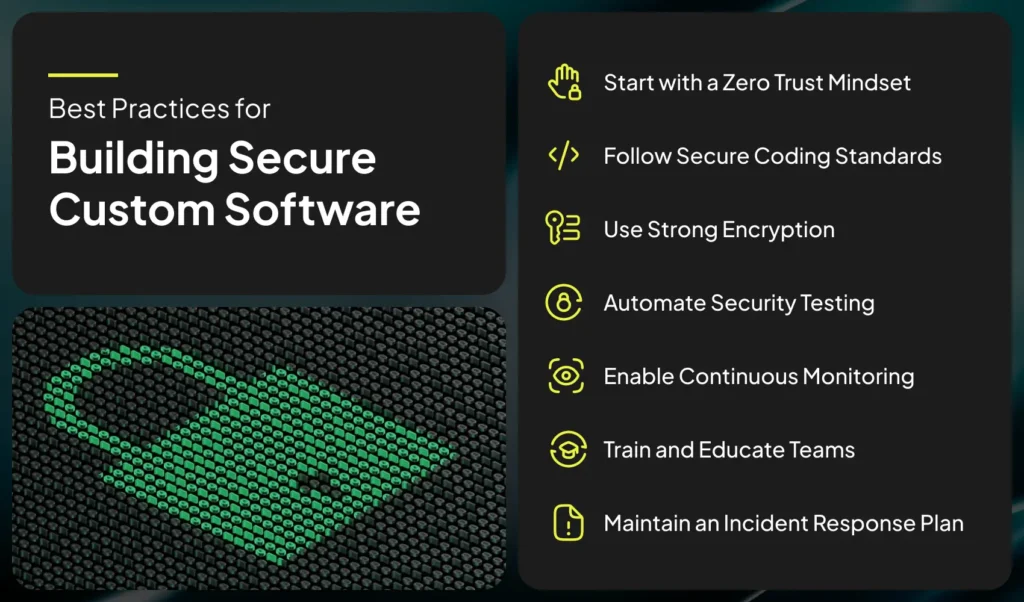
Best Practices for Building Secure Custom Software
It is understood that having a strong security system right from the start is necessary; you need to incorporate it right from the very beginning of the development. No matter if you are building a fintech app or any healthcare platform, you cannot miss out on addressing security concerns.
Here are some simple yet effective practices that help make custom software truly secure.
1. Start with a Zero Trust Mindset
Zero Trust means no user or device is trusted automatically. Every access request needs to be verified carefully. This approach keeps systems safe even if one account is compromised. A 2025 Forrester study showed that companies using Zero Trust software security had 50 per cent fewer data breaches compared to traditional security methods.
2. Follow Secure Coding Standards
The very first layer of defence is the developers themselves. This is possible by closely following the coding guidelines, such as OWASP, which is very helpful to avoid SQL injections or cross-site scripting. Consider doing regular code reviews and automated scans to find and fix any issues before your software is officially deployed.
3. Use Strong Encryption
Just make sure that your data is protected at every stage. This is applicable for every stage where data is stored, processed, or in case shared. Using modern encryption like AES-256 ensures that data cannot be read without the right key, even if the data is stolen.
4. Automate Security Testing
Do you still rely on manual testing for today’s development? Well, it may fail as automated tools like Snyk, Veracode, and Checkmarx can check for vulnerabilities during every build. This helps teams fix issues quickly and maintain a high level of security as the product grows.
5. Enable Continuous Monitoring
Never forget that security is a full-time job and you will have to regularly engage with it. Even if your software is launched, you need to keep an eye on the various aspects. Monitoring tools are very helpful to observe network behaviour or system logs and detect any suspicious activity.
6. Train and Educate Teams
The deployment of the best tools to your software can also fail. Hence, it is important to consider that regular training of your developers and employees about the latest threats and teach them how to avoid common traps.
7. Maintain an Incident Response Plan
No software is totally risk-free, no matter how careful a team is. A clear incident response plan helps the organization act quickly during a breach. Defined roles, clear communication, and regular practice drills make a big difference when quick action is needed.
Security Starts with the Right Build
Security Testing and Continuous Monitoring Strategies
Suppose you have prepared a foolproof software by following all the possible security measures and technology incorporation, still, there will be some loopholes that might be uncovered when the software is deployed or launched.
Hence, continuous security testing and constant evaluations are an essential aspect that helps to build trust and keep systems safe throughout their lifecycle.
1. Start Security Testing Early
Security should be part of development from the very first line of code. Starting early helps detect and fix vulnerabilities. Developers often use static code analysis tools to catch these flaws in real time to save time and money, but also to strengthen the foundation of the software.
2. Go Beyond Penetration Testing
Traditional penetration testing remains important, but modern threats demand deeper, ongoing checks. Many teams now combine manual testing with automated tools to uncover hidden entry points. Organizations that conduct regular penetration tests reduce breach costs by nearly 30 percent according to IBM. This proactive approach turns testing into an ongoing defence rather than a one-time exercise.
3. Implement Continuous Monitoring Tools
The real challenge begins with staying alert after the launch of your software. Continuous monitoring tools such as Splunk or Microsoft Sentinel help track live activity and detect suspicious behaviour in real time. For instance, if someone tries to access restricted data late at night, the system immediately flags it for review. This constant vigilance keeps security threats in check before they escalate.
4. Patch Vulnerabilities Regularly
Do you know that the outdated systems or unpatched vulnerabilities are the major target points for cyberattackers? You can utilize automated patch management tools to close these gaps quickly before the new updates are released. Keeping your software updated not only strengthens security but also ensures compliance with modern data protection standards.
5. Use AI-Powered Threat Detection
The modern continuous security monitoring systems are so advanced that they can use artificial intelligence to predict and identify threats even before they occur. These tools can analyze behaviour patterns or detect suspicious data transfers and alert security teams in real-time. This is something like having a smart digital guard watching over your software 24/7.
6. Integrate Monitoring With DevSecOps
You need to keep in mind that the security testing and monitoring cannot be isolated. It is necessary to integrate them into a DevSecOps framework to ensure every update and feature release is automatically checked for any vulnerabilities. The end goal is to make sure that your security measures are consistently evolving with your software.
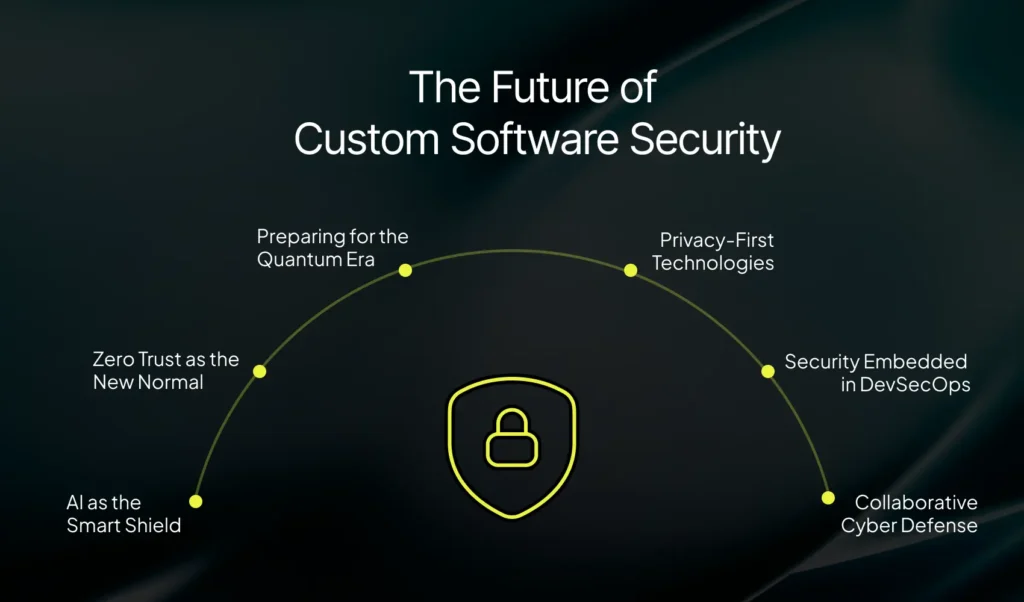
The Future of Custom Software Security
As technology continues to evolve, it also transforms the ways threats can come, changing the future of software security. So, it is necessary to upgrade the approaches to build and protect custom software. The main aim is to launch a software that is strong enough to handle even the most advanced attackers.
1. AI as the Smart Shield
Artificial intelligence is becoming one of the strongest defenses in cybersecurity. It can study patterns and stop threats before they cause any harm to our systems. Not only this, AI continuously learns from data and improves its ability to detect risks on its own in order to protect your systems. This means security that grows smarter with every use of a custom software and helps teams stay one step ahead of attackers. It also saves time that would otherwise be spent on manual checks.
2. Zero Trust as the New Normal
The Zero Trust model has quickly moved from being a buzzword to a standard practice in secure software development. It’s built on a simple but powerful principle never assume trust, always verify it. This means that every user or application must prove its identity before gaining access to any data or feature. This layered approach ensures the safe and protection of the entire system even if one part of the system is compromised.
3. Preparing for the Quantum Era
The introduction of quantum computing itself reflects that it can change everything about technology and security. Besides this, it might be possible that you may encounter a new kind of threat with the incorporation of advanced systems. This led developers to explore new forms of encryption that are designed to withstand attacks at this level and adapt to this shift.
4. Privacy-First Technologies
Well, privacy is no longer just a legal requirement; it has become a value that defines trust in digital systems. Technologies that enhance privacy would allow data to be used for analysis and innovation without exposing any personal information catering to the privacy concerns. Healthcare providers can use AI tools to study treatment patterns while keeping patient records secure and making care even better. Also, businesses can protect both people and information effectively by combining security and privacy at the design stage only.
5. Security Embedded in DevSecOps
In the future, security will not be a final checkpoint but a continuous process which one cannot bypass. The DevSecOps approach ensures that security is built into every stage of software creation. Developers and security experts will work together closely to identify vulnerabilities early and fix them before they become serious problems. This collaborative mindset turns security into a shared responsibility rather than a specialized task, making custom software more secure and reliable.
6. Collaborative Cyber Defense
Cyber threats are global, and every company or country is prone to them. The future of secure software will depend on collaboration between developers and businesses, government agencies. The entire digital ecosystem becomes stronger with the right knowledge and DevSecOps security practices. The security transforms from a competitive advantage into a collective strength when organizations work together with transparency and shared goals.
How Imenso Software Builds Secure and Scalable Solutions?
At Imenso Software, security isn’t something we add at the end, but what we build from the very beginning. Every project starts with the same goal: to create software that performs flawlessly while keeping data and users safe. Our developers think about protection at every stage.
We follow the Zero Trust principle, where every connection is verified before gaining access. This constant validation helps ensure that systems stay secure without interrupting smooth operations or performance.
Also, we don’t stop once your software launch is completed; we keep monitoring and improving to stay ahead of new threats. We build custom solutions that are ready for the future.
Build Software That Stands Up to Modern Threats


Similar Posts
Top 10 User Design Strategies Of 2021 To Reduce Bounce Rate
If we have a look at the past decade, we can see how far the digital marketing domain has come. Every single business is making the best use of this technology in boosting its growth. In a field which is expanding at a high rate, it becomes important to keep a check on the upcoming […]...

Integration Fatigue: How Custom Software Simplifies API Complexity
Most businesses today use many different tools to run their work. A CRM in one place and a billing system in another, along with a support dashboard somewhere else. This might feel manageable initially, but eventually, you might find it very confusing and something that doesn’t support your system at all. Do you know the […]...
Imenso Software Succeeds by Offering Client-Focused Services: GoodFirms
Having the required expertise and experience to develop and deploy customer-oriented solutions endows Imenso Software as one of India’s top web development companies at GoodFirms....