Why HIPAA Compliance Matters for Healthcare Data Protection
The Health Insurance Portability and Accountability Act (HIPAA) is now a critical tenet of the healthcare industry in the US. The act goes beyond just protecting patient data. It also addresses the portability of insurance coverage. HIPAA makes medical facilities accountable for every aspect of safeguarding patient data. It establishes information security protocols that all healthcare businesses must abide by.
HIPAA compliance thus gives businesses a strong security posture, better internal processes, and greater patient trust.
In this blog, we will understand this act in more detail and understand why ensuring compliance is critical for medical organizations.
What Is HIPAA Compliance?
HIPAA, or the Health Insurance Portability and Accountability Act, is a U.S. law aimed at protecting people’s private health information. Compliance with this act keeps the medical data secure when it is shared electronically between different parties. These include healthcare providers, insurance companies, and other authorized entities.
What HIPAA Compliance Does?
HIPAA Compliance sets up rules regarding the handling of Protected Health Information (PHI) between organizations. These can be the records, test results, and insurance details of patients. A healthcare entity cannot disclose such information without the permission of patients. Failure to comply with HIPAA leads to legal damage in the form of fines and penalties.
HIPAA has the following major parts:
- Privacy Rule – It protects personal health data and lets patients control its visibility.
- Security Rule – It ensures that the electronic records are safe
- Breach Notification Rule – It requires organizations to inform patients if their data is revealed in a security breach.
HIPAA’s Role in Healthcare Data Protection
The HIPAA Security Rule, a part of HIPAA law, focuses on protecting electronic Protected Health Information (ePHI). This means digital health records that are stored or sent virtually.
The Security Rule requires healthcare entities to ensure the following things about electronic health data:
- Confidentiality: Health information is solely accessible to authorized people
- Integrity: No modifications in health data. It should not be destroyed without permission.
- Availability: Authorized people should be able to access the information whenever they need for their patients’ well-being and care.
How HIPAA Protects Healthcare Data?
HIPAA uses ”safeguards” to keep electronic health information secure:
Administrative Safeguards
These are the policies for data security management. They include:
- Conducting risk assessments to find loopholes in security
- Staff training for handling patient data
- Assigning a security officer to look at protection efforts
- Controlling access to medical information
- Planning to respond to security incidents
Physical Safeguards
Physical safeguards in HIPAA are protections for the actual physical locations and equipment where there is health data. The major examples are:
- Controlling who can enter facilities with patient records
- Using badge systems and visitor logs
- Securing workstations so screens aren’t visible to everyone
- Placing devices in locked areas
- Properly disposing of old hard drives and equipment with patient data
Technical Safeguards
Technical safeguards are tech tools to protect electronic data. They include:
- Access controls that verify user identity before giving them access
- Encryption to scramble data to avoid unauthorized access
- Audit systems that track the identity of information accessed
- Firewalls to block unauthorized network access
- Secure data transmission methods
In simple words, HIPAA compliance for healthcare data protection helps both healthcare providers and patients. For patients, it keeps their health details confidential. This also means protection from cyberattacks or accidental leakage. For healthcare providers and insurance companies, HIPAA compliance ensures proper handling of patient information. It makes the use of standardized electronic formats compulsory. So, providers don’t need to use different systems to conduct health-related business plans. Thus, this facilitates high-quality care.
The Cost of Non-Compliance with HIPAA
The cost of non-compliance with HIPAA is financial, operational, and reputational. For healthcare organizations, the effects of it are devastating.
1. Financial Penalties
Fines are imposed by the U.S. Department of Health and Human Services (HHS) and State Attorneys General. These include:
- Fines are tiered based on the level of culpability. The lowest penalty starts at $137 per violation, and the maximum can be $2,067,813 per violation.
- Actual settlements often involve massive fines, such as the $16 million fine against Anthem Inc. Another example is the $6.85 million fine against Premera Blue Cross. This happened when it failed to enforce proper security protocols.
- The average cost of a healthcare data breach averages at $10.93 million per incident.
2. Reputational Damage
- Healthcare data breaches take away patient trust. It also gets negative publicity and media attention.
- Healthcare experiences one of the highest customer churn rates (around 6.7%) after a data breach. It leads to major revenue loss.
- Patients are eligible to file class-action lawsuits under their state’s consumer privacy laws. It results in high legal fees.
3. Operational & Recovery Costs
These costs become visible after a data violation incident. From forensic investigation to downtime, and more, they make up for a huge expenditure.
| Cost Component | Details |
| Forensic Investigation | Hiring external experts to determine the cause and timeline of the breach. |
| System Downtime & Disruption | Cyberattacks cause weeks of operational delays, which leads to productivity loss. |
| Corrective Action Plans (CAPs) | CAPs are resource-intensive as they involve a complete modification of security, policies, and monitoring. |
| Loss of Government Funding | Organizations are susceptible to the closure of their participation in critical government programs if they don’t comply. |
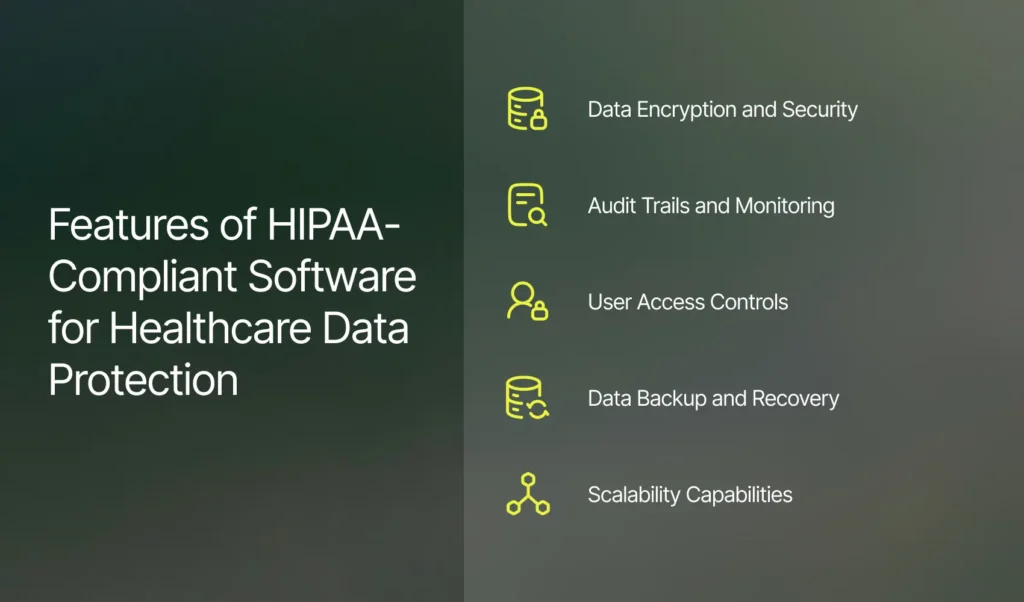
Features of HIPAA-Compliant Software for Healthcare Data Protection
HIPAA-compliant software is necessary for any biopharma company. It helps them comply and efficiently engage and support patients and caregivers. Below are some essential features of such software.
Data Encryption and Security
Data encryption at rest centres on information stored in databases & data encryption in transit safeguards any data being transferred between servers or networks. Medical data is frequently at rest and in transit. So, HIPAA-compliant software must consider both.
Secure access control systems are key to HIPAA compliance. Keeping access to patient data systematically arranged and secure saves time and organizational downtime. Secure access is generally granted in any one of these ways:
- Role-based access control: Give access to data based on a role and its function, not on individual identity.
- Discretionary access: Share access to the data as required on a case-by-case basis.
- Mandatory access: Arrange access into strict tiers. Assign specific clearance levels for confidential data.
Audit Trails and Monitoring
HIPAA-compliant patient software should be able to track and manage access to confidential data. Audit trails document who accesses data. Thus, it effectively keeps a log of which data has been seen and by whom.
The monitoring features and tools simplify compliance reporting processes. It enables the detection and prevention of unapproved access. A HIPAA-compliant software logs all user communications and activity in it for compliance purposes.
This audit trail makes it easy for compliance teams to learn how data is being used. Thus, they can identify potential causes if an issue arises. Intelligent data privacy and security tools in the software enable the occurrence of abnormal activities. Compliance teams can then quickly and proactively resolve the issue.
User Access Controls
Poor access control blinds business associates from knowing who is accessing data and when. HIPAA-compliant software limits access to data based on attributes or roles. For example, doctors can view and update patient records. Nurses, on the other hand, can only view them.
The role-based permissions in the software are tailored according to the medical facility’s unique needs. Role-based access automatically offers the right level of data based on user roles. Thus, it removes the guesswork from compliant coordination. Further, it permits only admins to do crucial things like making changes to templates and business rules. etc.
Data Backup and Recovery
Today, no organization is fully protected from data breaches. So, a HIPAA-compliant software provides robust backup and emergency recovery plans. Regular backups and secure storage of backup data enable medical organizations to act quickly to safeguard data if and when something occurs
Scalability Capabilities
A good HIPAA-compliant healthcare software not only protects patient data, but it also grows with the organization. This means that the system is flexible enough to scale with the needs. This is essential to ensure the future success of the software.
Further, the software integrates with the organization’s existing systems. It enables synchronization of EHRs and data from payors, HUBs, and more.
Where SMBs Fail with HIPAA Compliance for Data Protection?
Many SMBs unknowingly operate with security gaps that can have serious consequences, like penalties and data violations. A recent report shows that 98% of small healthcare organizations think they are HIPAA compliant, but when audited, 99% reveal significant compliance gaps. Here are the main failures that should be addressed:
Insufficient Risk Assessments
SMBs lack a dedicated IT team for comprehensive security risk assessments. These assessments are necessary as they show areas within systems and processes where PHI is exposed. Such assessments are foundational to being HIPAA compliant and are the first request of evidence by the Office for Civil Rights when it investigates a data breach.
Inadequate Compliance Recordkeeping
When there is no consistent record of compliance training, incident response plans, and risk assessments, financial penalties are the consequence. Most SMBs fail to record these details and the actions they’ve taken. It indicates that there is no effort to reduce risks to appropriate levels.
Poor Employee Training
Small medical practices lack formal training programs. They don’t have technical safeguards or a dedicated security team in place. This causes human error, which is one of the top causes for HIPAA breaches. Staff usually do not know how to identify social engineering attacks and the cybersecurity safeguards they must follow. So, it is important to educate employees about PHI, its secure handling, recognizing phishing attempts, and how employees themselves can mistakenly create vulnerabilities.
Weak or Missing BAAs
In March 2025, Health Fitness Corporation, a wellness plan provider in Minneapolis, settled with OCR over a breach that involved the exposure of ePHI. The violation occurred due to a software misconfiguration. Since the company did not perform a thorough risk analysis, it violated the HIPAA Security Rule. It also had to pay $227,816 to OCR.
Each third-party vendor in charge of PHI must have a signed Business Associate Agreement (BAA) that warrants HIPAA compliance. The BAA lays out what a business associate can and cannot do with PHI. It also sets security expectations. But for SMBs, managing these agreements is a major compliance failure. As a result, mistakes like the absence of BAAs with all vendors handling PHI, using generic agreement templates, and failing to track expiration and renewal dates of these agreements are common.
A dedicated software development partner specializing in healthcare technology enables you to develop HIPAA-compliant products and become compliant. The developers use robust controls, monitor every system, and are proactive to avoid threats. Thus, it eliminates the risk of expensive violations.
Summing Up
HIPAA compliance lays the foundation of trust and security in healthcare. It helps businesses become and maintain their credibility. In the increasingly competitive healthcare domain, this is critical.
Imenso Software develops HIPAA-compliant solutions for businesses in this industry. Each of our solutions is secure and tailored to your needs. Ready to deliver quality care backed by powerful tech? Get in touch with us today.
Unsure If Your Systems Meet HIPAA Standards?


Similar Posts

Healthcare IT Outsourcing Explained: Benefits and Implementation Guide
Do you know that healthcare organizations are increasingly turning to external IT partners to align in the digital landscape? Managing EHRs and telehealth platforms is costly within the context of running a healthcare system. Hence, organizations are looking for options that offer specialized skills and scalable infrastructure along with consistent compliance support. This way, clinical […]...
How to Build a Digital Workspace for Frontline Healthcare Workers
There are over 2 billion frontline workers globally. Their number far outnumbers that of knowledge workers. Surprisingly, technology has done little to improve their lives compared to white-collar employees. The benefits of a digital workspace go way beyond growth in business revenue. Digital solutions also boost worker productivity and job satisfaction. Frontline workers have largely […]...
AI Implementation in Healthcare Software
Have you noticed how AI is silently changing modern healthcare? What once seemed like science fiction is now a normal part of hospitals. The tools we imagined ten years ago are now helping doctors treat patients more effectively every day. Technology has helped care institutions to incorporate smart supporting systems that can filter through thousands […]...