Custom Software for Niche Industries: Why ‘Off-The-Shelf’ Never Cuts It
Have you ever felt that the software your business depends on is holding you back instead of helping you grow? That frustration is very obvious, especially in industries that operate with specialized rules and compliance needs. Off-the-shelf software is designed for broad appeal rather than precision. They might fit everywhere, but never fit perfectly according to the needs.
| Key Takeaways: • Custom software provides flexibility and depth that generic tools can’t match. • It bridges the gap between complex industry needs and digital efficiency. • Investing in tailored systems fosters innovation and long-term growth. • Collaboration between business leaders and users is key to lasting success. |
Gartner’s 2025 report states that 60% of technology buyers regret their software purchase decisions within the first year, mainly because generic tools fail to meet their specific operational needs. This sense of regret is even higher in niche sectors like healthcare, logistics, and manufacturing, where every process has unique layers of complexity.
That’s why more organizations are moving toward custom software development to build exclusive systems for their challenges.
In this blog, we’ll explore why off-the-shelf solutions often fall short in niche verticals and how custom-built software helps businesses achieve precision and long-term value.
The Real Problem With Off-the-Shelf Software
Off-the-shelf software sounds tempting at first as it is quick to set up and can be widely used and often marketed as a one-size-fits-all solution. But many businesses realize that the “fit” isn’t quite right going forward. Generic systems rarely understand the unique workflows and customer experiences that define niche industries.
For example, a ready-made scheduling system for a healthcare institution might ignore compliance requirements like HIPAA. Such gaps force companies to work around the software rather than letting the software work for them.
You also need to take note that this generic software restricts growth. You may find yourself trapped with rigid templates and missing integrations as your business grows. It is like what you have chosen, considering that it would save you money, but it becomes a costly compromise in the long run.
Common Issues Businesses Face
- Limited customization options that restrict innovation and process alignment
- Inability to integrate smoothly with existing legacy systems
- Frequent feature bloat forces companies to pay for unnecessary tools
- Poor scalability, especially as operations expand or diversify
- Security and compliance challenges for regulated industries
Why Custom Software Works Better for Specialized Industries?
Custom software, on the other hand, is built to fit the business, not force the business to fit the software. It’s shaped around how your teams work and what your industry demands. Everything is tailored to match your real-world operations.
Here’s why that matters:
- Custom software works the way your team already works, so you don’t have to change your everyday routine just to fit the tool.
- Staying compliant becomes easier because the needed rules and checks are built into the system from the start.
- Connecting it with your other tools is simple, since it can link with older software, CRMs, and any platforms your business depends on.
- As your company grows, the software can grow with you, letting you add new features whenever you need them.
For niche industries, custom software isn’t just about technology; it’s about freedom. It lets you focus on your strengths without being held back by systems that don’t understand your world.
Industries Where Custom Software Creates the Biggest Impact
Some industries need more than just generic software. They need software that fits their own rules, problems, and the way their business changes. Custom solutions work better because they’re built to match exactly what the company needs and offer something that ready-made tools can’t do.
Let’s look at how different sectors benefit from going custom:
1. Healthcare
2. Fintech
3. Education
4. Manufacturing
5. Retail and E-commerce
6. Logistics and Transportation
Real-World Impact: Custom Software in Action
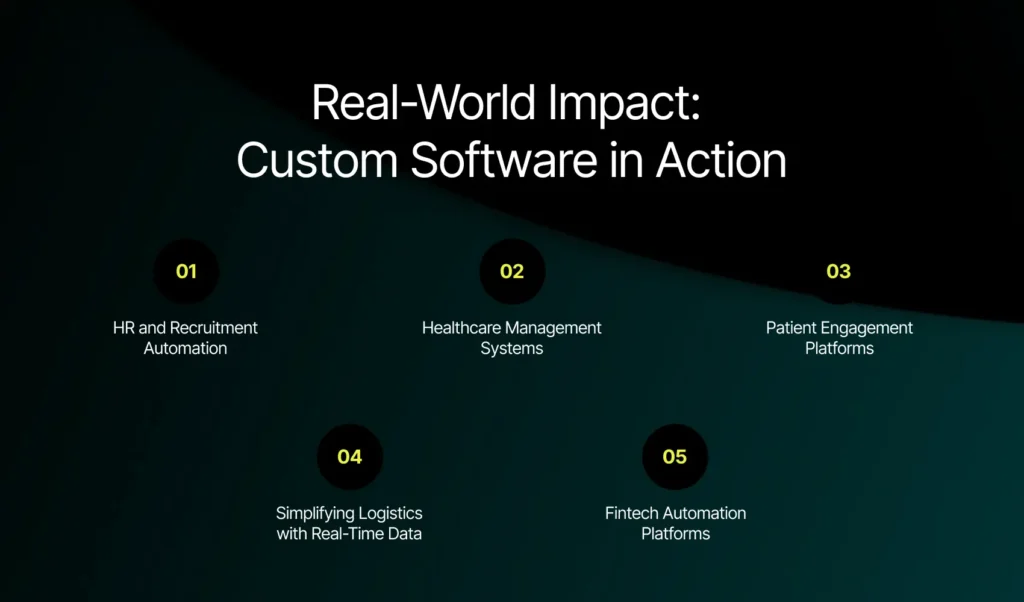
Custom software proves its value through real-world results. Businesses are navigating to develop tools that are designed to cater to their exact needs and help to streamline their work. Take a look at the scenario to get a better idea about how tailored solutions can be a better substitute than generic software products.
1. HR and Recruitment Automation
A leading HR solutions provider needed a more efficient way to handle large volumes of resumes and improve hiring speed. Here, the generic options can’t do justice to managing the complexity and perform the tasks fast enough.
Imenso Software developed a custom recruitment automation platform featuring AI-powered resume parsing and real-time candidate tracking. This streamlined the hiring process and saved valuable time with automation while improving accuracy.
2. Healthcare Management Systems
Accuracy and compliance in healthcare are not negotiable. Many medical providers struggled with outdated systems, which have slowed down the appointment management and billing.
Imenso created an end-to-end healthcare appointment management system with features for scheduling and secure data storage. It helped the organization automate patient flow and maintain HIPAA compliance effortlessly.
3. Patient Engagement Platforms
It is a major challenge to manage patient interaction beyond hospital visits with a growing healthcare network. There is a need for a platform that allows patients to access their records and receive updated security. A customized platform is the best solution to allow patients to access their records or payments, while safely managing updates.
Imenso developed a Patient Resource Center and Payment Solution that provided real-time access to patient data, automated reminders, and an integrated billing module.
4. Simplifying Logistics with Real-Time Data
A logistics company was dealing with frequent delays because its tracking systems were scattered across different tools. This made it hard for the team to see where shipments were, plan better routes, or catch issues early.
Imenso stepped in and built a custom logistics dashboard that brought everything together in one place. It showed live GPS tracking for every vehicle and sent early maintenance alerts so breakdowns could be avoided.
5. Fintech Automation Platforms
A fintech startup wanted a secure platform to automate loan processing and ensure compliance with financial standards. Imenso developed a custom fintech application with encrypted transactions, automated KYC, and fraud detection algorithms.
These examples show that pre-made software is not enough when a business has special needs. Custom-built tools fit the way your team works and make your brand stand out from others.
Custom Software as a Growth Strategy
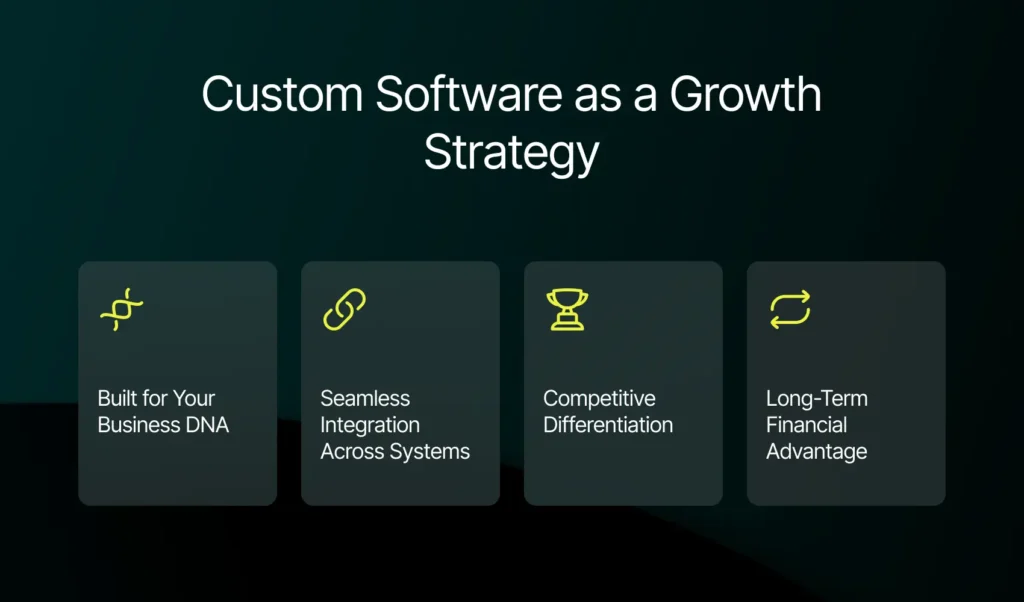
For many businesses, custom software was once seen as a technical investment, something to make daily operations easier. But today, it’s become much more than that. It’s a growth strategy that defines how a company innovates and competes.
Generic tools can restrict the business operations, which won’t be a good sign. When you consider that custom software will help you to evolve with the company. This makes it easier to adapt to the new customer expectations and offer them the freedom to stay competitive with dynamic industry needs.
1. Built for Your Business DNA
Every company has a unique way of doing things, its processes, values, and customer touchpoints. Custom software is designed around that DNA. Instead of forcing employees to adjust to a tool, the tool adapts to the people using it and doesn’t force
2. Seamless Integration Across Systems
Businesses often juggle a lot with different apps and different teams that might end up messing up altogether. The custom software development actually removes all those barriers by integrating all the systems into one unified app or platform. This allows a seamless flow of information that helps teams to work faster and make fewer mistakes.
3. Competitive Differentiation
It is very tough to survive with generic software products, as they don’t have any features that can help you to stand out in the market. Personalized software offers you distinguished features to optimize your workflow in your business, so that you can focus on your growth.
4. Long-Term Financial Advantage
You might think that custom software may require a bigger upfront budget, but over time, it pays off every penny you invest in it. This will reduce your unnecessary expenses for unused features or licenses. You will also not be paying for forced upgrades because you have already invested in a customized software that your team actually needs.
Build Software That Adapts to You
Custom software isn’t just about automation or convenience. It’s about owning your technology, your data, and your direction.
How Custom Software Empowers Niche Verticals
Businesses serving a niche audience usually have specific needs, and these are not addressed by generic tools. It is possible to bridge this gap with the introduction of customized software and fix the exact challenges.
Take a look at how tailored solutions can be helpful to businesses in their growth and innovations:
1. Healthcare: From Data Silos to Seamless Care
Even a slight delay in healthcare can result in halting critical decisions. Custom healthcare solutions are connecting patient records and their treatment systems into a seamless flow. In fact, as per the McKinsey report, the AI-driven and custom healthcare software can generate up to $150 billion in annual savings by 2026 as it offers better efficacy with reduced human error.
Besides this, these systems are also HIPAA compliant and improve data sharing without compromising on their advancement, where generic software products usually crash.
2. FinTech: Compliance and Precision in Every Transaction
It is important to make sure that financial services are equipped with accuracy and airtight security. Generic platforms are unable to offer you that or integrate with smooth banking APIs. A customised software bypasses every restriction and fulfils all the requirements to ensure smooth operations.
3. Logistics and Supply Chain: Real-Time Visibility that Scales
Time is everything for logistics. Businesses need to have all-time visibility across delivery routes and warehouses. The customized platforms designed for logistics help with GPS tracking and other important aspects to reduce delays and costs.
4. EdTech: Personalized Learning at Scale
Education technology thrives on personalization. While off-the-shelf rarely adapts to diverse teaching methods or institutional requirements. Custom EdTech software allows schools and training providers to create adaptive learning paths and track student progress with precision.
5. Manufacturing: Smarter Production and Predictive Maintenance
Manufacturers rely on precise coordination between machines and supply chains. A custom-built solution can integrate essential elements into a unified dashboard. According to Deloitte, companies using custom IoT-driven manufacturing software have seen up to 20% higher production efficiency compared to those using standard ERP tools.
The biggest advantage of custom software beyond the industry needs lies in control. Businesses own their technology to decide how it evolves and avoid vendor lock-in. The software can evolve with the growth of industries or support new compliance requirements without starting over.
Cost, Scalability, and Long-Term ROI of Custom Software
Cost is often the biggest question when companies begin exploring custom software. Building something tailored does feel like a major investment at first. But the long-term payoff is much bigger than most expect. Gartner reported in 2025 that organizations using custom digital tools improved their efficiency by as much as 38% within two years.
1. The Real Cost Equation
Off-the-shelf software may seem cheaper upfront, but costs quickly add up through:
- Monthly or annual subscription fees
- Licensing for multiple users or departments
- Additional integration or customization charges
- Hidden upgrade and maintenance expenses
In contrast, custom software has a higher initial cost but lower lifetime expense. You own the product, control updates, and avoid recurring licensing fees. It also integrates more seamlessly with your existing systems to reduce downtime and dependency on external vendors.
2. Built to Scale, Not to Break
There comes a point where businesses hit the reality that their plug-and-play software isn’t fitting. The personalized software solutions evolve with businesses by adding new features and adjusting their capacity as it grows.
For example:
- A retail brand can scale its e-commerce backend during peak seasons.
- A healthcare provider can integrate new compliance modules as regulations evolve.
- A logistics company can connect real-time data streams for smarter forecasting.
3. Long-Term ROI That Outlasts Trends
Unlike off-the-shelf systems that often need replacement within 3–5 years, a well-built custom solution can last a decade or more with proper updates. That longevity alone offers a major return.
ROI comes from:
- Automation that saves time and reduces labour costs
- Data analytics that improves decision-making
- Better user experience leading to higher customer retention
- Security architecture designed for long-term compliance
Custom software is not just a product purchase; it’s a strategic investment that grows with your business. When designed with scalability and ROI in mind, it becomes one of the strongest assets a company can own, efficient, adaptable, and built to last.
Conclusion: Building Beyond Boundaries
Generic software may promise convenience, but it often limits how far a business can truly go. For industries with unique workflows, compliance needs, or specialized customer experiences, it’s like trying to fit a square peg into a round hole. Custom software, on the other hand, grows with your vision, adapting, learning, and evolving as your business scales.
In niche verticals, the smallest details make the biggest difference. Whether it’s a healthcare app ensuring patient data security, a logistics platform optimizing real-time routes, or an education system adapting to each learner, the power of tailored solutions lies in how precisely they reflect real-world needs.
The message is clear: innovation doesn’t come from one-size-fits-all systems; it comes from software designed for your world.
Ready to Build Software That Fits Your Industry?


Similar Posts

How To Pick The Right Offshore Partner For Your SaaS Company
The offshore software development model is surely enticing for upcoming SaaS companies and startups. Offshore development companies are up-and-coming with lower development rates, faster project completion, high-quality deliverables, and much more. ...

10 Ways in Which Artificial Intelligence Is Revolutionizing the Financial Services Sector
Have you ever wondered how technology is reshaping the world of finance? As we navigate through the intricate web of financial transactions and investment strategies in today’s digital age, one cannot ignore the profound impact of technological innovations. From Artificial Intelligence (AI) revolutionizing risk management to Blockchain transforming the concept of trust, the financial services […]...
The Rising Trend of Mobile App Development in the Education Industry
Educational mobile apps are at their peak in popularity in the COVID era. It is no surprise that kids and teenagers like them equally as they create more interactive and visually supportive experiences for learning. Thanks to technology, schools and universities have continued the regular curriculum online without any facade or extra investment. ...