Why Today’s Enterprises Choose Custom Software Instead of Packaged Solutions
For years, packaged software seemed like the easiest way for enterprises to modernize. It was fast to deploy, easy to buy, and came with features that worked well enough for most teams. As digital adoption accelerated, companies collected tool after tool CRMs, ERPs, HR systems, analytics dashboards, collaboration apps, and industry-specific platforms.
But now, something has shifted. Enterprises are realizing that the more tools they add, the harder their operations become. Workflows no longer move in a straight line. Data gets scattered. Teams spend more time navigating software than doing meaningful work. Every new subscription fixes one problem but creates two new ones. And eventually, leaders reach the same conclusion.
Packaged solutions were never designed for the way their business actually works.
Modern enterprises run on complex processes, multi-layered approvals, unique customer journeys, and constantly evolving operations. No off-the-shelf software can fully support that. Not without forcing the organization to change its workflow just to match the tool.
This growing gap is driving a major shift in enterprise strategy. Companies are no longer looking for popular software. They’re looking for precise software solutions built around their systems, their data, their people, and their long-term goals.
And that is where custom software enters the picture quietly, but powerfully reshaping how modern enterprises think about technology, scalability, and digital resilience.
In this blog, we explore why packaged solutions are losing ground, how integration fatigue has become a breaking point, and why custom software is emerging as the smarter, future-ready choice for enterprise growth.
Why Packaged Software is Failing Modern Enterprises
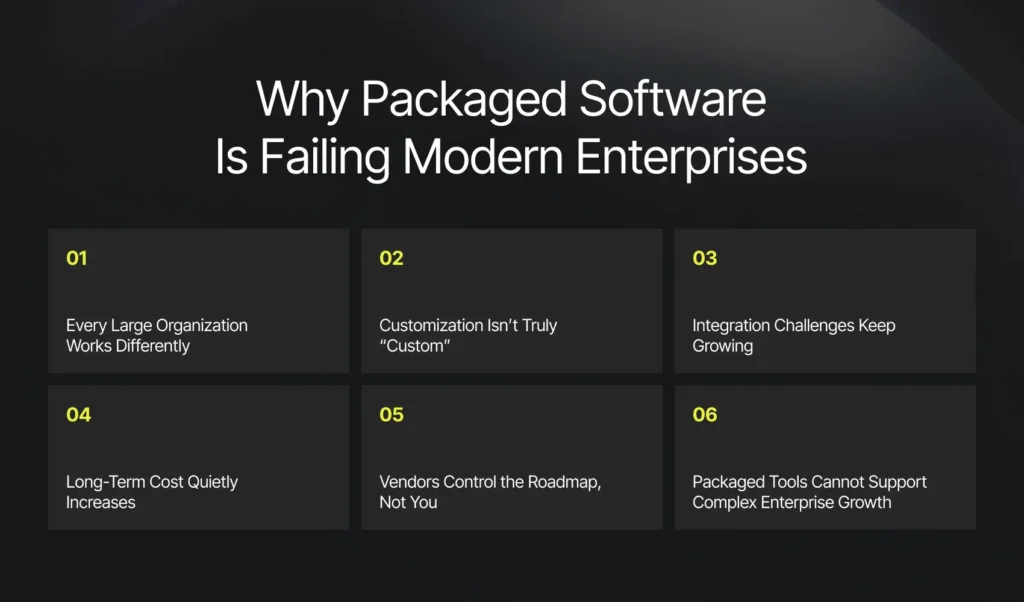
1. Every Large Organization Works Differently
Packaged software is built for the masses making companies reshape their workflows to match the software’s limitations. This leads to workarounds and inconsistent processes across departments.
2. Customization Isn’t Truly “Custom”
Vendors often allow only light modifications, such as changing labels, adding fields, or turning toggles on/off. But deep customization like new modules, logic, or architecture changes is rarely possible. Enterprises eventually hit a ceiling they cannot break through.
3. Integration Challenges Keep Growing
Every new SaaS tool comes with its own API rules, update cycles, and data structures. Once a company relies on 10–50 tools, the connections become fragile and time-consuming to maintain. What begins as convenience slowly becomes integration debt.
4. Long-Term Cost Quietly Increases
Packaged solutions seem affordable until you add:
- Per-user pricing
- Paid add-ons
- Mandatory upgrades
- API usage costs
- Third-party connectors
Over time, enterprises pay far more than expected without gaining full control over their system.
5. Vendors Control the Roadmap, Not You
Businesses with specialized needs must wait months or years for features they urgently need. Even worse, updates can break existing workflows overnight. Dependency on a vendor becomes a long-term operational risk.
6. Packaged Tools Cannot Support Complex Enterprise Growth
As enterprises expand into more regions, business units, product lines, and operations, their digital needs outgrow standardized tools.
They need:
- Multi-layer automation
- Custom data architecture
- Enterprise-grade workflows
- Tailored analytics
- Domain-specific features
Packaged software simply cannot stretch that far. Packaged tools were the perfect solution for a different time. Today’s enterprises demand flexibility, precision, and seamless digital alignment. And that’s exactly where custom software begins to outperform everything else.
Why Packaged Software Became Popular and Why It’s Failing Enterprises Now?
Why It Took Off
Packaged software gained traction because it made digital transformation fast and simple.
- Quick setup: Teams could start in days, not months.
- Low upfront cost: Subscription models looked affordable for growing companies.
- Prebuilt features: Businesses could run standard workflows out of the box.
- Vendor-managed upkeep: No need to worry about servers, patches, or IT resources.
For a while, this worked well. But as enterprises scaled, the cracks began to show.
Why It’s Failing Enterprises Today
1. One-Size-Fits-All Doesn’t Fit Anyone Anymore
Packaged tools follow generic workflows that rarely match enterprise complexity. Teams end up adapting their processes to the software, not the other way around.
2. “Customizable” Doesn’t Mean Custom
You can tweak settings or add fields, but you can’t reshape the product to fit your business logic or data structure. That’s where growth gets restricted.
3. Integration Fatigue Is Real
Each SaaS product has its own rules, updates, and APIs. Once a company connects dozens of them, maintaining integrations becomes a constant headache.
4. Costs Creep Up Over Time
User-based pricing, API limits, and premium plug-in costs add up fast. What once seemed affordable turns into a long-term financial drain.
5. Vendors Hold the Power
Feature updates, UI changes, and even downtime you have no control over. Enterprises depend on external roadmaps instead of setting their own.
6. It Can’t Scale With Enterprise Growth
Expanding operations need deeper automation, custom logic, and cross-department workflows. Packaged tools can’t stretch that far.
In short, packaged software was great for speed and convenience. But in today’s enterprise world where agility, integration, and customization define success, it’s starting to hold businesses back.
Why Integration Fatigue Is the Turning Point?
Integration used to be a checkbox and now it’s a breaking point for enterprises. Most companies grew by stacking dozens of SaaS tools, CRM, HRMS, billing, support, analytics, automation, security, and more. Individually, each tool worked well. Together, they created chaos.
1. Too Many Apps, Not Enough Harmony
Teams jump between platforms that don’t talk to each other cleanly. Data lives in silos. Processes break. Context gets lost. This drains productivity more than outdated hardware ever did.
2. Every Integration Becomes a Mini-Project
Even “plug-and-play” integrations require time, testing, monitoring, and fixes after every vendor update. Instead of simplifying operations, the integration layer becomes another system to maintain.
3. Data Consistency Becomes Impossible
Two tools rarely interpret data the same way. A customer ID, product code, or financial entry may sync incorrectly and quietly break downstream reports. Enterprises end up spending more time correcting data than analyzing it.
4. IT Teams Are Stretched Thin
More apps mean more APIs and more maintenance cycles. Over time, this creates an invisible tax on IT teams that slows all digital initiatives.
5. The App Stack Grows, Efficiency Drops
Ironically, adding tools to “improve efficiency” often results in the opposite. People spend more time navigating systems than getting actual work done.
This is why integration fatigue has become the tipping point: Enterprises no longer need more tools, they need systems that work together. This shift is exactly what’s driving the move toward custom software.
Why Packaged Software Fails Modern Enterprises
Packaged software still looks attractive on the surface: fast setup, predictable pricing, and a long list of features. But once enterprises start scaling, the cracks show quickly. Here’s why off-the-shelf tools no longer match the speed or complexity of modern organizations:
1. Packaged tools are built for “average” companies
They’re designed to work for thousands of businesses at once. That means enterprises end up with software that:
- Doesn’t fully map to their workflows
- Restricts how teams can customize processes
- Forces departments to change how they work just to fit the tool
The result? Processes lose efficiency instead of improving.
2. Integration fatigue is becoming a real operational cost
A recent report revealed that enterprises now use 1,061 applications on average, yet only a small share integrates properly. This creates:
- Constant switching between tools
- Data mismatches
- Manual workarounds
- Slow reporting
- IT teams spending hours fixing sync issues
Packaged tools add clutter instead of simplifying operations.
3. Customization stops at the surface level
Most SaaS platforms let you change fields, dashboards, and labels, but not the core logic. Deeper customization usually requires:
- Paying for higher-tier plans
- Buying expensive add-ons
- Involving the vendor with slow timelines
Even then the system rarely matches enterprise needs end-to-end.
4. Vendor lock-in becomes a long-term risk
With packaged tools, enterprises have no control when vendors:
- Increase prices
- Remove or repackage features
- Sunset older versions
- Change APIs
- Update UI and break existing workflows
Business continuity is suddenly tied to a third-party roadmap.
5. Security isn’t tailored to your environment
Packaged software follows general security standards which often fall short for industries like finance, healthcare, energy, and public services. Enterprises need:
- Fine-grained access control
- Custom audit logs
- Private or hybrid deployment
- Industry-specific compliance features
These are rarely available in standard SaaS tools.
6. Scaling your business doesn’t mean the software will scale with you
When enterprises:
- Add new product lines
- Expand into new markets
- Create new digital experiences
Packaged tools struggle to adapt. They evolve only as fast as the vendor updates them which isn’t fast enough for modern enterprise growth.
7. The hidden costs pile up quietly
What starts as “affordable” SaaS becomes expensive over time because of:
- Additional user licenses
- Add-ons for basic features
- API usage limits
- Paid integration connectors
- External implementation partners
- Downtime during forced upgrades
For many enterprises, packaged software becomes more costly than a custom system built around their actual needs.
How Custom Software Solves These Problems?
Custom software eliminates integration fatigue by creating technology that works the way your business already operates. Instead of forcing teams to adjust to rigid tools or maintain a patchwork of disconnected systems, custom solutions bring everything together into one unified, reliable ecosystem.
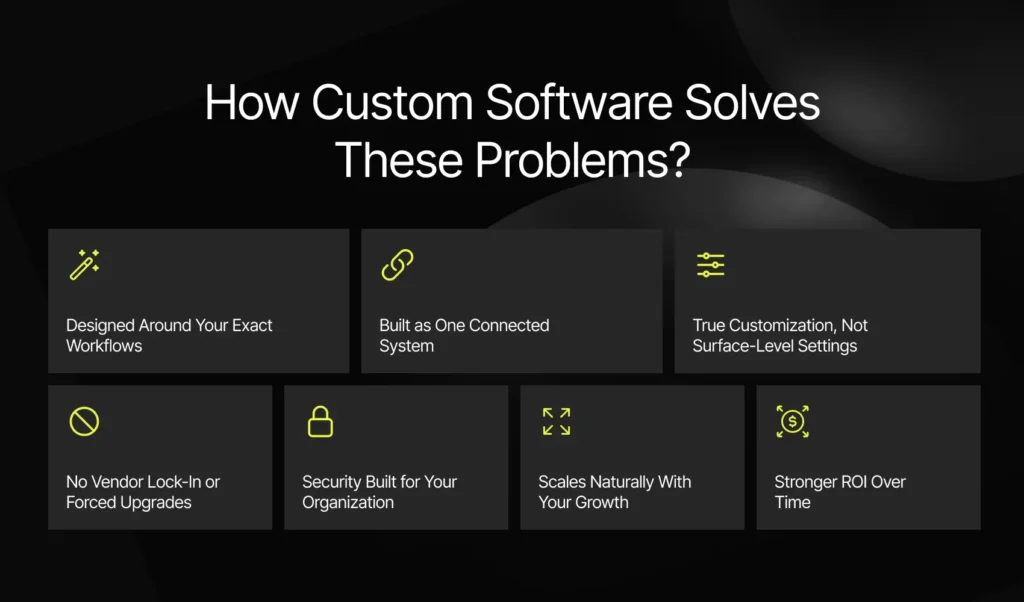
1. Designed Around Your Exact Workflows
Custom platforms mirror your real operations. Every workflow, approval route, exception case, and customer journey is built exactly as your teams follow it. This means employees don’t waste time adjusting to new interfaces or adapting their process to fit a tool; the software naturally fits the way they work.
2. Built as One Connected System
With custom development, you avoid managing dozens of disjointed platforms. Instead, all modules share the same architecture, data standards, and logic. Systems don’t “sync”, they simply operate together from the start. This removes the daily friction of switching apps, fixing mismatched data, and managing unstable integrations.
3. True Customization, Not Surface-Level Settings
Packaged tools often allow small tweaks, but they rarely support deeper flexibility. Custom software lets you control the entire experience, including advanced automation, unique business rules, specialized features, and interfaces designed for your teams. Nothing is restricted by vendor templates.
4. No Vendor Lock-In or Forced Upgrades
Enterprises often feel trapped when a SaaS vendor changes pricing, removes features, or updates APIs that break their workflows. Custom software gives full ownership and stability. You decide when updates happen and what features matter.
5. Security Built for Your Organization
Custom systems align directly with your internal policies instead of relying on generic SaaS safeguards. Everything can be created exactly to fit your standards as per the need for stricter role permissions that allow sensitive data to stay in your control.
6. Scales Naturally With Your Growth
As your business launches new products, expands into new markets, or restructures operations, custom software evolves with you. Features can be added without breaking the system, and the architecture is built to support long-term expansion.
7. Stronger ROI Over Time
While custom software requires upfront investment, it removes the long-term costs of recurring licenses, integration maintenance, external consultants, and employee time lost due to inefficient workflows. Over the years, the system becomes one of the highest-value assets in your technology stack.
Tired of Managing Software Instead of Running Your Business?
Examples When Custom Software Wins and When Packaged Tools Hold Companies Back
As enterprises scale off-the-shelf tools don’t fit with the fast-growing ones. Modern businesses rely on hundreds of apps and yet very few talk to each other properly, creating roadblocks and operational friction.
Below are real examples showing exactly why high-growth companies eventually turn to custom software.
1. Netflix Scaled Only After Ditching Off-the-Shelf Tools
Netflix initially depended on packaged analytics and content systems. But as streaming exploded globally and those tools hit hard limits:
- They couldn’t handle Netflix’s massive data velocity
- Recommendation accuracy dropped
- System performance lagged in high-traffic regions
Netflix responded by building its own custom architecture covering everything from recommendations to DevOps automation.
Due to custom engineering:
- Netflix delivers over 1+ billion personalized recommendations every day
- Manages traffic from 260+ million global subscribers
- Runs one of the world’s most advanced microservice systems
This level of scale simply isn’t possible on generic SaaS tools.
2. Domino’s Became a Tech Company Because of Custom Development
Domino’s once relied on fragmented third-party tools for ordering, POS, and delivery tracking. These systems couldn’t integrate smoothly and slowed digital growth.
Their shift to a fully custom digital ecosystem changed the entire business:
- 70%+ of all orders now come from digital channels
- Millions of orders processed daily through a unified custom platform
- Delivery tracking, POS, supply chain, and analytics operate as one system
Custom software turned Domino’s into a digital-first brand and a global case study.
When Enterprises Know It’s Time to Move to Custom Software
Most enterprises don’t switch to custom software because it sounds innovative. They switch because their current tools create friction that directly impacts revenue or growth. The decision usually becomes clear when leadership evaluates five practical areas of the business.
1. When Standard Tools No Longer Support the Actual Business Workflow
Packaged software is built for the average company. Enterprises operate with processes that are anything but average. The decision turns toward custom when teams repeatedly say things like:
- This feature doesn’t exist.
- We can’t customize this step.
- Three tools are needed to complete one workflow.
Once workflows start bending to fit the tool, instead of the tool supporting the workflow enterprises realize packaged software has reached its limit.
2. When Integration Overload Starts Affecting Daily Operations
Enterprise tech stacks are already crowded. So the key question becomes: Does this new tool reduce complexity or add another system to manage? Teams choose custom when:
- Data sync breaks frequently
- SaaS vendors push updates that disrupt operations
- Too many tools require middleware to speak to each other
- Critical data sits isolated in external platforms
At this stage, custom software becomes the route to long-term stability because it’s built around the systems already running the business.
3. When Growth Outpaces the Capability of the Packaged Tool
This is one of the biggest triggers. Leaders look at the next 12–24 months and ask:
- Will user volume increase?
- Will automation requirements grow?
- Will data processing become heavier?
- Will compliance requirements tighten?
If the answer is yes, packaged tools usually fail. They scale only through higher pricing tiers, not deeper functionality. Custom systems scale with the business instead of holding it back.
4. When the Cost of Workarounds Becomes Higher Than Building the Right System
This is where most enterprises finally decide. What starts as a low monthly subscription turns into:
- Multiple add-ons
- API overage costs
- Integration repair
- Forced upgrades
- External plugins
- Manual work because the tool can’t adapt
The moment leadership compares “subscription and fixes also workarounds” vs “a system that does exactly what we need,” the financial logic leans toward custom.
5. When Technology Starts Directly Affecting Competitive Advantage
This is the most important signal to consider. If software impacts how fast you operate or how intelligently you use data packaged tools eventually become limitations. Enterprises choose custom when they realize, you can’t build a competitive edge on the same software your competitors use. Custom platforms let companies automate deeper and design workflows that match their strategy.
The Moment the Decision Becomes Clear
Enterprises move to custom software when three things happen at once:
- Internal teams start hitting the limits of their tools
- Integration becomes messy and expensive
- Technology becomes strategic and not optional
At this point, leadership stops asking, “How much does custom cost?” and starts asking, “How much is the current system costing us every month?” That’s when the switch happens.
Enterprises Are Moving Toward Custom Software
Enterprises don’t choose custom software because it’s trendy; they choose it because packaged tools eventually hit limits that slow the business down. Custom platforms give enterprises something packaged software can never fully match complete control. Imenso Software helps enterprises move away from fragmented systems and build digital foundations that scale without breaking.
We bring the technical depth and strategic understanding needed to create software that fits your business instead of forcing it to fit the software.
Build Technology That Scales With Your Enterprise.
Similar Posts

How Agile Software Development Can Empower Startups to Innovate Faster
Is your startup struggling to stay ahead of the competition? The revolutions in modern progress and business pace require speed, change, and new ideas. Providing the best products within the shortest time and tightest financing may seem intimidating for new businesses. This is exactly how agile software development changes the narrative. What if you were […]...
How Long Does It Take to Develop a Mobile App?
In the modern digital landscape, the phrase “there’s an app for that” has become more than just a catchphrase—it’s a testament to the ubiquitous nature of mobile applications. These pocket-sized powerhouses have transformed the way we communicate, work, shop, and entertain ourselves. Behind every successful app lies a complex and meticulously orchestrated process known as […]...

Offshore Software Development Trends For 2022 (One’s You Can’t Miss)
In 2022, we will see rapid digitization and virtualization of businesses and societies. The primary trends in the IT and software development industry will result from this COVID driven change. However, sustainability and data security will be at the forefront of this digital transformation. ...